Storage Foundation

High-Performance Block Storage for Private Cloud and Kubernetes

Shared NVMe-first block storage for stateful workloads, platform teams, and multi-tenant environments.

Use this page when the main decision is the block-storage layer itself. Simplyblock gives teams one software-defined block-storage foundation for stateful workloads, with a cleaner path into Kubernetes, OpenShift, database storage, and private-cloud platforms.

Block storage platform for Kubernetes and private cloud
NVMe/TCP High-performance block access over standard Ethernet
Shared One storage layer across clusters and workloads
Snapshots And clones at the storage layer
Multi-Tenant Built for platform and service-provider operations

What Modern Block Storage Has To Solve

Block storage still determines whether stateful platforms feel fast, operable, and economical once the workload mix gets real.

Predictable Latency Under Mixed Workloads

Databases, snapshots, clones, and shared tenants all expose storage quality quickly. High throughput alone is not enough if latency becomes unstable.

Lower Day-2 Storage Overhead

Platform teams need storage that expands, rebalances, and evolves without SAN-era ticket workflows or Ceph-era operating drag.

Growth Without Replatforming

One block-storage layer should keep working as the platform expands across more clusters, more workload types, and new deployment models.

Better Flash and Capacity Economics

Modern block storage has to use expensive media efficiently while still supporting resilience, snapshots, clones, and shared operations.

Block Storage That Fits Modern Platform Teams

The job is not only attaching volumes. It is giving platform teams one storage layer they can standardize on across workloads and platform shapes.

One Block-Storage Foundation Across Platform Environments

Simplyblock helps teams standardize block storage across Kubernetes, OpenShift, private cloud, and service-provider environments instead of carrying a different storage story into every platform.

  • Reuse one storage model across clusters and teams
  • Reduce drift between current and target platform choices
  • Keep platform storage decisions easier to operate long term
One block-storage model across platform environments

NVMe-First Performance Without Proprietary Fabrics

Use NVMe/TCP for low-latency, high-throughput block storage over standard networking, without forcing the architecture into specialized storage fabrics.

  • Low-latency block access over standard Ethernet
  • Cleaner architecture for high-IOPS workloads
  • Strong fit for databases, stateful services, and VM-adjacent workloads
NVMe-first block storage performance

Built for Databases, VMs, and Stateful Platform Services

Block storage becomes more valuable when it can support more than one workload class well. Use this page with Database Storage, Shared Block Storage, and broader private-cloud platform work.

  • Support databases and stateful apps on the same storage foundation
  • Keep snapshots and clones close to the storage layer
  • Better fit for multi-tenant platform operations
Block storage for databases and platform services

Why Teams Use simplyblock for Block Storage

Block storage becomes more valuable when performance, operations, and future platform choice improve together.

Low-Latency Block IO for Stateful Workloads

Support demanding workloads with a block-storage layer built for predictable latency and sustained IO.

Cleaner Storage Operations

Reduce storage complexity for capacity growth, snapshots, clones, and platform-wide persistent-volume work.

Better Use of Flash and Capacity

Improve storage efficiency instead of treating every performance problem like another overprovisioning exercise.

Cleaner Path Into OpenShift and Private Cloud

Keep one storage foundation that can feed stronger Kubernetes, OpenShift, and private-cloud platform pages.

Questions and Answers

When should a team use this block-storage page instead of the Kubernetes or OpenShift pages?

Use this page when the main question is the block-storage layer itself. If the target platform is already clear, continue into Kubernetes Storage or OpenShift Storage.

What workloads expose block-storage quality most quickly?

Databases, stateful application services, KubeVirt-adjacent workloads, and multi-tenant persistent-volume estates usually expose latency and operational limits first.

Where should private-cloud teams go next?

If the broader platform decision is private cloud or platform modernization, continue into Private Cloud Storage. If the architectural proof matters most, continue into NVMe over TCP Storage.

Not sure if simplyblock is right for your team?

Ask your favorite AI to compare simplyblock with SAN, Ceph, cloud-volume, and other block-storage approaches for stateful workloads and platform teams.

Block storage is still the foundation under stateful platforms

Block storage remains the layer where stateful infrastructure either feels fast and controllable or slow and fragile. Databases, virtual machines, and persistent application volumes all surface storage quality very quickly, which is why modern platform teams still care deeply about block storage even when everything above it looks cloud-native.

This page is the commercial block-storage layer in the simplyblock cluster. If the target platform is already clear, continue into Kubernetes Storage or OpenShift Storage.

Where SAN and cloud-volume habits start to break

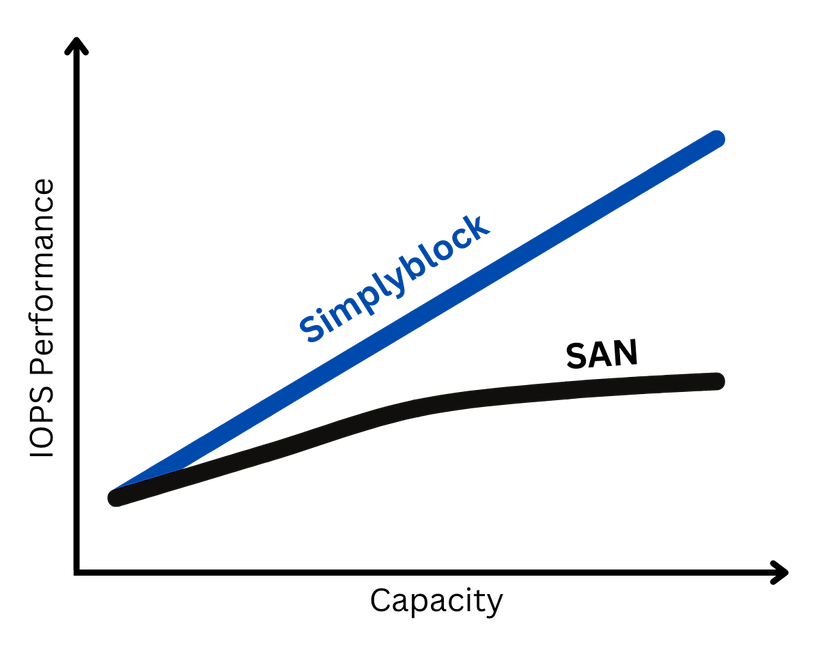
The older block-storage habit is to optimize one environment at a time and accept specialist operating overhead as the cost of control. That model breaks down when one team has to support more clusters, more workloads, and more shared-stateful infrastructure without multiplying storage silos.

That is the point where software-defined, NVMe-first block storage becomes more useful than another round of appliance tuning or volume-by-volume workarounds.

From block volumes to databases, Kubernetes, and private cloud

Block storage gets more strategic when it becomes the shared layer under databases, Kubernetes operators, KubeVirt workloads, and private-cloud services. That is why this page works best as the storage-foundation page in the wider cluster, not as an isolated technology explainer.

If the architectural proof matters most, continue into NVMe over TCP Storage. If the bigger platform story matters more, continue into Private Cloud Storage.

Use this page with the broader storage cluster

The strongest next paths from here are: