
VMware vs OpenStack Virtualization or Open Infrastructure?
Nov 21st, 2025 | 7 min read
Table Of Contents
- How VMware Virtualizes Infrastructure at the Hypervisor Level
- How OpenStack Provides Infrastructure as a Service (IaaS)
- VMware vs OpenStack – Comparing the Core Differences
- Running Postgres on VMware vs OpenStack
- Storage Is the Common Pain Point — Simplyblock Solves It
- When to Choose VMware, OpenStack — or a Hybrid Model
- See Other Comparisons:
- Questions and answers
As cloud strategies evolve, many infrastructure teams are weighing their options between VMware and OpenStack. VMware has led the virtualization space for years with commercial solutions that are trusted but tightly coupled. OpenStack, by contrast, offers open-source infrastructure automation with greater flexibility and cost control.
This guide compares how VMware and OpenStack differ in architecture, operational overhead, and storage — and how Simplyblock supports both with performance-focused, scalable infrastructure.
How VMware Virtualizes Infrastructure at the Hypervisor Level
VMware helps IT teams run multiple workloads on a shared physical host through its hypervisor and management tools.
Though widely trusted in enterprise environments, the growing complexity of its ecosystem — along with rising licensing costs — is leading many teams to evaluate more flexible solutions that better support modern, scalable infrastructure needs.
🚀 Facing Limitations with vSAN or Licensing?
Looking for a VMware alternative? Simplyblock offers fast, flexible NVMe-over-TCP storage as a vSAN replacement.
👉 Simplyblock for VMware
Built for Control, Not Flexibility
VMware offers consistent infrastructure management, but its proprietary stack limits adaptability in modern environments.
- Hypervisor-based virtualization (ESXi) supports stable VM performance
- GUI-driven tools like vSphere and vCenter simplify infrastructure ops
- Centralized control across compute, network, and storage layers
- Often used in finance, healthcare, and compliance-heavy sectors
Where VMware Adds Hidden Cost and Complexity
High licensing costs and rigid architecture make VMware a challenge as demands evolve.
- Licensing fees grow with scale, especially post-Broadcom acquisition
- vSAN ties storage scaling to VMware ecosystem
- Limited integration with Kubernetes and modern DevOps tooling
- Infrastructure tightly coupled to certified hardware vendors
Why Migration Isn’t Always Straightforward
Moving off VMware takes more than tooling changes — it requires rethinking architecture and operations.
- Deep toolchain integration across storage and networking layers
- Operations teams trained primarily in VMware workflows
- Transitioning stateful services requires careful planning
- Hardware compatibility tied to VMware certification
How OpenStack Provides Infrastructure as a Service (IaaS)
OpenStack provides a modular platform to manage compute, storage, and network resources — like building your own cloud.
Its open-source foundation appeals to teams that want infrastructure control without licensing overhead. With flexible components and API-driven orchestration, OpenStack offers a scalable alternative for building hybrid or private cloud environments tailored to specific operational and cost needs.
Modular Architecture Designed to Be Customized
OpenStack breaks infrastructure into building blocks that you can scale or swap independently.
- Uses services like Nova (compute), Neutron (network), and Cinder (storage)
- Supports mixed environments: bare metal, VMs, and containers
- RESTful APIs allow infrastructure automation and self-service provisioning
- Works with commodity hardware, reducing vendor dependencies
Operational Trade-Offs of OpenStack
Running OpenStack gives flexibility — but demands deeper internal expertise to manage.
- Complex initial setup with multiple components to configure
- Lifecycle management varies across OpenStack distributions
- Upgrades may break compatibility if not coordinated properly
- Troubleshooting spans across compute, storage, and network layers
Where OpenStack Enables Long-Term Agility
OpenStack fits teams that want full control and modular design for evolving workloads.
- Avoids lock-in via open APIs and a large contributor ecosystem
- Flexible for public/private cloud and edge computing models
- Scales effectively for telecom, research, and HPC use cases
- Supports automation and integration with orchestration platforms
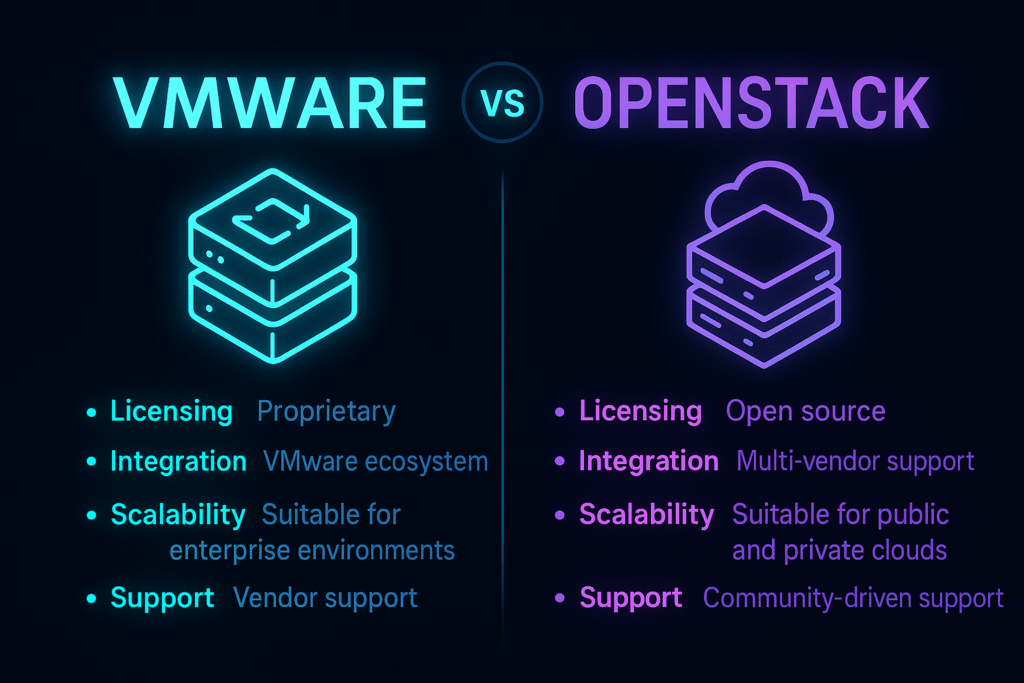
VMware vs OpenStack – Comparing the Core Differences
VMware and OpenStack both manage virtualized workloads, but they differ in architecture, openness, and how deeply you can customize operations. Here are the key differences:
| Category | VMware | OpenStack |
| Infrastructure Model | Hypervisor with proprietary management tools | Modular open-source services (Nova, Neutron, Cinder) |
| Control Plane | GUI and CLI via vSphere, vCenter | API-first with customizable orchestration |
| Openness | Closed ecosystem with vendor lock-in | Fully open-source and hardware agnostic |
| Storage Handling | vSAN or external SAN/NAS | Cinder-managed block storage via drivers |
| Automation Fit | Manual or semi-automated | Built for infrastructure-as-code (IAC) environments |
| Scalability | Scales with hosts and VMs | Scales services independently across compute/storage |
| Licensing Model | Subscription-based, cost tied to features and scale | Free (with optional paid support from distros) |
Running Postgres on VMware vs OpenStack
Both VMware and OpenStack can host PostgreSQL, but they handle it very differently. With VMware, Postgres typically runs inside virtual machines, managed like any traditional application stack. With OpenStack, Postgres is deployed as part of a cloud-native environment — often through Kubernetes clusters running on OpenStack infrastructure, using operators and StatefulSets for automated scaling and resilience.
If Postgres is the main workload you care about, it’s often more efficient to treat it as a managed platform rather than something you build manually. Vela is a Postgres platform by Simplyblock that runs on Kubernetes, delivering high-performance PostgreSQL with automation, backups, and scaling built in.
Storage Is the Common Pain Point — Simplyblock Solves It
No matter which platform you choose, storage becomes a limiting factor when scaling reliably. VMware and OpenStack each have their own storage models — but both need performance, availability, and flexibility to keep up with growing workloads.
Simplyblock unifies both environments with a single software defined block storage layer that simplifies performance tuning and scaling.
VMware’s Storage Model Comes with Constraints
VMware’s storage is deeply integrated with its proprietary ecosystem — making expansion costly and inflexible.
- Built around vSAN, which locks you into specific hardware
- Scaling storage often requires scaling compute simultaneously
- Storage snapshots and DR workflows depend on vSphere tooling
- Licensing costs increase with additional vSAN or SAN capacity
OpenStack Storage Requires Deep Planning
OpenStack storage, managed via Cinder, is powerful but depends on backend configuration and orchestration.
- Cinder acts as an abstraction layer for block storage
- Backends range from LVM to Ceph, each with performance tradeoffs
- Volume performance tied to hardware and driver compatibility
- Requires strong operational practices to scale cleanly
One Block Storage Layer for Both Worlds
Simplyblock bridges VMware and OpenStack storage with a shared, high-performance storage backend.
- Supports vSphere and OpenStack Cinder through standard drivers
- Uses NVMe-over-TCP for high throughput and low latency
- Deployable on-prem or across hybrid clouds
- Thin provisioning, snapshots, replication, and multi-tenant QoS supported
When to Choose VMware, OpenStack — or a Hybrid Model
Both platforms offer value — VMware delivers stability, while OpenStack delivers flexibility.
- Choose VMware if you prioritize traditional virtualization and have existing investment in its ecosystem.
- Choose OpenStack when you need cost control, modularity, and infrastructure automation at scale.
- Choose both during transition phases — or when you want separation of concerns between legacy apps and modernized infrastructure.
With Simplyblock’s unified storage foundation, you can simplify operations no matter which stack you choose — or how long you run both in parallel.
See Other Comparisons:
Take a look at how these platforms measure up:
- Proxmox vs OpenStack
- VMware vs OpenShift
- Kubernetes vs OpenStack
- VMware vs Kubernetes
- Talos vs OpenStack
Questions and answers
VMware uses a hypervisor-based architecture with centralized control through proprietary tools like vSphere and vCenter, providing stability but limited flexibility. OpenStack, however, is a modular open-source platform offering more customization through services like Nova, Neutron, and Cinder, supporting mixed environments and greater scalability.
VMware is ideal for enterprises seeking a stable, centralized infrastructure management system. It excels in regulated industries such as finance and healthcare. VMware provides integrated, user-friendly tools for managing virtual machines, networking, and storage, but it comes with high licensing costs and lacks flexibility for modern DevOps practices.
OpenStack is perfect for teams needing flexible, cost-effective infrastructure management. It offers a fully open-source platform with customizable components, supporting private or hybrid clouds. OpenStack is best for organizations seeking to avoid vendor lock-in and build tailored solutions with full control over infrastructure, scaling, and automation.
VMware uses vSAN for tightly integrated storage, which can be costly and lacks flexibility, as scaling storage often requires scaling compute. OpenStack, through Cinder, abstracts storage management, enabling the use of multiple backends like Ceph or LVM, offering greater flexibility but requiring careful orchestration and configuration.
Simplyblock provides a unified, high-performance block storage solution that integrates seamlessly with both VMware and OpenStack. It uses NVMe-over-TCP technology to ensure fast, low-latency storage scaling, offering features like snapshots, thin provisioning, and multi-tenant QoS. This simplifies storage management and enhances performance across both environments.