
Table Of Contents
- OpenShift for Next-Level Kubernetes in Enterprise Applications
- Talos Kubernetes - First OS for Scalable Infrastructure
- OpenShift vs Talos - Architecture and Operational Differences
- Running Postgres on OpenShift vs Talos
- How Simplyblock Supports Both OpenShift and Talos
- OpenShift, Talos, or Both — Which Fits Your Use Case?
- See other comparisons :
- Questions and answers
As organizations move towards cloud-native and containerized applications, selecting the right platform to manage Kubernetes becomes a key decision. OpenShift offers an enterprise-ready, comprehensive solution built around Kubernetes, providing built-in tools for development and operations.
On the other hand, Talos is a lightweight, Kubernetes-first operating system designed for simplicity, security, and performance. In this comparison, we’ll look into the strengths and limitations of both platforms to help you determine which one fits your needs for modern infrastructure.
OpenShift for Next-Level Kubernetes in Enterprise Applications
OpenShift is a Kubernetes-native platform designed to provide a comprehensive solution for managing containerized applications at scale. Built by Red Hat, OpenShift goes beyond Kubernetes by bundling tools for continuous integration, delivery, and security.
It’s favored by enterprises that require a robust, stable platform with enterprise support, but it can also introduce complexity for teams looking for more lightweight, flexible solutions.
🚨 Struggling with OpenShift’s storage complexities?
Simplyblock provides high-performance, software-defined storage for OpenShift and Kubernetes.
👉 Simplyblock for OpenShift environments
What OpenShift Is Designed to Handle
OpenShift offers a full suite of features for managing modern applications, from development to production.
- Kubernetes container orchestration with advanced security
- Built-in CI/CD pipelines for automated deployment
- Multi-cluster and hybrid cloud management
- Integrated networking, monitoring, and logging tools
Why Teams Rely on OpenShift
OpenShift’s enterprise-grade features make it a top choice for many organizations that need scalability and security.
- Enterprise support with a large, active ecosystem
- Strong security features like SELinux and role-based access control (RBAC)
- Simplified developer workflows with tools like OpenShift CLI, Web Console, and GitOps
- Integration with existing tools and services within the Red Hat ecosystem
Where OpenShift Faces Challenges
While OpenShift excels in many areas, it may not be the best fit for teams seeking simplicity and flexibility in cloud-native environments.
- Complex setup and high operational overhead for smaller teams
- Licensing costs can add up quickly with scale
- Heavy reliance on Red Hat’s ecosystem and services
- Limited flexibility compared to more lightweight, Kubernetes-focused alternatives
Talos Kubernetes – First OS for Scalable Infrastructure
Talos is a minimal, Kubernetes-native operating system built for simplicity, security, and scalability. Unlike traditional operating systems that support a wide range of applications and workloads, Talos is designed specifically for Kubernetes environments.
It removes unnecessary components, focusing on providing a streamlined, secure platform that integrates seamlessly with containerized workloads. Talos is ideal for teams that want a lightweight OS with strong security features and minimal overhead.
How Talos Is Built for Kubernetes
Talos is designed to run Kubernetes clusters efficiently, with Kubernetes as the central control plane.
- Immutable operating system with no shell or package manager access
- Fully API-driven management, with configuration through YAML files
- Bootstrapped out-of-the-box for Kubernetes environments
- Strong integration with container management platforms like Rancher and Kubeadm
Key Benefits of Using Talos
Talos’ simplicity and Kubernetes-native design make it an attractive choice for modern cloud-native environments.
- Minimal footprint for faster deployments and reduced attack surface
- Fully automated deployment, scaling, and lifecycle management via APIs
- Advanced security with an immutable OS that eliminates manual config drift
- Supports edge computing, cloud-native workloads, and large-scale clusters
Talos for Teams Transitioning to Kubernetes
While Talos offers many benefits for cloud-native teams, it may not be the right fit for those requiring a traditional OS or full-stack virtualization solutions.
- Limited flexibility for teams accustomed to full OS control
- No direct support for legacy applications or traditional VM workloads
- Debugging and troubleshooting require a different skill set than typical OS-based environments
- A steeper learning curve for teams transitioning from traditional operating systems
OpenShift vs Talos – Architecture and Operational Differences
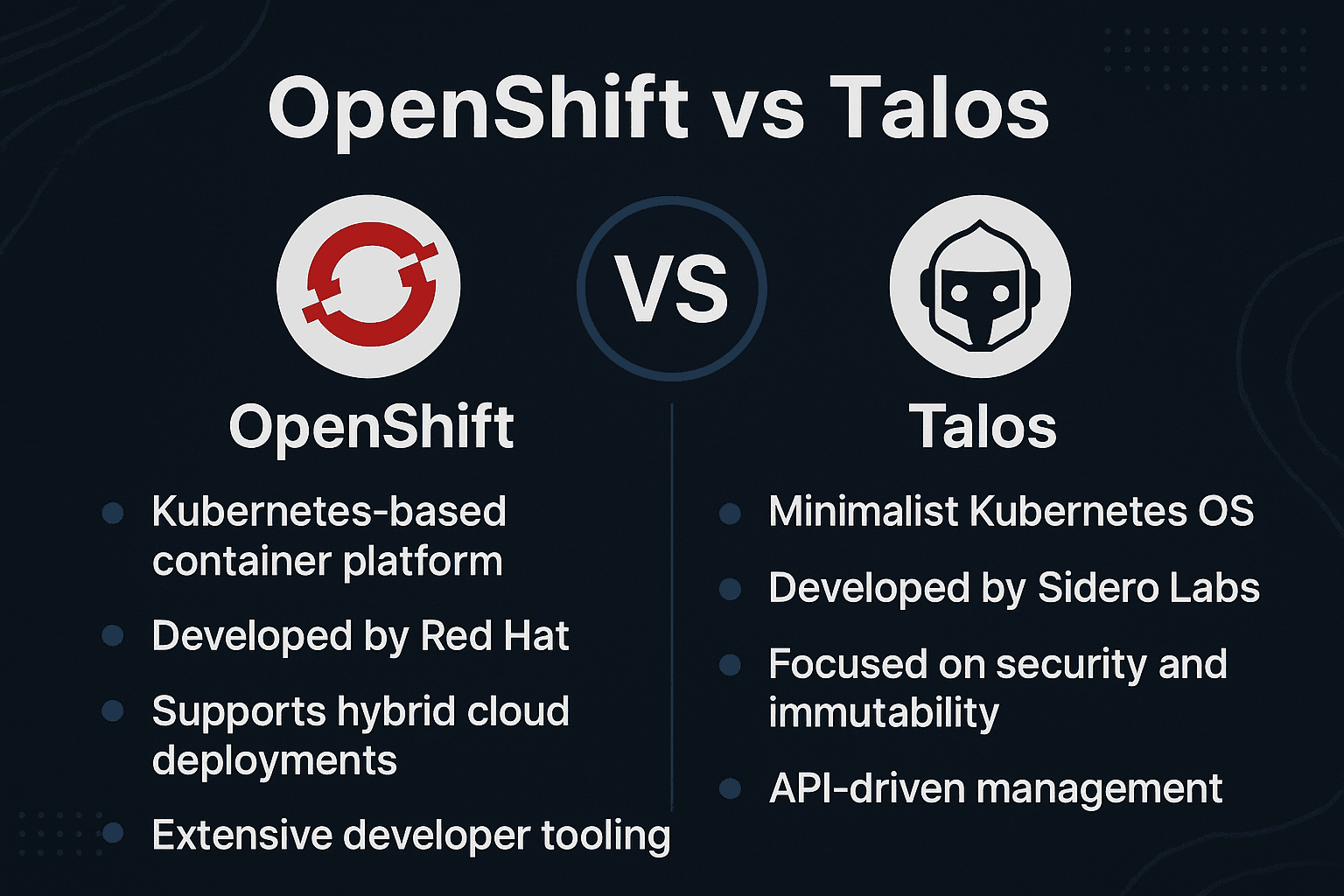
When comparing OpenShift and Talos, it’s clear that they each bring distinct approaches to managing Kubernetes environments. OpenShift is a comprehensive, enterprise-grade platform for containerized applications, while Talos is a lightweight, Kubernetes-first operating system designed to streamline management and advance security.
Here’s a side-by-side breakdown of their core differences:
| Category | OpenShift | Talos |
| Core Architecture | Full-stack Kubernetes platform with built-in management tools | Minimal OS built specifically for Kubernetes environments |
| Management Approach | GUI and CLI-driven management with integrated CI/CD tools | API-driven, immutable OS with YAML configuration for Kubernetes |
| Storage Integration | Integrated storage with persistent volumes and CSI drivers | External storage support via CSI relies on third-party tools |
| Security | Enterprise-grade security features like SELinux and RBAC | Immutable OS with advanced security through minimal attack surface |
| Flexibility | Extensive, but can be complex for smaller or cloud-native environments | Highly flexible and lightweight, but lacks traditional OS control |
| Best Use Case | Ideal for large-scale, enterprise-grade container orchestration | Best for cloud-native and Kubernetes-first environments |
Running Postgres on OpenShift vs Talos
Both OpenShift and Talos can host PostgreSQL, but they handle storage and infrastructure differently. On OpenShift, Postgres runs within a Kubernetes-native environment, using StatefulSets and operators for automation, high availability, and scaling, with integrated persistent storage through CSI drivers. Talos, being a lightweight, Kubernetes-first OS, does not manage storage natively, relying on external solutions like Longhorn or other third-party tools for persistent volumes.
If Postgres is the primary workload, it’s often more efficient to use a managed platform rather than handling it manually. Vela, a Postgres platform by Simplyblock, runs on Kubernetes and offers high-performance PostgreSQL with built-in automation, backups, and scaling.
How Simplyblock Supports Both OpenShift and Talos
Both OpenShift and Talos are designed to manage containerized applications, but their storage requirements differ. OpenShift integrates storage directly into its ecosystem, while Talos relies on external storage solutions.
Simplyblock offers a unified storage solution that works seamlessly across both platforms, solving common storage pain points such as scaling, flexibility, and performance.
Storage Challenges in OpenShift Environments
OpenShift’s storage model, while powerful, can create complexity for large-scale environments.
- Persistent storage management requires third-party CSI drivers
- Storage scaling can be complex with larger Kubernetes clusters
- Challenges in ensuring high availability for stateful applications like databases
- Integration with external storage solutions is often required for cloud-native workloads
Talos and Container Storage Interface (CSI)
Talos, being a minimalist OS, doesn’t come with native storage management. It relies on external tools for container storage.
- Talos requires external, container-aware block storage for Kubernetes persistent volumes
- Storage scaling is independent of compute, but requires reliable backend integration
- Talos supports Kubernetes-native CSI for storage, but third-party solutions are often needed for complex workloads
- Optimizing storage performance in Talos environments depends heavily on hardware and network infrastructure
Why Simplyblock Works Across Both Platforms
Simplyblock’s software-defined storage provides a consistent, high-performance solution across OpenShift and Talos.
- NVMe-over-TCP architecture ensures low-latency, high-performance storage for both platforms
- Supports Kubernetes’ CSI and OpenShift’s persistent storage requirements
- Easily deployable across hybrid and multi-cloud environments
- Provides snapshots, replication, and multi-tenant QoS to handle stateful workloads like Postgres, Kafka, and more.
OpenShift, Talos, or Both — Which Fits Your Use Case?
When choosing between OpenShift and Talos, consider your organization’s needs for flexibility, security, and scalability. Both offer unique advantages in different scenarios.
- Use OpenShift when you need an enterprise-grade platform for Kubernetes with built-in CI/CD and monitoring tools.
- Use Talos if you’re looking for a lightweight, Kubernetes-first OS that emphasizes simplicity and security.
- Use both if you’re managing hybrid workloads, with OpenShift for traditional apps and Talos for cloud-native environments.
Simplyblock ensures consistent, high-performance storage across both platforms, allowing seamless integration and scalability for your entire infrastructure.
See other comparisons :
Take a look at how these platforms measure up.
Questions and answers
OpenShift is a full-stack Kubernetes platform with built-in management tools, designed for large-scale enterprise environments. It includes features like CI/CD pipelines, security tools, and multi-cluster management. Talos, on the other hand, is a lightweight, Kubernetes-first operating system designed specifically for Kubernetes environments. Talos focuses on simplicity, security, and performance, with a minimal footprint and immutable architecture.
OpenShift provides an enterprise-grade platform with robust security (SELinux, RBAC), full-stack Kubernetes orchestration, built-in CI/CD pipelines, and a large ecosystem of integrated tools. It is ideal for organizations requiring scalability, multi-cluster management, and strong developer support in regulated environments.
Talos is built with an immutable operating system, reducing the attack surface and preventing configuration drift. Its minimalistic design makes it highly secure and efficient for Kubernetes-based workloads. Talos also automates deployment, scaling, and lifecycle management via APIs, enhancing performance with less overhead compared to traditional operating systems.
OpenShift has integrated storage with persistent volumes and built-in support for container storage interface (CSI) drivers, but it may require third-party CSI drivers for complex workloads. Talos, being a minimalist OS, relies on external storage solutions for persistent volumes, often needing third-party tools for cloud-native and complex workloads. Simplyblock provides consistent, high-performance storage across both platforms, supporting CSI and persistent storage needs.
OpenShift is better suited for hybrid and multi-cloud environments when you need a comprehensive Kubernetes platform with built-in tools for monitoring, CI/CD, and security. Talos is ideal for teams that prioritize simplicity, security, and scalability in cloud-native Kubernetes workloads. Both platforms can work together in a hybrid setup, with OpenShift handling traditional workloads and Talos managing modern, cloud-native applications.