
Kubernetes vs OpenStack – Cloud and Virtualization Comparison
Nov 23rd, 2025 | 7 min read
Table Of Contents
- Kubernetes for Cloud-Native Applications
- OpenStack for Private Cloud Infrastructure
- Kubernetes vs OpenStack - Key Comparisons
- Running Postgres on Kubernetes vs OpenStack
- Kubernetes vs OpenStack - How Simplyblock Supports Both
- Deciding Between Kubernetes and OpenStack for Your Infrastructure
- See other comparisons :
- Questions and answers
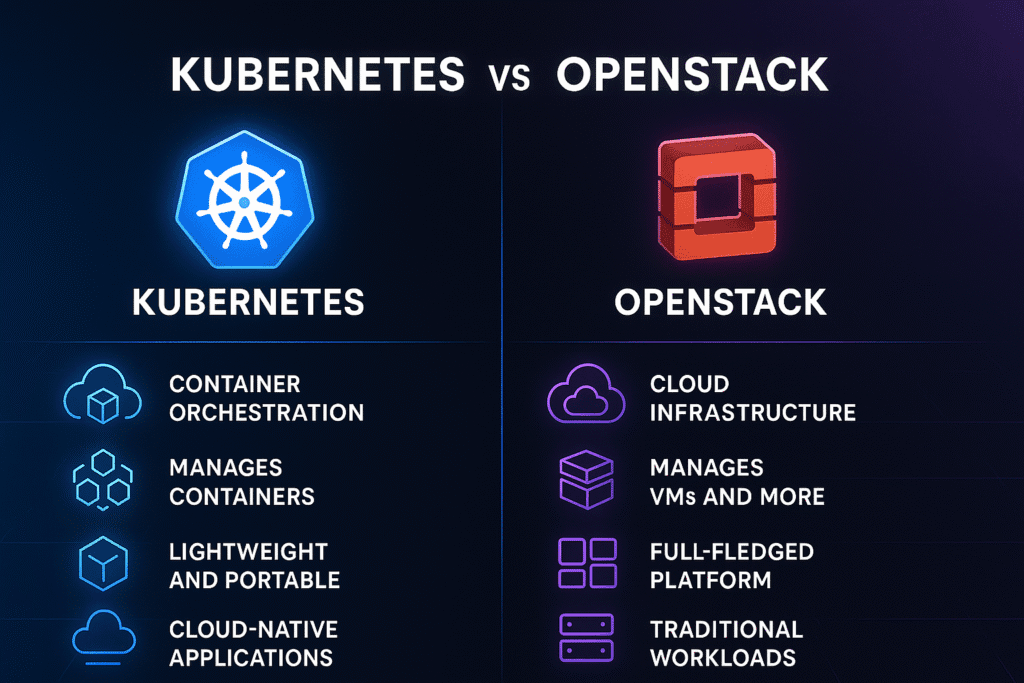
When it comes to managing infrastructure, Kubernetes and OpenStack serve distinct but important roles. Kubernetes excels at orchestrating containers for cloud-native applications, enabling businesses to scale and manage microservices efficiently. In contrast, OpenStack offers a flexible, open-source platform for building and managing private clouds.
This comparison will look into how each platform operates, its strengths and challenges, and which one might be best suited to your infrastructure needs.
Kubernetes for Cloud-Native Applications
Kubernetes is a powerful container orchestration platform designed to help organizations manage containerized applications at scale. It abstracts away underlying infrastructure, allowing developers to focus on building and scaling applications rather than managing complex systems.
With its ability to automate and scale applications, Kubernetes is central to cloud-native environments and DevOps workflows.
🚨 Need scalable storage for Kubernetes?
Simplyblock provides high-performance storage solutions that integrate seamlessly with Kubernetes for containerized workloads.
👉 Simplyblock for Kubernetes
Key Features of Kubernetes
Kubernetes automates many tasks involved in managing containerized applications, offering several key features:
- Automatically scales the number of containers based on demand.
- Restarts failed containers and replaces them to ensure uptime.
- Distributes network traffic efficiently across containers for high availability.
- Manages storage for stateful applications in a dynamic environment.
How Kubernetes Powers Cloud-Native Workloads
Kubernetes is designed to support cloud-native workloads, including microservices and distributed applications.
- Manages microservices that communicate via APIs.
- Simplifies CI/CD workflows for faster deployment.
- Facilitates cloud migrations and hybrid cloud deployments.
- Ensures scalability and high availability across large environments.
Challenges When Scaling Kubernetes
Scaling Kubernetes can introduce complexities, especially when integrating with other systems.
- Requires advanced expertise to manage large clusters.
- Managing persistent storage for databases in Kubernetes can be tricky.
- Can be resource-heavy, requiring significant computing power.
- Integration with existing legacy systems often requires custom solutions.
OpenStack for Private Cloud Infrastructure
OpenStack is an open-source platform used to build and manage private clouds. It provides the tools necessary to manage compute, storage, and networking resources within a data center, offering a comprehensive Infrastructure as a Service (IaaS) solution.
Unlike Kubernetes, which focuses on container orchestration, OpenStack is designed for managing virtualized workloads, making it ideal for enterprises that need to manage large-scale virtual infrastructure.
Key Features of OpenStack
OpenStack offers a flexible platform for managing virtualized environments, providing several critical features:
- Manages compute resources (VMs) and storage within a private cloud.
- Provides networking tools for managing IP addresses, routing, and security.
- Includes object storage for large-scale data storage solutions.
- Offers orchestration to automate provisioning and deployment of resources.
How OpenStack Powers Private Cloud Environments
OpenStack is particularly well-suited for organizations looking to build and manage private clouds, enabling full control over infrastructure.
- Enables private cloud deployment and management for sensitive workloads.
- Supports multi-tenant environments with secure isolation of resources.
- Easily integrates with existing on-premise hardware and legacy systems.
- Provides high availability and disaster recovery capabilities for virtualized workloads.
Challenges with OpenStack
While powerful, OpenStack can present challenges, especially in large-scale or complex deployments.
- Complexity in setup and maintenance: Requires expertise in managing a distributed system.
- Storage management can become complicated as the cloud grows.
- Upgrades may introduce compatibility issues between OpenStack components.
- Integration with existing infrastructure and third-party tools requires planning.
Kubernetes vs OpenStack – Key Comparisons
Here’s a side-by-side comparison of Kubernetes and OpenStack, offering a quick overview of the features and functionalities that differentiate the two platforms:
| Category | Kubernetes | OpenStack |
| Core Purpose | Container orchestration for cloud-native applications | Infrastructure as a Service (IaaS) for private clouds |
| Primary Use Case | Managing containers and microservices at scale | Managing virtualized compute, storage, and networking |
| Deployment Model | Cloud-native or hybrid cloud environments | Private cloud, hybrid cloud, or on-premise infrastructure |
| Scalability | Scales horizontally for containers and clusters | Scales virtual machines and resources in private clouds |
| Storage Model | Dynamic, flexible container storage (CSI) | Block and object storage with backend customization |
| Management | API-driven management with Kubernetes CLI & Dashboard | Managed via Horizon UI and OpenStack CLI tools |
| Flexibility | Highly flexible for cloud-native apps and microservices | Best suited for virtualized infrastructure with customizable components |
| Cloud Integration | Native support for hybrid and multi-cloud environments | Hybrid cloud support with integration for external storage |
| Automation | Built-in CI/CD pipeline support for automation | Requires third-party tools for automation and integration |
Running Postgres on Kubernetes vs OpenStack
With Kubernetes, Postgres benefits from flexible containerized deployments that scale automatically, suited for cloud-native environments. On the other hand, OpenStack provides robust IaaS capabilities, offering dedicated resources for Postgres in private cloud infrastructures.
If Postgres is the main workload you care about, it’s often easier to treat it as a platform rather than something you hand-roll on top of your virtualization choice. Vela is a Postgres platform by Simplyblock that runs on Kubernetes, providing high-performance PostgreSQL with built-in automation, backups, and scaling.
Kubernetes vs OpenStack – How Simplyblock Supports Both
Both Kubernetes and OpenStack require robust and scalable storage solutions to manage persistent workloads, whether they’re containerized or virtualized. Kubernetes relies on persistent volumes for containerized applications, while OpenStack integrates with various storage backends to manage virtual machine and container data.
Simplyblock provides a unified storage solution that works seamlessly across both platforms, offering high performance and scalability for dynamic workloads.
Storage in Kubernetes Environments
Kubernetes environments require flexible, scalable storage solutions to handle the dynamic nature of containerized applications.
- Uses CSI drivers to integrate with storage providers for persistent volumes.
- Ensures data persistence across container restarts and scaling events.
- Manages stateful applications like databases (e.g., Postgres, Kafka) within Kubernetes clusters.
- Scales storage independently from compute resources to handle growing demands.
Storage for Virtual Machines in OpenStack
In OpenStack environments, storage is essential for managing virtual machine and container data.
- Supports both block and object storage to meet diverse workload needs.
- Works with Ceph, LVM, and other backends for high availability and redundancy.
- Provides snapshot and backup capabilities for VM and container workloads.
- Easily integrates with external storage systems to expand capacity.
Why Simplyblock Works for Both Kubernetes and OpenStack
Simplyblock offers a unified software-defined storage solution that integrates seamlessly with both Kubernetes and OpenStack, ensuring high-performance and scalable storage for modern infrastructure.
- NVMe-over-TCP delivers low-latency, high-throughput storage.
- Fully integrates with Kubernetes CSI drivers and OpenStack storage backends.
- Supports multi-cloud and hybrid environments, ensuring consistent performance across deployments.
- Provides features like replication, snapshots, and QoS for disaster recovery and high availability.
Deciding Between Kubernetes and OpenStack for Your Infrastructure
Choosing between Kubernetes and OpenStack depends on your specific infrastructure needs.
- Kubernetes is ideal for managing cloud-native applications, microservices, and containerized workloads with scalability and automation. It excels in hybrid cloud and multi-cloud environments.
- In contrast, OpenStack is best for managing virtualized infrastructure in private clouds, offering full control over compute, storage, and networking resources.
For both platforms, Simplyblock provides high-performance, scalable storage to support persistent workloads and ensure data reliability across both Kubernetes and OpenStack environments.
See other comparisons :
Take a look at how these platforms measure up.
Questions and answers
Kubernetes is designed to manage containerized applications, automating the deployment and scaling of microservices in cloud-native environments. OpenStack, however, is a platform for building and managing private clouds, focused on virtual machines, networking, and storage in private data centers.
Kubernetes is the ideal choice for managing containers. It offers powerful orchestration tools for scaling, automating, and managing containerized applications, making it perfect for cloud-native environments. OpenStack, while it can manage containers, is not as optimized for container orchestration as Kubernetes.
Yes, OpenStack can support hybrid cloud environments, allowing integration with public clouds. However, Kubernetes is better suited for hybrid and multi-cloud deployments due to its native support for managing cloud-native applications across various environments.
Kubernetes uses persistent volumes (PVs) and persistent volume claims (PVCs) to manage storage for stateful applications. It ensures that storage remains available even when containers are rescheduled or restarted, using storage solutions that integrate through the Container Storage Interface (CSI).
As OpenStack manages a wide range of virtualized workloads, storage management can become complex. It requires careful configuration of block and object storage, and integrating with third-party storage systems can add complexity. Simplyblock helps by offering seamless, scalable storage for OpenStack environments.