
Kubernetes vs Nutanix – The Better Choice for Scalable Infrastructure
Nov 25th, 2025 | 7 min read

Table Of Contents
- Kubernetes - Container Management at Scale
- Nutanix - Simplified Infrastructure Management
- Comparing Kubernetes vs Nutanix
- Running Postgres on Kubernetes vs Nutanix
- Unified Storage for Kubernetes and Nutanix - How Simplyblock Advances Both
- Kubernetes vs Nutanix - Which Infrastructure Solution Fits Your Needs?
- See other comparisons :
- Questions and answers
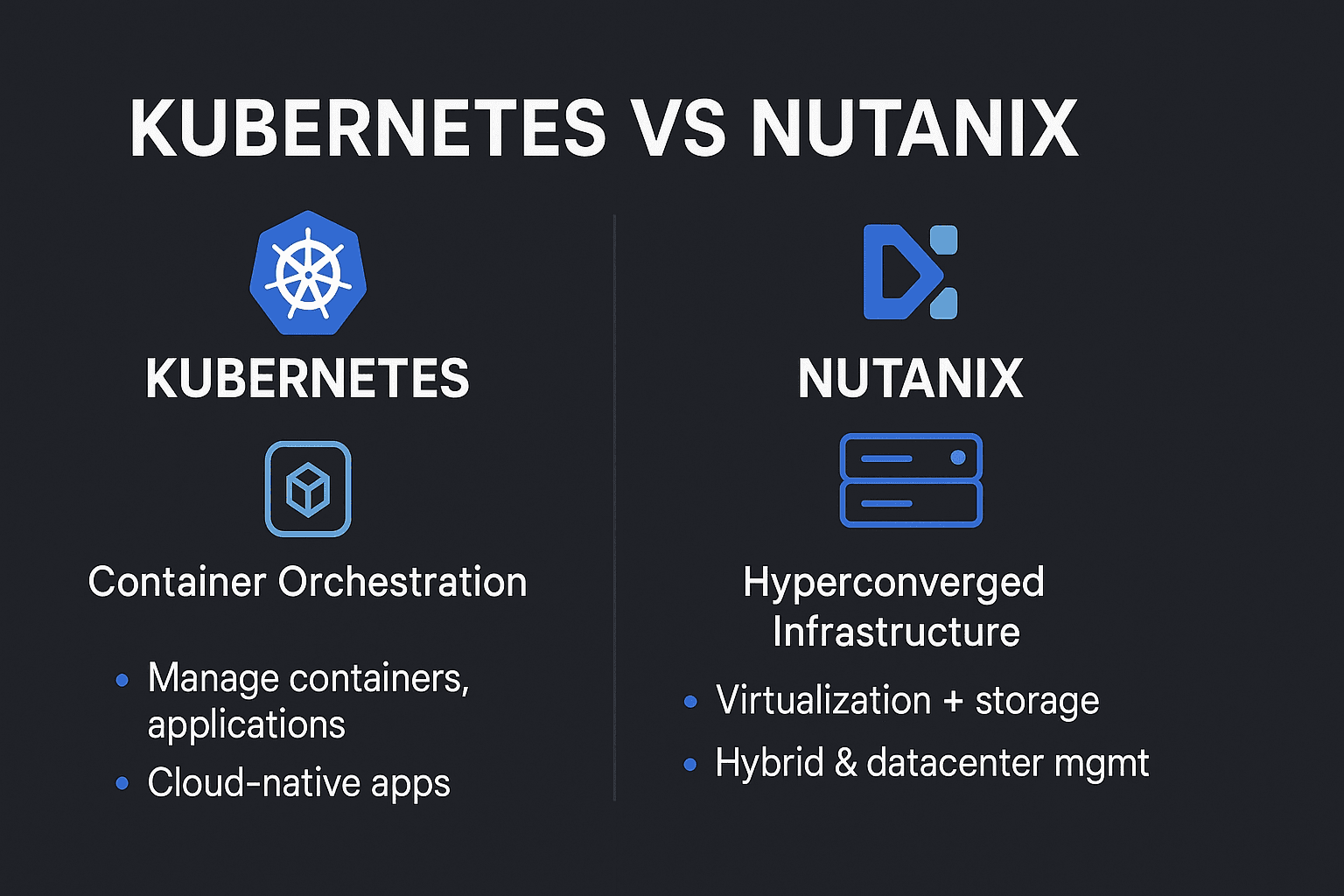
Kubernetes and Nutanix are two leading technologies in modern IT infrastructure, but they serve very different purposes. Kubernetes is a container orchestration platform designed to manage the lifecycle of containerized applications at scale, ideal for cloud-native environments.
On the other hand, Nutanix is a hyper-converged infrastructure (HCI) solution that integrates compute, storage, and networking into a unified platform for managing both virtualized and containerized workloads. Understanding when to use each can help businesses optimize their infrastructure for performance, scalability, and cost efficiency.
Kubernetes – Container Management at Scale
Kubernetes is an open-source container orchestration platform that automates the deployment, scaling, and management of containerized applications. It is designed to handle complex, large-scale container environments with ease.
Kubernetes enables efficient management of microservices architectures by grouping containers into units called Pods, which are then deployed and managed across clusters.
🚀 Advance Kubernetes and Nutanix with High-Performance NVMe Storage.
Achieve high performance and scalability using NVMe-over-TCP storage across all environments.
👉 Simplyblock for Kubernetes storage solutions
Core Features of Kubernetes
Kubernetes excels at automating container management for large-scale applications and microservices environments.
- Automates the distribution of containers across clusters for efficient resource usage.
- Restarts and replaces containers to ensure application uptime.
- Dynamically scales containers based on traffic or resource demand.
- Distributes traffic evenly across containers to ensure consistent performance.
Why Kubernetes is Ideal for Cloud-Native Applications
Kubernetes provides the perfect foundation for modern, cloud-native applications, especially microservices-based systems.
- Ideal for running microservices architectures where each service runs in its own container.
- Supports multi-cloud deployments, allowing for flexibility and redundancy.
- Easily integrates with CI/CD pipelines, enabling fast and automated deployments.
- Optimizes hardware usage, reducing waste and improving operational costs.
How Kubernetes Drives Modern Infrastructure
Kubernetes enables businesses to run highly available, resilient applications with automated scaling and management.
- Kubernetes reduces manual overhead with automated deployment and scaling.
- Ensures that apps are available by redistributing containers if they fail.
- Efficiently utilizes infrastructure resources, reducing unnecessary overhead.
- Works seamlessly across both on-prem and cloud environments for adaptable infrastructure.
Nutanix – Simplified Infrastructure Management
Nutanix is an integrated hyper-converged infrastructure (HCI) platform that combines compute, storage, and networking into a single solution. It simplifies the deployment and management of virtualized workloads, making it an excellent choice for organizations seeking to modernize their IT infrastructure while maintaining flexibility and scalability.
Nutanix is ideal for managing both traditional workloads and containerized applications, providing seamless support for hybrid and multi-cloud environments.
Key Capabilities of Nutanix
Nutanix delivers a unified platform that integrates critical infrastructure components for simplified management.
- Combines compute and storage resources in a hyper-converged system for streamlined management.
- Easily scales with growing infrastructure needs, adding compute or storage resources as required.
- Enables hybrid and multi-cloud deployments, providing flexibility across private and public clouds.
- Provides robust data protection and disaster recovery features to ensure availability and reliability.
Why Nutanix is Ideal for Enterprise IT
Nutanix is a powerful solution for enterprises looking to simplify their infrastructure and scale effectively.
- Centralized management interface for monitoring and controlling compute, storage, and networking.
- Reduces the need for complex hardware setups, improving cost efficiency and reducing operational overhead.
- Optimized for handling demanding workloads with high throughput and low latency.
- Supports both traditional virtualization and containerized applications for a unified approach.
How Nutanix Drives IT Modernization
Nutanix accelerates digital transformation by providing an agile, cost-effective infrastructure that supports a wide range of workloads.
- Delivers an easy-to-manage platform for enterprise-grade virtualization, storage, and network management.
- Provides seamless hybrid cloud capabilities, allowing enterprises to extend workloads to public cloud services.
- Reduces infrastructure complexity with automated provisioning, patching, and monitoring.
- Supports the evolving needs of modern applications, from virtualized VMs to containerized environments.
Comparing Kubernetes vs Nutanix
Kubernetes and Nutanix serve different purposes in modern IT infrastructures. Kubernetes focuses on automating containerized application deployment and management, while Nutanix offers an integrated hyper-converged platform for managing virtualized workloads. Below is a comparison to help you determine which solution best meets your needs:
| Category | Kubernetes | Nutanix |
| Primary Purpose | Container orchestration and management | Hyper-converged infrastructure (HCI) for VMs and storage |
| Layer of Stack | Platform-as-a-Service (PaaS) | Infrastructure-as-a-Service (IaaS) |
| Core Components | Pods, Nodes, Deployments, Services | Virtual Machines, Storage, Networking |
| Deployment Models | Cloud-native, hybrid, multi-cloud, on-prem | Private cloud, hybrid cloud, multi-cloud |
| Best Use Cases | Cloud-native apps, microservices, CI/CD | Enterprise workloads, virtualization, hybrid cloud |
| Scalability | Scalable containerized workloads across clusters | Scalable VM and storage environments |
| Storage Management | Persistent storage for containers | Integrated storage with VM and workload management |
| Typical Applications | Microservices, big data, cloud-native apps | Enterprise IT, virtualization, and hybrid cloud infrastructures |
Running Postgres on Kubernetes vs Nutanix
When choosing between Kubernetes and Nutanix for Postgres, Kubernetes offers scalability for containerized environments, while Nutanix provides a robust infrastructure for traditional virtual machines, making it ideal for enterprise workloads needing high availability and performance.
If Postgres is the main workload you care about, it’s often easier to treat it as a platform rather than something you hand-roll on top of your virtualization choice. Vela is a Postgres platform by Simplyblock that runs on Kubernetes, providing high-performance PostgreSQL with built-in automation, backups, and scaling.
Unified Storage for Kubernetes and Nutanix – How Simplyblock Advances Both
Simplyblock provides high-performance, scalable NVMe storage solutions that seamlessly integrate with both Kubernetes and Nutanix environments. Whether you’re managing containerized applications or virtualized workloads, Simplyblock’s unified storage layer offers fast, reliable, and scalable storage.
This integration simplifies storage management, reduces operational complexity, and ensures high availability for applications across cloud-native and hybrid infrastructures.
Seamless Kubernetes Integration
- Easily provision persistent storage for containerized workloads.
- Scales with containerized applications based on demand.
- NVMe-based storage provides low-latency and high throughput for stateful apps.
- Integrates with Kubernetes’ native storage management tools for simplified operations.
Effortless Nutanix Integration
- Combines storage for virtual machines and containers in a single platform.
- Supports multi-cloud deployments for consistent data access across environments.
- Easily scales with Nutanix’s virtualization platform, ensuring smooth resource allocation.
- Provides fast, reliable storage, improving virtual machine and workload performance.
Why Simplyblock Works for Both
- One solution for both containerized and virtualized workloads.
- NVMe storage ensures quick data access for fast workloads.
- Reduces complexity with seamless integration into both environments.
- Adapts to both cloud-native and virtualized infrastructures for consistent performance.
Kubernetes vs Nutanix – Which Infrastructure Solution Fits Your Needs?
Choosing between Kubernetes, Nutanix, or both depends on your specific infrastructure needs and workload types.
- Kubernetes is ideal for containerized, cloud-native applications, especially microservices, and hybrid cloud environments.
- Nutanix excels in virtualized workloads, providing an integrated, simplified platform for hybrid cloud infrastructure.
Using both combines the strengths of Kubernetes for containers and Nutanix for VMs, offering flexibility, scalability, and streamlined management. Simplyblock’s unified storage advances both, optimizing performance across these platforms.
See other comparisons :
Take a look at how these platforms measure up.
Questions and answers
Kubernetes is an open-source container orchestration platform designed to automate the deployment, scaling, and management of containerized applications. It is essential for cloud-native applications, particularly those based on microservice architectures, as it ensures efficient resource management and high scalability.
Nutanix is a hyper-converged infrastructure (HCI) platform that combines compute, storage, and networking into a single solution. It simplifies the management of both traditional virtual machines (VMs) and containerized applications, offering flexibility for hybrid and multi-cloud environments.
Kubernetes focuses on container orchestration, managing and scaling containerized applications. It’s ideal for cloud-native environments. Nutanix, on the other hand, offers an integrated infrastructure platform that unifies compute, storage, and networking resources, making it better suited for managing both virtualized and containerized workloads.
Yes, Kubernetes and Nutanix can be used together. Nutanix can serve as the underlying infrastructure, providing the necessary compute, storage, and networking, while Kubernetes can manage containerized applications on top of it. This combination is ideal for organizations that require both container orchestration and virtualization.
Simplyblock provides high-performance NVMe storage solutions that integrate seamlessly with both Kubernetes and Nutanix. This ensures that containerized and virtualized workloads can run efficiently with low-latency, high-throughput storage, and easy scalability across both platforms.