
OpenShift vs Harvester – Virtualization Meets Cloud-Native Infrastructure
Nov 22nd, 2025 | 8 min read
Table Of Contents
- OpenShift the Kubernetes Platform Built for Enterprises
- Harvester Simplifying Kubernetes Infrastructure
- Key Comparison - OpenShift vs Harvester Across Features
- Running Postgres on OpenShift vs Harvester
- How Simplyblock Supports Both OpenShift and Harvester
- Making the Right Choice - OpenShift, Harvester, or Both
- See other comparisons :
- Questions and answers
As cloud-native adoption accelerates, organizations are increasingly evaluating the tools that can best support their Kubernetes-based infrastructure. OpenShift, with its robust enterprise features, is a trusted platform for large-scale container orchestration. On the other hand, Harvester presents a simplified, Kubernetes-first approach, designed for smaller teams and edge environments looking for a streamlined solution.
This blog compares the two platforms, exploring their strengths, weaknesses, and which workloads each platform is best suited for, alongside how Simplyblock helps manage storage across both.
OpenShift the Kubernetes Platform Built for Enterprises
OpenShift is an enterprise-grade platform built around Kubernetes, providing a comprehensive solution for managing containerized applications. It integrates seamlessly with existing infrastructure and offers out-of-the-box tools for continuous integration and deployment (CI/CD).
OpenShift’s focus on automation and scalability makes it a top choice for large organizations that need a secure, stable, and scalable environment to run both legacy and modern applications.
🚨 Looking for storage flexibility with OpenShift?
Simplyblock provides a software-defined storage solution that integrates seamlessly with OpenShift’s persistent storage needs, offering high performance and scalability.
👉 Simplyblock for OpenShift environments
Why OpenShift Excels in Large-Scale, Regulated Environments
OpenShift’s robust set of features is designed to meet the demands of large enterprises and regulated industries.
- Enterprise-grade security, compliance, and monitoring tools
- Simplified management with integrated CI/CD pipelines and GitOps workflows
- Kubernetes-native orchestration for consistent app deployment across environments
- Multi-cluster management for distributed and hybrid cloud infrastructures
The Power of OpenShift’s Integrated CI/CD Pipelines
OpenShift is built for DevOps, streamlining the process of automating and managing containerized applications.
- Out-of-the-box GitOps and CI/CD pipeline integration
- Fully integrated monitoring, logging, and alerting
- Built for automation and agile, rapid deployment cycles
- Simplifies the adoption of microservices and containerized workloads
The Cost of OpenShift’s Flexibility for Smaller or Agile Teams
While OpenShift offers many advantages, it can be complex and costly for smaller organizations or those with fewer resources.
- High licensing and operational costs associated with large-scale environments
- Complexity in managing environments, especially in smaller deployments
- Requires skilled teams to manage Kubernetes clusters and infrastructure
- Heavy resource consumption when compared to more lightweight alternatives
Harvester Simplifying Kubernetes Infrastructure
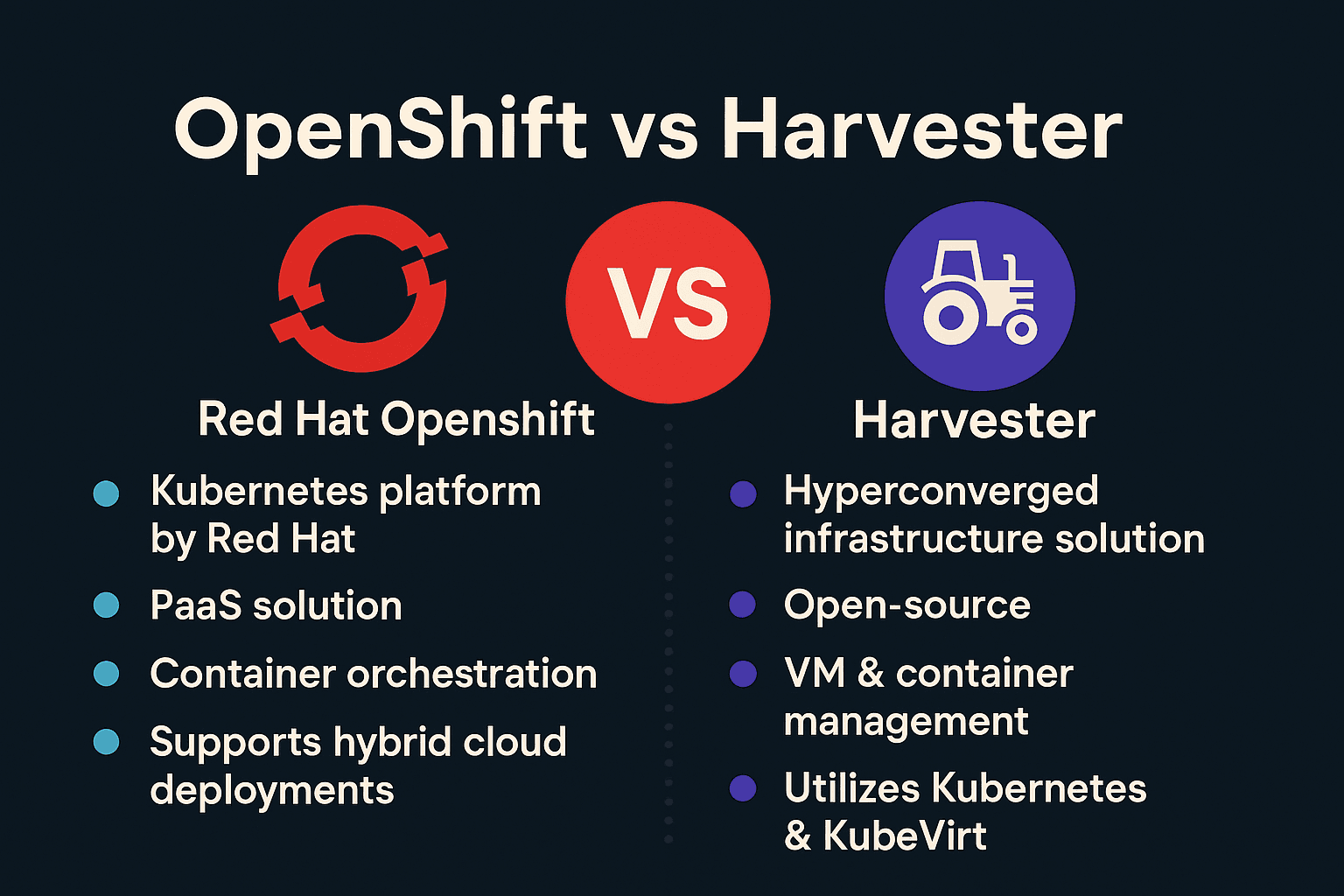
Harvester is a hyperconverged infrastructure (HCI) platform that combines storage, networking, and compute into a single unified system, designed specifically for Kubernetes workloads. It is built with simplicity in mind, offering a Kubernetes-native OS that allows small to medium-sized organizations to manage containerized workloads easily.
Unlike traditional virtualization solutions, Harvester integrates all components into one platform, making it a great fit for organizations that need simplicity, scalability, and performance.
Harvester’s Hyperconverged Model for Kubernetes Management
Harvester’s hyperconverged architecture simplifies infrastructure management by tightly integrating compute, storage, and networking into a single platform.
- Unified platform for compute, storage, and networking
- Kubernetes-native design, leveraging KubeVirt for virtual machine management
- Low overhead and simplified management for small to mid-sized environments
- Easily scalable to support cloud-native workloads in hybrid cloud or edge environments
Why Harvester Shines for Smaller, Edge, or Hybrid Deployments
Harvester is a great solution for teams looking for a simple, cost-effective platform to manage both containers and virtual machines.
- Ideal for edge computing, remote offices, and small-scale hybrid environments
- Cloud-native with full Kubernetes integration for seamless app delivery
- Simplifies multi-cloud and hybrid cloud deployments
- Cost-effective solution compared to traditional virtualization platforms
Harvester’s Limitations for Larger, Complex Deployments
While Harvester excels in simplicity and cloud-native integration, it may not be ideal for large-scale, enterprise environments that require extensive support and features.
- Lacks the depth and enterprise features of platforms like OpenShift
- Storage flexibility may be limited compared to full-stack solutions
- Limited integration with legacy infrastructure and large-scale legacy applications
- Smaller community and support network when compared to more mature platforms
Key Comparison – OpenShift vs Harvester Across Features
To better understand how OpenShift and Harvester compare, here’s a side-by-side breakdown of their core features and capabilities. This table highlights the key areas where each platform excels and where it may have limitations.
| Category | OpenShift | Harvester |
| Architecture | Full-stack Kubernetes platform with integrated tools | Hyperconverged infrastructure (HCI) designed for Kubernetes-first workloads |
| Management Tools | GUI and CLI for centralized control (vSphere, OpenShift CLI) | Simple, API-driven management for Kubernetes workloads |
| Storage Integration | Integrated persistent storage using CSI drivers and vSAN | Integrated storage with KubeVirt, external storage via CSI |
| Scalability | Highly scalable, best for large enterprise environments | Scalable for small-to-medium deployments, optimized for edge computing |
| Security | Enterprise-grade security (RBAC, SELinux, network policies) | Lightweight and secure, with minimal attack surface |
| Cloud Integration | Native multi-cloud integration (AWS, Azure, GCP) | Supports hybrid cloud and edge computing, but has limited multi-cloud integration |
| Licensing | Subscription-based, with enterprise support | Open-source, free to use with optional paid support |
Running Postgres on OpenShift vs Harvester
Both OpenShift and Harvester can host PostgreSQL. With OpenShift, you use operators and StatefulSets to run Postgres as a containerized service, providing automation, scaling, and high availability. In contrast, with Harvester, you typically run Postgres as a Kubernetes-native workload using StatefulSets or operators, while virtual machines are handled via KubeVirt on top of the platform.
If Postgres is the main workload you care about, it’s often easier to treat it as a platform rather than something you manually configure. Vela is a Postgres platform by Simplyblock that runs on Kubernetes, offering high-performance PostgreSQL with built-in automation, backups, and scaling.
How Simplyblock Supports Both OpenShift and Harvester
Both OpenShift and Harvester require flexible, high-performance storage solutions to handle persistent workloads.
While each platform has its own storage management approach, Simplyblock’s software-defined storage layer integrates seamlessly across both, providing consistent performance and scalability for cloud-native applications.
Storage Needs in OpenShift Environments
OpenShift’s storage model is flexible, but managing persistent volumes across large clusters can introduce complexity.
- Requires third-party CSI drivers for storage integration
- Persistent storage can be difficult to scale with growing workloads
- State-driven applications like databases need high-throughput, low-latency storage
- Storage scaling is tied to Kubernetes pods, making it harder to scale independently
Managing Storage for Kubernetes in Harvester
Harvester is built to handle both containers and virtual machines, but its storage needs are simpler.
- Relies on external storage integrations via CSI for persistent volumes
- Highly efficient for cloud-native applications, but may require additional third-party solutions for advanced storage needs
- Optimized for smaller-scale environments, edge computing, and hybrid cloud setups
- Storage scalability is tied to the underlying infrastructure, making it more flexible but requiring careful planning
Why Simplyblock Works Seamlessly for Both Platforms
Simplyblock solves these challenges by providing a unified, high-performance storage solution that works across both OpenShift and Harvester environments.
- NVMe-over-TCP architecture delivers low-latency, high-throughput performance across both platforms
- Compatible with Kubernetes’ CSI drivers for flexible and scalable storage provisioning
- Supports hybrid and multi-cloud environments with consistent storage performance
- Features like snapshots, replication, and multi-tenant QoS provide reliability and high availability for persistent workloads like Postgres, Kafka, and more.
Making the Right Choice – OpenShift, Harvester, or Both
Choosing between OpenShift and Harvester depends on your infrastructure needs:
- Use OpenShift for a comprehensive, enterprise-grade solution with robust security and management tools, ideal for large-scale deployments.
- Harvester is perfect for organizations seeking a lightweight, cloud-native platform for smaller-scale or edge environments.
For hybrid infrastructures or teams transitioning, Simplyblock bridges the gap by providing seamless storage across both platforms. Whether using OpenShift, Harvester, or both, Simplyblock ensures consistent, high-performance storage at any scale.
See other comparisons :
Take a look at how these platforms measure up:
Questions and answers
OpenShift is a robust, enterprise-grade Kubernetes platform that integrates various tools for CI/CD, security, and compliance, making it ideal for large-scale enterprises and regulated industries. Harvester, on the other hand, is a simplified Kubernetes-native solution designed for smaller teams or edge environments, offering a more lightweight infrastructure.
OpenShift is better suited for large-scale enterprise deployments. It provides advanced features like multi-cluster management, enterprise-grade security, compliance tools, and integrated CI/CD pipelines, making it the preferred choice for complex, large-scale, regulated environments.
Yes, Harvester is designed for hybrid cloud and edge environments. Its simplified, hyperconverged architecture integrates compute, storage, and networking into a single platform, making it a great choice for organizations with limited resources that need to manage both containers and virtual machines.
OpenShift’s storage model can be complex, especially with scaling persistent volumes across large clusters. Simplyblock offers a seamless, software-defined storage solution that integrates with OpenShift’s CSI drivers to provide consistent, high-performance storage for Kubernetes workloads, ensuring scalability and flexibility.
Harvester simplifies storage management by offering integrated storage with Kubernetes via KubeVirt, while OpenShift uses third-party CSI drivers for persistent storage. Simplyblock advances storage management for both platforms by providing a unified, high-performance storage solution that works seamlessly across both environments.