
Talos vs OpenStack – Cloud-Native OS vs Cloud Infrastructure Platform
Nov 28th, 2025 | 8 min read
Table Of Contents
- Talos - A Secure, Kubernetes-Centric Operating System
- OpenStack - A Flexible Platform for Cloud Infrastructure
- Talos vs OpenStack - Key Differences and Use Cases
- Running Postgres on Talos vs OpenStack
- How Simplyblock Supports Both Talos and OpenStack
- Talos, OpenStack, or Both - Get the Best for Your Workloads
- See other comparisons :
- Questions and answers
As technology advances in modern infrastructure, selecting the right platform for managing cloud-native and virtualized workloads becomes crucial. Talos is designed to streamline Kubernetes environments, offering a secure, lightweight operating system built for containerized applications. In contrast, OpenStack provides a robust platform for managing private cloud environments.
Whether you’re focused on cloud-native applications or need to manage traditional virtual machines, understanding the strengths of each platform can help you make the right choice for your infrastructure needs.
Talos – A Secure, Kubernetes-Centric Operating System
Talos is a cutting-edge, immutable operating system designed specifically for Kubernetes workloads. Unlike traditional operating systems, Talos operates as an immutable, secure environment, ensuring that infrastructure remains consistent, scalable, and highly available.
Its integration with Kubernetes enables simplified deployment and management of cloud-native applications. Talos offers a lightweight, self-healing system that minimizes operational overhead while providing seamless support for containerized workloads.
🚀 Advance your Talos environment with Simplyblock’s storage solutions.
Effortlessly manage Kubernetes workloads with scalable, reliable storage for optimal performance. Ready to enhance your Talos deployment?
👉 Start with Simplyblock storage for Talos
Key Advantages of Talos in Cloud-Native Environments
Talos brings several unique advantages to organizations that rely on cloud-native technologies like Kubernetes.
- Talos eliminates unnecessary overhead by being a purpose-built, secure, and lightweight OS for Kubernetes.
- Talos ensures security and consistency by providing an operating system that is read-only and cannot be modified without deliberate action.
- Offers simplified lifecycle management and Kubernetes integration, reducing manual configuration work.
- Easily scale Kubernetes clusters with Talos as your containerized workloads grow.
How Talos Revolutionizes Kubernetes Infrastructure
Talos is optimized for organizations looking to deploy, manage, and scale Kubernetes clusters with minimal intervention.
- Natively designed to work with Kubernetes, Talos streamlines container orchestration and simplifies cluster operations.
- Talos automates critical infrastructure tasks, allowing businesses to focus on application development and deployment.
- With built-in security features like encrypted communication and system integrity checks, Talos reduces vulnerabilities often seen in mutable systems.
- Talos works seamlessly across public and private cloud environments, ensuring Kubernetes clusters scale flexibly.
Why Talos Stands Out for Performance and Scalability
Talos is engineered to deliver outstanding performance for containerized applications and Kubernetes clusters.
- Instantly scale infrastructure to meet growing Kubernetes demand, without downtime or performance degradation.
- Talos ensures maximum performance for cloud-native workloads while minimizing system overhead.
- Built-in recovery and failover capabilities ensure high availability even during failures.
- Delivers fast and reliable performance for containerized workloads with low-latency and high throughput.
OpenStack – A Flexible Platform for Cloud Infrastructure
OpenStack is an open-source cloud computing platform that enables organizations to build and manage private and public cloud environments. It provides a modular set of services, including compute, storage, and networking, to create scalable Infrastructure-as-a-Service (IaaS) solutions.
OpenStack’s flexibility allows businesses to design and customize their cloud infrastructure based on specific needs. Whether for public cloud, private cloud, or hybrid cloud, OpenStack enables organizations to deploy and manage cloud-based applications and services with ease.
Key Strengths of OpenStack for Cloud Infrastructure
OpenStack is a versatile cloud management platform that offers several features that cater to both virtualized and hybrid cloud infrastructures.
- OpenStack provides a suite of services like Nova (compute), Cinder (block storage), and Swift (object storage), allowing businesses to manage cloud resources effectively.
- OpenStack supports multiple hypervisors, including KVM, Xen, and VMware, providing flexibility in cloud deployments.
- OpenStack allows you to pick and choose services based on your cloud environment’s requirements, offering full customization for every deployment.
- Being open-source, OpenStack benefits from a large, active community, constantly advancing its features and security.
How OpenStack Fits into Your Hybrid Cloud Strategy
OpenStack is an ideal solution for organizations that need to create a hybrid cloud infrastructure, where on-premise data centers can be integrated with public cloud resources.
- OpenStack works with both private and public cloud environments, allowing businesses to build a unified infrastructure across various platforms.
- Empower users to provision resources on demand with OpenStack’s self-service portal, simplifying cloud resource management.
- OpenStack integrates well with other cloud platforms like AWS and Azure, enabling smooth transitions and migrations between clouds.
- Use a unified interface to manage all your cloud resources—compute, storage, and networking—across your hybrid cloud infrastructure.
How OpenStack Powers Large-Scale Cloud Environments
OpenStack is designed to handle the scalability and performance demands of large cloud environments, ensuring high availability and reliability.
- Easily scale resources up or down to meet the demands of growing businesses, without the need for manual intervention.
- Built-in load balancing and failover support ensure your applications and services remain available even during failures.
- OpenStack allows for efficient allocation and use of resources, ensuring high performance for cloud-based applications.
- OpenStack includes redundancy features to ensure that critical applications and services are always available, even during hardware failures.
Talos vs OpenStack – Key Differences and Use Cases
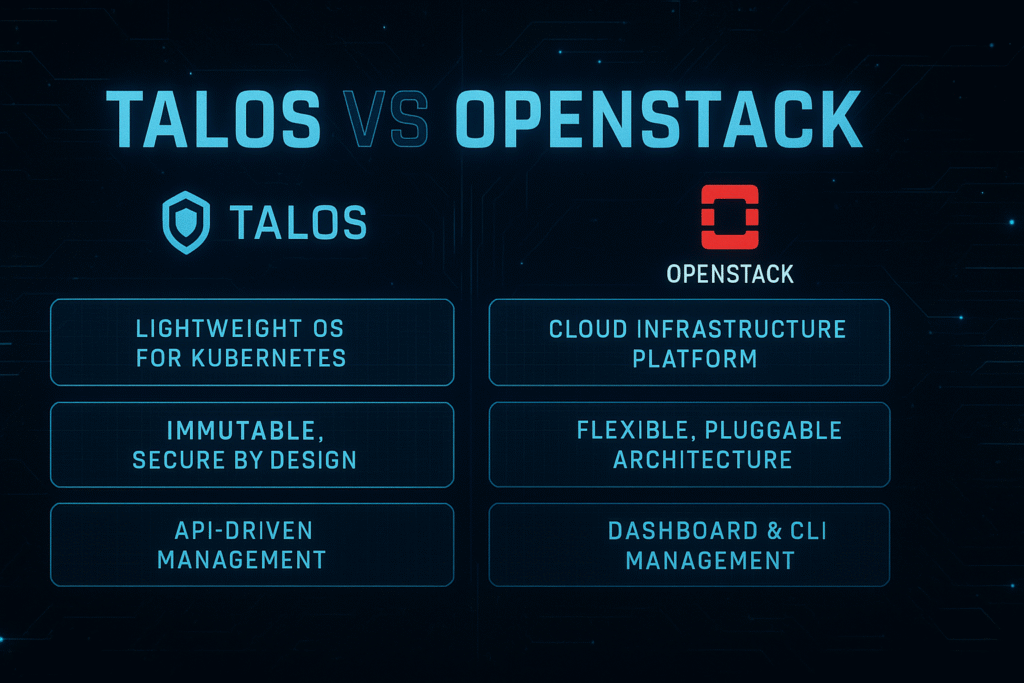
While both Talos and OpenStack are powerful platforms for managing modern infrastructure, they serve very different purposes and excel in different areas. Below is a side-by-side comparison to help you understand which platform best fits your organization’s needs.
| Category | Talos | OpenStack |
| Primary Purpose | Cloud-native OS for Kubernetes workloads | Cloud platform for managing IaaS |
| Technology Base | Kubernetes, container orchestration | Virtual machines, storage, and networking services |
| Ideal Use Cases | Cloud-native apps, Kubernetes management | Private and hybrid cloud, VM, and storage management |
| Deployment Models | Multi-cloud, Kubernetes-first environments | Private cloud, hybrid cloud, public cloud |
| Scalability | Scales Kubernetes clusters and containerized workloads | Scales compute, storage, and networking resources |
| Storage Management | Persistent storage for Kubernetes workloads | Block and object storage for VMs and containers |
| Best For | Containerized applications, cloud-native infrastructure | Private cloud, IaaS, VM-based workloads |
Running Postgres on Talos vs OpenStack
Deploying Postgres on Talos optimizes it for cloud-native environments with Kubernetes, offering scalability and automation. In contrast, OpenStack provides robust, persistent storage for VM-based Postgres deployments, ideal for managing traditional infrastructures at scale.
If Postgres is the main workload you care about, it’s often easier to treat it as a platform rather than something you hand-roll on top of your virtualization choice. Vela is a Postgres platform by Simplyblock that runs on Kubernetes, providing high-performance PostgreSQL with built-in automation, backups, and scaling.
How Simplyblock Supports Both Talos and OpenStack
Simplyblock provides seamless storage solutions for both Talos and OpenStack, ensuring high performance and scalability across cloud-native and virtualized environments.
Whether managing Kubernetes clusters with Talos or VM workloads with OpenStack, Simplyblock offers reliable, persistent storage that scales as your infrastructure grows, advancing efficiency and simplifying management for both platforms.
Talos Integration with Simplyblock
- Easily manage persistent storage for containerized workloads in Kubernetes clusters.
- Effortlessly integrate Simplyblock’s storage solutions with Talos’ native Kubernetes support.
- As Kubernetes clusters grow, Simplyblock ensures storage scales alongside.
- Provides low-latency and high-throughput storage for cloud-native workloads.
OpenStack Integration with Simplyblock
- Easily manage block and object storage for OpenStack’s diverse environments.
- One solution for managing both virtual machines and containerized workloads within OpenStack.
- Quickly scale storage as your OpenStack cloud grows.
- Optimize performance for demanding virtualized workloads and applications.
Why Simplyblock Works for Both Talos and OpenStack
- Manage both virtualized VMs and cloud-native containers from a single platform.
- Scale Simplyblock’s storage solutions to meet the growing demands of Talos and OpenStack environments.
- NVMe-powered storage delivers exceptional performance and reliability across both platforms.
- Centralized management of storage across Kubernetes and OpenStack infrastructures.
Talos, OpenStack, or Both – Get the Best for Your Workloads
Choosing between Talos, OpenStack, or both depends on your infrastructure needs.
- Talos is ideal for Kubernetes-driven, cloud-native workloads, providing a secure and automated environment.
- OpenStack is best for managing private clouds, IaaS, and VM-based infrastructures, offering flexibility and scalability.
Using both platforms can help organizations manage both containerized and virtualized workloads. Simplyblock advances both platforms by providing scalable storage solutions, ensuring high performance and reliability across Kubernetes and VM environments.
See other comparisons :
Take a look at how these platforms measure up.
Questions and answers
Talos is ideal for cloud-native applications that rely heavily on Kubernetes. Its immutable design simplifies the lifecycle management of Kubernetes clusters and supports rapid scaling of containerized workloads. OpenStack, on the other hand, is more suited for traditional VM-based workloads and hybrid cloud environments, where compute and storage resources need to be managed at a larger scale.
OpenStack is well-suited for hybrid cloud environments due to its ability to manage resources across private and public clouds. It integrates well with other platforms like AWS and Azure, allowing for seamless migrations and multi-cloud strategies. Talos is designed primarily for cloud-native applications, making it less versatile for managing hybrid infrastructure.
Talos integrates seamlessly with Kubernetes, offering a self-healing, automated, and secure environment specifically for containerized applications. It eliminates the operational overhead required by traditional OS management, making it easier to scale and secure Kubernetes clusters. OpenStack, while powerful for managing VM-based infrastructures, is not as tailored for Kubernetes environments.
OpenStack is optimized for VM-based workloads. It supports multiple hypervisors (like KVM, Xen, VMware) and provides robust storage and networking solutions for large-scale infrastructure. Talos, being a cloud-native operating system, does not focus on VM management.
Talos is designed as an immutable operating system, meaning it cannot be altered without deliberate action, reducing the risk of configuration drift and vulnerabilities. It also has built-in security features like encrypted communication and system integrity checks to ensure safe and consistent operation for Kubernetes workloads.