
Table Of Contents
- Where VMware Still Fits (But Not Without Trade-Offs)
- What Makes Harvester a Different Kind of Virtualization Stack
- How VMware and Harvester Compare Head to Head
- Running Postgres on VMware vs Harvester
- How Simplyblock Simplifies Storage Across VMware and Harvester
- When VMware Excels — and When Harvester Does
- See other comparisons :
- Questions and answers
As companies rethink how they manage infrastructure, many are searching for a VMware alternative that’s more flexible and cost-effective. VMware remains a go-to for traditional virtualization, but its licensing model and closed ecosystem push teams to look for options like Harvester.
Harvester offers open-source virtualization with Kubernetes-native tools, no vendor lock-in, and simplified operations. This comparison helps you weigh both platforms—so you can plan smarter around modern workloads, scalability, and long-term infrastructure strategy.
Where VMware Still Fits (But Not Without Trade-Offs)
Even with rising costs and the emergence of newer platforms, VMware continues to play a central role in many enterprise environments. It’s built around mature virtualization tools that teams have relied on for years.
But while it still delivers on control and performance, it also introduces constraints that are hard to ignore when infrastructure needs to evolve fast.
💡 Need to break free from rigid virtualization stacks?
Tired of VMware’s pricing or vSAN limits? Simplyblock gives you flexible, software-defined storage for any platform.
👉 Simplyblock compares VMware to other modern platforms
Why VMware Remains a Go-To for Many
VMware offers a stable, integrated ecosystem for managing infrastructure at scale.
- Built-in tools like vSphere and vCenter make VM management easier
- Trusted across industries that require uptime and strict compliance
- Deep integrations with networking (NSX) and storage (vSAN)
- Strong enterprise support and familiarity across ops teams
But It’s Getting Harder to Justify
The tighter your infrastructure ties to VMware, the harder it is to adapt.
- Licensing changes post-Broadcom have driven up long-term costs
- vSAN introduces hardware lock-in and scaling limitations
- Not built with DevOps or automation-first environments in mind
- Container support feels like an add-on, not a core feature
Why Teams Start Exploring Alternatives
Organizations modernizing infrastructure need more flexibility than VMware allows.
- Scaling storage often means scaling compute too
- Hybrid and multi-cloud support is limited and costly
- Operational overhead grows with each added service
- Developers need environments that match cloud-native workflows
What Makes Harvester a Different Kind of Virtualization Stack
Unlike traditional virtualization platforms, Harvester is built from the ground up using open-source components. It blends lightweight hypervisor capabilities with Kubernetes orchestration to create a flexible alternative to tools like VMware.
While still relatively new, it’s gaining traction for its simplicity, cost transparency, and compatibility with modern workloads.
Built with Open-Source Foundations
Harvester isn’t just another hypervisor — it’s tightly integrated with cloud-native tooling.
- Uses KubeVirt to manage VMs on top of Kubernetes
- Built by SUSE with Rancher integration out of the box
- Leverages Longhorn for distributed storage across nodes
- Completely open-source and hardware agnostic
Designed for Cloud-Native Teams
Harvester appeals to teams that already work in containerized environments.
- Works well in DevOps and GitOps-first pipelines
- Unified management for both VMs and containers
- Ideal for edge, lab, and small-scale production clusters
- No proprietary tooling or vendor lock-in
Where It’s Gaining Ground
Harvester is becoming a preferred alternative to VMware for infrastructure teams seeking agility.
- Replaces vCenter and NSX with Kubernetes-native tooling
- Enables hybrid workloads with VM and container support
- Reduces cost by avoiding closed ecosystems
- Backed by a growing open-source community
How VMware and Harvester Compare Head to Head
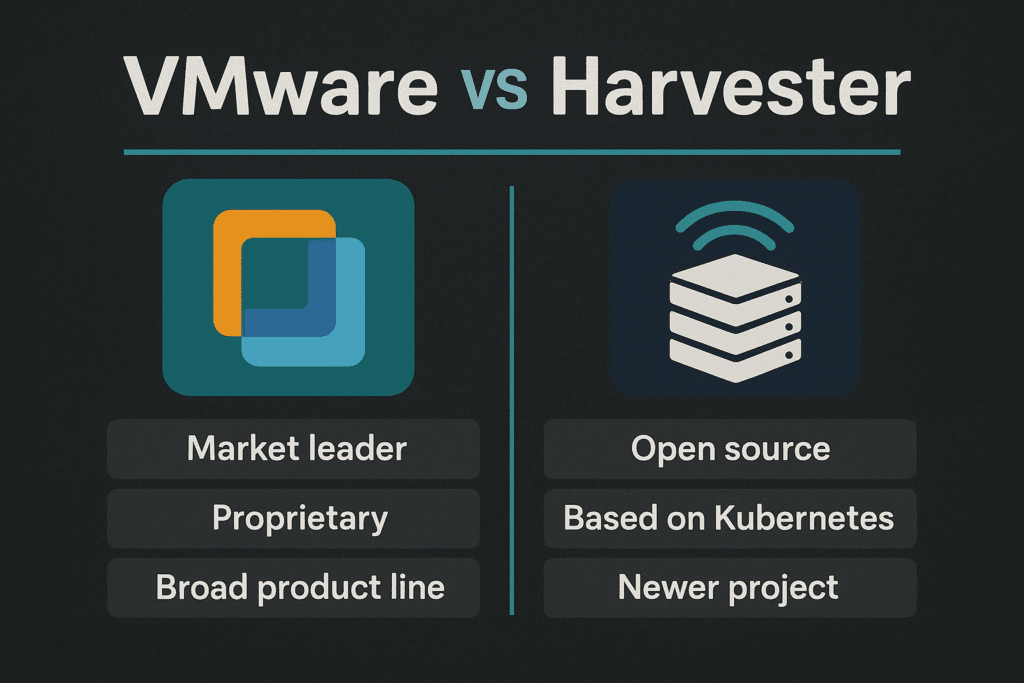
While both platforms manage virtual machines, their design goals and operating models couldn’t be more different. VMware is a polished, enterprise-grade virtualization suite built on proprietary tools. Harvester, by contrast, is Kubernetes-native and open-source — designed to blur the lines between VMs and containers.
Here’s how they stack up across key areas:
| Category | VMware | Harvester |
| Architecture | Traditional hypervisor (ESXi) with vSphere, vCenter | Built on KubeVirt, managed through Rancher and Kubernetes APIs |
| Management Style | GUI-heavy, centralized control | GitOps-friendly, declarative infrastructure management |
| Storage Integration | Tied to vSAN or external SAN/NAS systems | Uses Longhorn for distributed, container-aware block storage |
| Licensing & Cost | Subscription-based pricing tied to scale | 100% open-source with no license fees |
| Kubernetes Support | Add-on (via Tanzu or external integration) | Native — built directly on top of Kubernetes |
| Best Fit For | Legacy workloads, regulated industries | Cloud-native teams, hybrid VM + container environments |
Running Postgres on VMware vs Harvester
Both VMware and Harvester can host PostgreSQL, but their approaches differ completely. With VMware, Postgres typically runs inside virtual machines, managed like any other traditional workload through vSphere and vCenter. With Harvester, Postgres runs as a Kubernetes-native workload using operators and StatefulSets, leveraging the platform’s tight integration with Rancher and KubeVirt for automation and scalability.
If Postgres is the main workload you care about, it’s often more effective to treat it as a platform rather than something you manage manually. Vela is a Postgres platform by simplyblock that runs on Kubernetes, providing high-performance PostgreSQL with automation, backups, and scaling built in.
How Simplyblock Simplifies Storage Across VMware and Harvester
Storage is where things get messy. VMware ties storage directly to its ecosystem — especially with vSAN — which makes scaling rigid and expensive. Harvester, while more flexible, relies on open-source tools like Longhorn that need careful tuning for performance.
Simplyblock solves these problems with one block storage layer that works for both platforms — virtualized or Kubernetes-native.
In VMware Environments
VMware’s storage stack is reliable, but comes with tight integration.
- Requires vSAN or a certified SAN/NAS for full functionality
- Scaling storage often means scaling compute together
- High availability tied to VMware-specific tooling
- Licensing inflates as capacity grows
In Harvester Clusters
Harvester uses cloud-native storage, but it’s not always fast or simple.
- Relies on Longhorn, which can be fragile at scale
- Performance tuning depends on the underlying disk and network setup
- Stateful workloads need consistent throughput
- Needs CSI-compatible, resilient block storage
What Simplyblock Adds
Simplyblock delivers consistent, high-performance volumes across both stacks.
- NVMe-over-TCP architecture with low latency and high IOPS
- Works with VMware, Harvester, and Kubernetes out of the box
- Supports replication, snapshots, and thin provisioning
- No vendor lock-in or hardware dependency
When VMware Excels — and When Harvester Does
Choosing between VMware and Harvester depends on your team’s infrastructure goals and how far along you are in your modernization journey. VMware still works well in large, traditional IT environments where stability, uptime, and established processes matter. But for teams embracing automation, containers, and open-source tools, Harvester offers a cleaner, more flexible path forward.
- Use VMware when you’re running legacy workloads, have existing commercial support contracts, or need integration with tools like vSphere and NSX.
- Use Harvester if you’re looking for a lightweight, Kubernetes-native virtualization stack that fits into GitOps workflows and container-first pipelines.
Use both when you’re in a hybrid phase — with VMware handling VMs and Harvester managing new, containerized workloads. Simplyblock helps unify storage in these environments with software-defined performance and flexibility that works across both platforms.
See other comparisons :
Take a look at how these platforms measure up:
Questions and answers
Harvester is a Kubernetes-native, open-source hyperconverged infrastructure (HCI) solution designed for modern, cloud-native workloads. Unlike VMware’s proprietary stack, Harvester uses tools like KubeVirt and Longhorn, offering flexibility without vendor lock-in. For hybrid environments, Simplyblock’s distributed storage integrates seamlessly with both.
VMware relies heavily on vSAN or certified SAN/NAS systems, which can limit scalability and increase cost. Harvester uses Longhorn, an open-source, distributed block storage, but tuning is needed for high performance. Simplyblock’s NVMe-over-TCP storage simplifies performance tuning for both platforms.
Many teams are reevaluating VMware due to rising costs, vSAN limitations, and limited native Kubernetes support. The push for cloud-native, DevOps-friendly infrastructure is leading to the adoption of open-source platforms like Harvester.
A Kubernetes-native virtualization platform, like Harvester, runs virtual machines alongside containers using Kubernetes orchestration. This approach unifies VM and container management. Tools such as KubeVirt enable this hybrid model, simplifying operations and boosting agility in CI/CD and GitOps workflows.
Yes, many teams adopt a hybrid approach during infrastructure transitions. VMware handles legacy or compliance-heavy workloads, while Harvester supports containerized, cloud-native apps. With Simplyblock, you can unify storage across both using a high-performance, software-defined solution that supports both VMware and Kubernetes environments.