
Table Of Contents
- VMware’s Infrastructure Playbook
- Nutanix’s Approach to Virtualization
- VMware vs Nutanix - Performance Breakdown
- Running Postgres on VMware vs Nutanix
- Simplyblock’s Versatility in Supporting VMware and Nutanix
- When to Use VMware, Nutanix, or a Combination of Both
- See other comparisons :
- Questions and answers
For years, VMware has been the backbone of many enterprises, offering robust virtualization for traditional workloads. However, as the IT landscape shifts toward more flexible, cloud-native environments, organizations are increasingly considering alternatives like Nutanix. Known for its hyperconverged infrastructure (HCI) approach, Nutanix promises simplified management, scalability, and lower total cost of ownership.
In this comparison, we will discuss how VMware and Nutanix stack up against each other and where Simplyblock fits in by providing a unified storage solution for both platforms.
VMware’s Infrastructure Playbook
VMware has long been the gold standard for virtualization, particularly in enterprise environments. Its robust tools, like vSphere, vCenter, and vSAN, enable teams to manage and scale infrastructure with high reliability.
While VMware excels in providing centralized control and support for traditional workloads, it often struggles to meet the demands of modern, dynamic infrastructure that increasingly relies on containers, automation, and hybrid cloud solutions.
🚨 Looking to scale VMware storage without the vSAN lock-in?
Simplyblock offers software-defined storage, bypassing VMware’s vSAN for better performance and flexibility.
👉 Simplyblock for VMware environments
Core Strengths of VMware
VMware’s long-standing reputation stems from its ability to offer a comprehensive solution for managing virtualized infrastructure. Here are the main strengths:
- Enterprise-grade reliability with robust VM management
- Tight integration with compute, network, and storage tools
- Trusted in regulated industries with high uptime requirements
- Proven in large-scale virtualization environments
Limitations for Modern IT
Despite its strengths, VMware presents several challenges for modern IT teams looking to scale efficiently and embrace the cloud-native ecosystem.
- High licensing costs, especially after the Broadcom acquisition
- Rigid scaling between compute and storage
- Limited native support for containerized workloads
- Not optimized for cloud-native or DevOps environments
Why Some Teams Continue Using VMware
Many enterprises continue to use VMware because it provides stability and familiarity, which is critical in specific environments.
- Strong ecosystem of third-party integrations and tools
- Operational knowledge and workflows already in place
- Easy migration for legacy systems and applications
- Best suited for environments requiring strict compliance and stability
Nutanix’s Approach to Virtualization
Nutanix has disrupted the traditional virtualization space by introducing hyperconverged infrastructure (HCI). By combining compute, storage, and networking into a single, software-driven platform, Nutanix simplifies infrastructure management and reduces operational complexity.
Unlike VMware, which relies on separate, tightly integrated components, Nutanix offers a modular approach that scales easily and adapts well to modern workloads like containers, microservices, and hybrid cloud environments.
Key Features of Nutanix
Nutanix brings simplicity and scalability to the forefront of virtualization. Here are the core features:
- Hyperconverged infrastructure for easier management and scaling
- Integrated storage and compute within a single platform
- Built-in support for Kubernetes and cloud-native workloads
- Centralized management through the Nutanix Prism interface
How Nutanix Supports Modern Infrastructure
Designed with cloud-first principles, Nutanix enables enterprises to manage both legacy and cloud-native applications from a single platform.
- Ideal for hybrid cloud and multi-cloud environments
- Native integration with public cloud services like AWS, Azure, and Google Cloud
- Strong support for automation, container orchestration, and DevOps workflows
- Simplifies disaster recovery and business continuity planning
Why Nutanix Is Gaining Traction
More enterprises are turning to Nutanix to simplify IT operations while increasing scalability and agility.
- Reduces the cost and complexity of traditional virtualization
- Offers more flexibility in managing modern and legacy applications
- Easier migration to hybrid and multi-cloud environments
- Great fit for organizations embracing automation and cloud-native strategies
VMware vs Nutanix – Performance Breakdown
When evaluating VMware and Nutanix, it’s important to understand how each platform aligns with your infrastructure needs. Both solutions aim to virtualize workloads, but they have different design philosophies, management tools, and scalability models.
Here’s a quick breakdown:
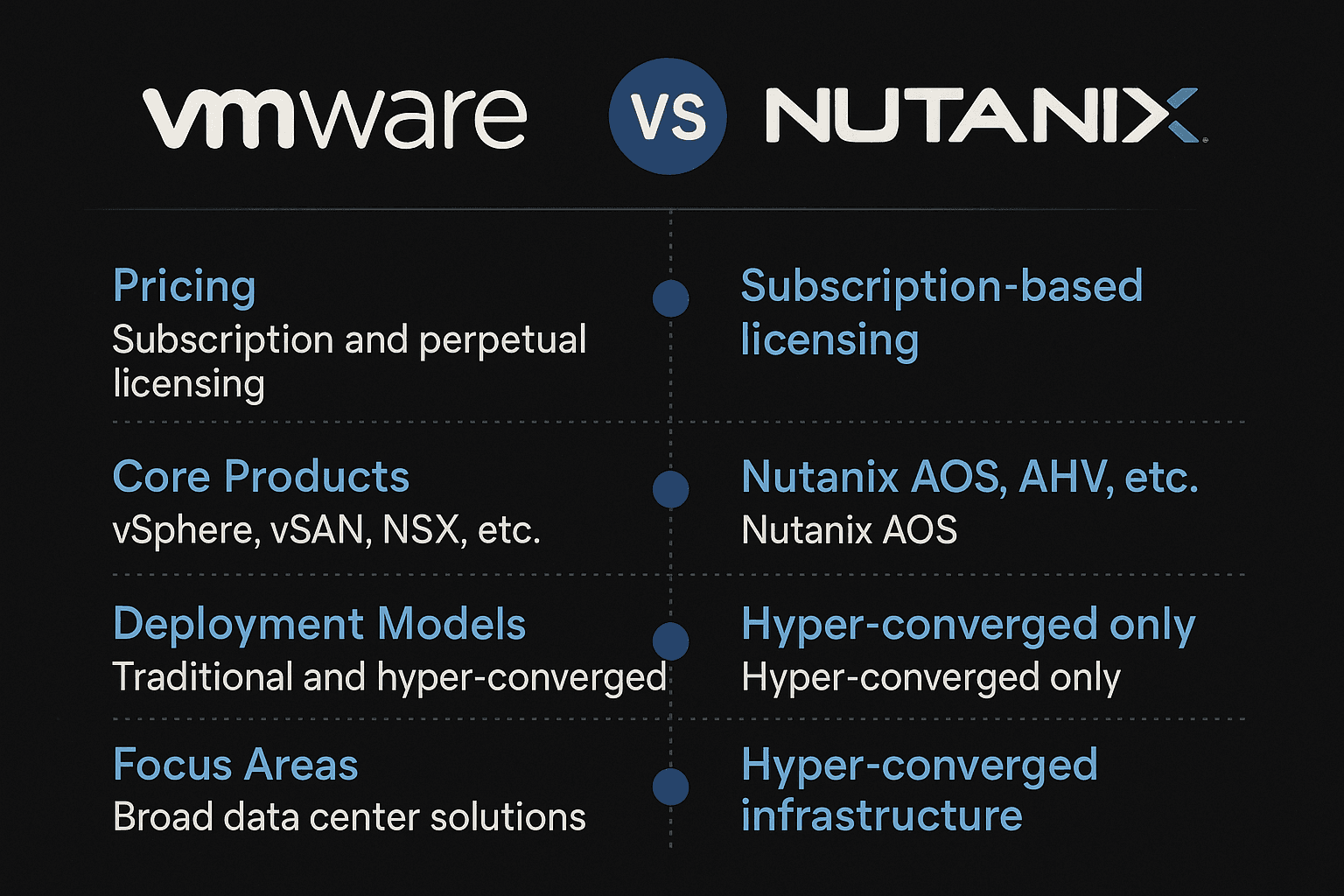
| Category | VMware | Nutanix |
| Core Architecture | Hypervisor-based (ESXi) with vSphere, vCenter | Hyperconverged Infrastructure (HCI) with integrated compute, storage, and networking |
| Management Tools | GUI-driven management (vCenter, vSphere) | Centralized management through Nutanix Prism |
| Licensing | Subscription-based pricing, higher total cost of ownership | Subscription-based, but more cost-effective with simplified infrastructure management |
| Support for Modern Apps | Limited native container support (via Tanzu or external tools) | Native support for Kubernetes, containers, and cloud-native workloads |
| Storage Integration | vSAN or external SAN/NAS for storage | Integrated storage with Nutanix Distributed Storage Fabric (DSF) |
| Cloud Integration | Multi-cloud integration available through VMware Cloud Foundation | Native integration with AWS, Azure, Google Cloud, and hybrid cloud setups |
Running Postgres on VMware vs Nutanix
Both VMware and Nutanix can host PostgreSQL, but their approaches to infrastructure and storage differ significantly. With VMware, Postgres typically runs inside virtual machines, where storage is tied to the VMware ecosystem, often leveraging vSAN or external SAN/NAS for persistent storage. In contrast, Nutanix, built on hyperconverged infrastructure (HCI), integrates compute, storage, and networking, using its Distributed Storage Fabric (DSF) for seamless scalability and performance.
If Postgres is a core workload, it’s often more effective to use a platform designed to handle it with ease. Vela by Simplyblock, built for Kubernetes, offers high-performance PostgreSQL with built-in automation, backups, and scaling, bridging both VMware and Nutanix environments seamlessly.
Simplyblock’s Versatility in Supporting VMware and Nutanix
Managing storage across both VMware and Nutanix can present unique challenges, particularly when scaling, integrating, and ensuring consistency across hybrid environments. Both platforms have different approaches to storage, but Simplyblock offers a unified solution that works seamlessly with both.
Storage in VMware Environments
VMware typically relies on vSAN for integrated storage, which, while effective, can introduce challenges when scaling and maintaining flexibility.
- vSAN ties storage to specific hardware and scaling requirements
- Expensive licensing costs as you expand storage capacity
- Storage scaling often requires scaling compute resources simultaneously
- Tightly coupled infrastructure that limits flexibility in mixed environments
Storage in Nutanix Clusters
Nutanix simplifies storage with its Distributed Storage Fabric (DSF), but it still has its own set of complexities.
- Integrated storage with compute in an HCI environment
- Designed for cloud-native workloads but may require tuning for stateful applications
- Scaling can be done independently of compute, but still requires careful capacity planning
- Performance can vary based on underlying hardware and network infrastructure
Why Simplyblock Is the Solution You Need
Simplyblock’s software-defined storage solution works across both VMware and Nutanix environments, eliminating the pain points associated with traditional or complex storage setups.
- NVMe-over-TCP architecture for high-speed, low-latency storage
- Compatible with both VMware vSphere and Nutanix clusters via CSI drivers
- Provides a consistent storage layer for hybrid or multi-cloud workloads
- Supports snapshots, replication, and multi-tenant QoS for persistent workloads like Postgres, Kafka, and more
When to Use VMware, Nutanix, or a Combination of Both
Choosing between VMware and Nutanix depends on your organization’s specific infrastructure needs.
- Use VMware if you need a mature, enterprise-grade platform that offers deep integrations with legacy systems.
- Use Nutanix if you’re focused on modernizing infrastructure with hyperconverged infrastructure (HCI), cloud-native workloads, and simplified management.
- Use both when transitioning from one platform to another or when your environment requires the flexibility of both legacy and modern workloads running side-by-side.
Simplyblock provides a consistent, high-performance storage layer that works seamlessly across both VMware and Nutanix, making it the ideal solution for hybrid or mixed infrastructure environments.
See other comparisons :
Take a look at how these platforms measure up:
Questions and answers
VMware uses a traditional hypervisor-based architecture with separate components for compute, network, and storage. In contrast, Nutanix offers hyperconverged infrastructure (HCI), where compute, storage, and networking are integrated into a single platform. Nutanix is designed to simplify management and scale more easily, making it ideal for cloud-native workloads, while VMware excels in traditional, enterprise-grade environments.
Nutanix is built for hybrid and multi-cloud environments and is designed to support modern workloads like containers and microservices. It integrates natively with public clouds like AWS, Azure, and Google Cloud, and offers strong automation and Kubernetes support, making it a good fit for organizations adopting DevOps and cloud-native strategies.
While VMware offers enterprise-grade virtualization, it struggles to keep up with cloud-native workloads. It has limited native support for containers and Kubernetes, and scaling compute and storage together can be rigid and costly. Additionally, VMware’s licensing model, especially after the Broadcom acquisition, has raised concerns due to increasing costs for scaling infrastructure.
Simplyblock provides a unified, software-defined storage solution that works seamlessly across both VMware and Nutanix environments. It addresses the pain points of both platforms’ storage approaches by offering high-performance, low-latency NVMe-over-TCP storage and supports hybrid or multi-cloud workloads, ensuring consistency in both environments.
VMware relies heavily on vSAN for storage, which ties storage to specific hardware, making it difficult to scale independently. Nutanix offers a more flexible, distributed storage fabric but requires careful capacity planning. Simplyblock overcomes these limitations by offering a unified storage solution that works across both VMware and Nutanix clusters, supporting scaling, snapshots, replication, and multi-tenant quality of service (QoS) for persistent workloads.