
Table Of Contents
- VMware – Traditional Virtualization at Scale
- OpenShift – Container-Native Infrastructure for Modern Teams
- VMware vs OpenShift – What You Should Know
- Running Postgres on VMware vs OpenShift
- Where Storage Becomes a Problem – And How Simplyblock Solves It
- When to Use VMware, OpenShift — or Both
- See Other Comparisons:
- Questions and answers
Virtual machines and containers solve different problems, but many teams still weigh VMware and OpenShift side by side. One powers traditional infrastructure, the other fuels modern application delivery — and choosing between them isn’t always straightforward.
With licensing shifts, rising costs, and evolving workloads, companies are reevaluating how they build and run systems — often searching for a VMware alternative that better aligns with modern needs. This breakdown covers how VMware and OpenShift differ, where each fits best, and how Simplyblock supports both with fast, flexible storage across mixed environments.
VMware – Traditional Virtualization at Scale
VMware has long been the backbone of enterprise virtualization. It enables organizations to run multiple virtual machines on a single physical host, centralizing control across compute, storage, and networking layers.
While trusted for its maturity, the platform’s high licensing costs and tight infrastructure coupling have made it less attractive for teams exploring cloud-native approaches or evaluating a VMware replacement to reduce long-term costs and gain flexibility.
🚀 Rethink VMware Storage Without vSAN Lock-In
Simplyblock delivers fast NVMe-over-TCP block storage that works out of the box for teams facing vSAN replacement issues.
👉 Simplyblock for VMware environments
What VMware Handles Well
VMware was designed to virtualize infrastructure and centralize control for compute, network, and storage across enterprise environments.
- Hypervisor-based architecture for running virtual machines efficiently
- Centralized infrastructure control through tools like vSphere and vCenter
- Supports HA, live migration, and enterprise workload isolation
- Integrates with storage (vSAN) and networking (NSX) layers
Why Teams Still Rely on It
Despite changing trends, VMware remains critical in environments that prioritize stability, compliance, and long-standing infrastructure maturity.
- Used in banks, telcos, and regulated industries
- Familiar tools and workflows for IT operations teams
- Easy to manage existing virtualized workloads at scale
- Strong vendor ecosystem and third-party integrations
Where VMware Starts to Struggle
Cost, complexity, and lack of native container support make VMware harder to justify as teams move toward modern infrastructure.
- Licensing costs continue to rise, especially after Broadcom acquisition
- vSAN introduces additional expense, often prompting search for a vSAN alternative
- Not built for DevOps, microservices, or CI/CD-first delivery
- Container support feels bolted-on compared to native platforms
OpenShift – Container-Native Infrastructure for Modern Teams
OpenShift is built on Kubernetes storage but goes further by bundling everything teams need to manage containerized applications at scale. It standardizes deployment, security, and lifecycle tooling in one platform.
Organizations adopting microservices and cloud-native patterns often choose OpenShift for its developer experience and built-in automation. It helps teams deliver software faster across environments without having to stitch tools together manually. It also simplifies OpenShift storage operations through CSI drivers and native Kubernetes integrations.
Built for Modern Application Delivery
OpenShift simplifies container orchestration with built-in components for scalable, secure, and repeatable deployments.
- Enterprise Kubernetes with native RBAC and policy controls
- GitOps-friendly workflows and integrated CI/CD pipelines
- Automatic scaling and self-healing workloads
- Works across multi-cluster and hybrid cloud setups
Why Engineering Teams Prefer It
Platform and DevOps teams value OpenShift for how it streamlines delivery and minimizes manual effort.
- Reduces infrastructure management overhead
- Standardizes developer workflows across environments
- Easily connects with observability and DevOps tooling
- Supports high-availability for stateful apps and services
Where OpenShift Delivers Best
OpenShift shines in modern environments that prioritize agility, automation, and portability.
- App modernization and digital transformation initiatives
- Microservice-based architectures and event-driven workloads
- Rapid CI/CD delivery pipelines
- Running data platforms like Postgres, Kafka, and Elasticsearch
VMware vs OpenShift – What You Should Know
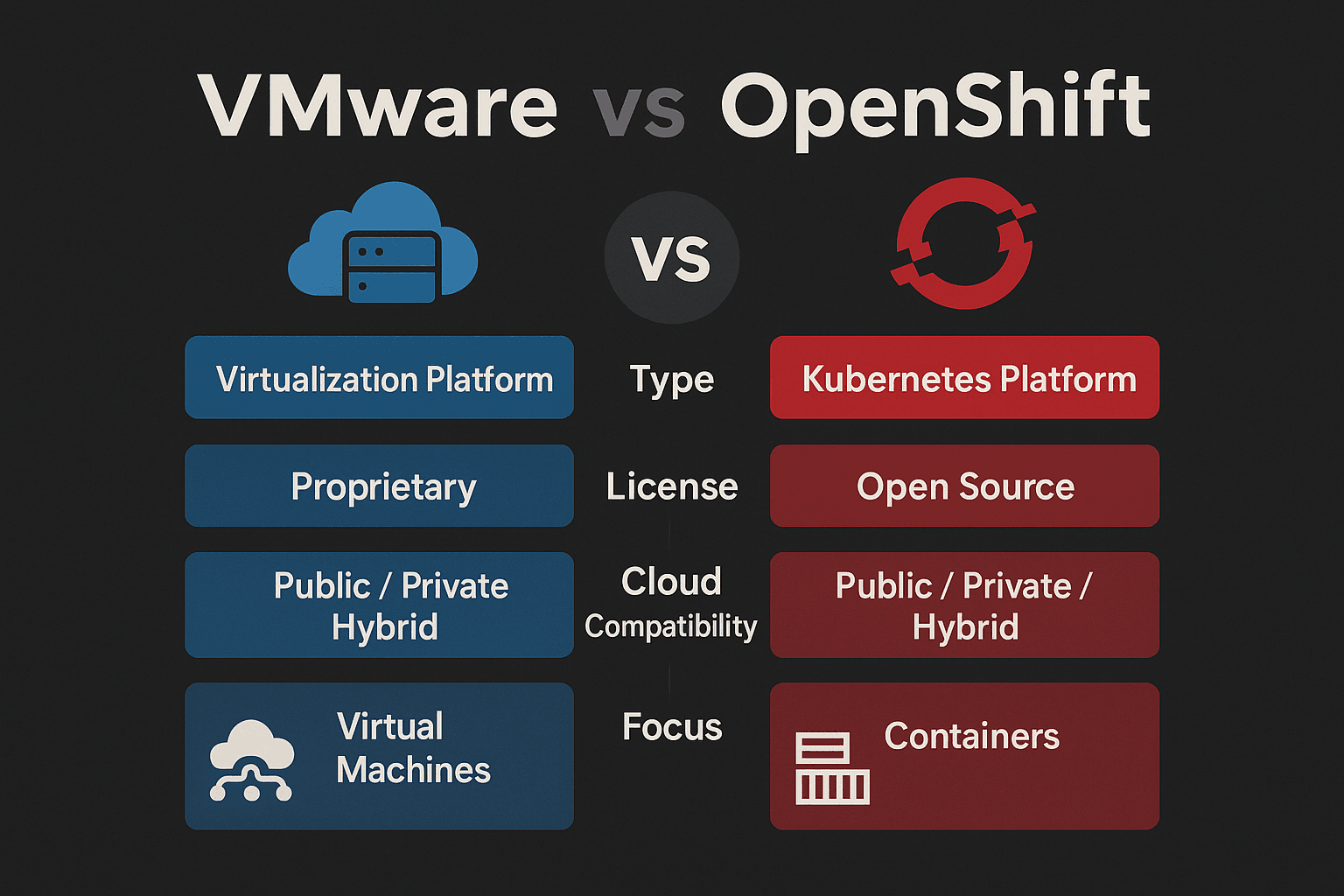
While VMware and OpenShift are both used to manage infrastructure, they operate at different layers and serve different goals. Here’s how they compare across key areas that matter to modern teams:
| Category | VMware | OpenShift |
| Core Purpose | Virtual machine orchestration and infrastructure control | Containerized application delivery and DevOps automation |
| Architecture | Hypervisor-based (vSphere, ESXi) | Kubernetes-based with additional enterprise features |
| Layer of the Stack | IaaS (Infrastructure as a Service) | PaaS / Developer platform built on Kubernetes |
| Primary Users | IT ops, sysadmins, infrastructure engineers | DevOps, developers, platform engineers |
| Scalability Model | Scales via VMs and hosts | Scales via containers and Kubernetes clusters |
| Storage Approach | vSAN or external block storage tied to VMs | CSI-compatible block storage for containers |
| Modern Fit | Suited for legacy apps, on-prem data centers | Ideal for microservices, CI/CD, and hybrid cloud environments |
Running Postgres on VMware vs OpenShift
Both VMware and OpenShift can host PostgreSQL. With VMware you typically run Postgres in VMs; with OpenShift you use operators and StatefulSets to run it as a containerized service.
If Postgres is the main workload you care about, it’s often easier to treat it as a platform rather than something you hand-roll on top of your virtualization choice. Vela is a Postgres platform by Simplyblock that runs on Kubernetes, giving you high-performance PostgreSQL with automation, backups, and scaling built in.
Where Storage Becomes a Problem – And How Simplyblock Solves It
Both VMware and OpenShift rely heavily on storage — but in very different ways. This makes managing performance, cost, and scaling difficult, especially when running them side by side.
From virtual machine disk provisioning to Kubernetes persistent storage for containers, teams often find themselves juggling fragmented tools and infrastructure. Simplyblock solves this with one software defined block storage layer that works for both platforms.
Storage in VMware Environments
Storage is tightly coupled with the virtualization layer, which can make scaling and flexibility expensive and complex.
- Built around vSAN, which adds cost and hardware lock-in
- Scaling often requires expanding both compute and storage at once
- Limited flexibility in cloud-native or container-first scenarios
- Performance tuning often depends on proprietary stack integrations
Storage in OpenShift Clusters
OpenShift uses Kubernetes’ CSI drivers to manage persistent storage for containerized apps — which requires fast, dynamic, and scalable infrastructure.
- Needs block storage that can keep up with dynamic pods and volumes
- Stateful apps like Postgres, Kafka, and Elasticsearch demand low latency
- Storage must scale independently from compute
- Complex setups when managing hybrid or multi-cloud deployments
How Simplyblock Supports Both Approaches
Simplyblock unifies storage across VM and container platforms with software-defined performance, simplicity, and flexibility.
- NVMe-over-TCP with ultra-low latency and high IOPS
- Thin provisioning, snapshots, replication, and multi-tenant QoS
- Fully compatible with vSphere, OpenShift, and Kubernetes CSI
- Works across on-prem, hybrid, and cloud environments
When to Use VMware, OpenShift — or Both
Every infrastructure team makes decisions based on workload needs, tooling, and where they are in their modernization journey.
- VMware is a fit when virtual machines remain central to your stack, especially in environments that require stability, tight access control, or regulatory alignment.
- OpenShift is built for teams that ship software fast — it supports container-native apps, automation, and cloud portability.
When both platforms are in play, simplyblock offers a shared, high-performance storage layer that supports both VM and container workloads without extra overhead.
See Other Comparisons:
Take a look at how these platforms measure up:
Questions and answers
VMware is focused on virtualization, managing virtual machines (VMs) for a wide range of workloads. OpenShift, on the other hand, is a container orchestration platform designed for deploying, managing, and scaling containerized applications, offering better scalability, flexibility, and management of cloud-native and microservices-based environments.
VMware scales virtual machines through its vSphere and vSAN technologies. These tools allow organizations to virtualize servers, storage, and networking, providing robust infrastructure management. VMware’s approach to scaling focuses on VM provisioning, orchestration, and resource allocation, but it can become complex and costly as workloads grow and demand flexibility.
OpenShift provides a containerized platform optimized for modern applications, offering high scalability, improved deployment speeds, and flexibility. Unlike VMware, OpenShift manages applications using Kubernetes, providing better orchestration and automation. This allows businesses to efficiently run cloud-native applications with reduced overhead and better resource utilization in dynamic environments.
OpenShift is ideal for modern workloads such as microservices-based applications, cloud-native applications, and those requiring rapid scaling and deployment. Its containerization model excels in environments with DevOps practices, CI/CD pipelines, and multi-cloud infrastructures. It provides the flexibility and performance needed for dynamic, highly available, and distributed applications in real-time.
VMware’s scaling challenges stem from managing legacy infrastructure and virtualized environments that may not handle modern cloud-native workloads efficiently. Issues include high resource consumption, complexity in managing large-scale VM environments, limited agility, and slower provisioning times, making it less ideal for modern, highly dynamic workloads in cloud environments.