MinIO Alternative
Software-Defined Storage with Lower TCO, No Vendor Lock-In, and Effortless Scalability
Teams typically start with MinIO for S3-compatible object storage. They look for alternatives to MinIO when licensing, operational friction, or workload mismatch becomes a blocker.Simplyblock is not “another object store.” It’s a modern, high-performance block storage platform designed for databases, Kubernetes, and IO-intensive workloads. And increasingly evaluated instead of MinIO when teams need predictable performance, open access, and lower long-term risk.
Challenges with MinIO

Licensing & openness concerns
Recent MinIO license changes have reduced confidence for teams that depend on long-term openness and unrestricted use, especially in commercial and managed environments.
Object storage is not ideal for all workloads
S3-compatible APIs work well for backups and data lakes, but introduce latency, complexity, and inefficiency for databases, VM disks, and stateful Kubernetes apps.
Operational friction at scale
Users report increased complexity when expanding clusters, tuning erasure coding, or operating MinIO reliably across large Kubernetes environments.
Free tier limitations
Key management and UI capabilities have been restricted, pushing many teams toward paid editions earlier than expected.
Built for Real Scalability and Simplicity
MinIO can slow down as clusters grow. Simplyblock™ scales linearly—add nodes in minutes and keep throughput steady. Expand to petabytes with built-in deduplication and compression, no downtime, and no hidden fees.
🔧 Deployment Comparison
Simplyblock is designed for flexible, cloud-native deployment:
- Hyper-converged: storage and workloads share the same nodes for maximum performance and locality
- Disaggregated: independent scaling of compute and storage
- Hybrid: combine both models in one cluster
MinIO is primarily deployed as a dedicated object storage cluster, which fits archive and backup use cases but is less flexible for mixed, performance-sensitive workloads and especially block-oriented ones.
🧱 Architecture Comparison
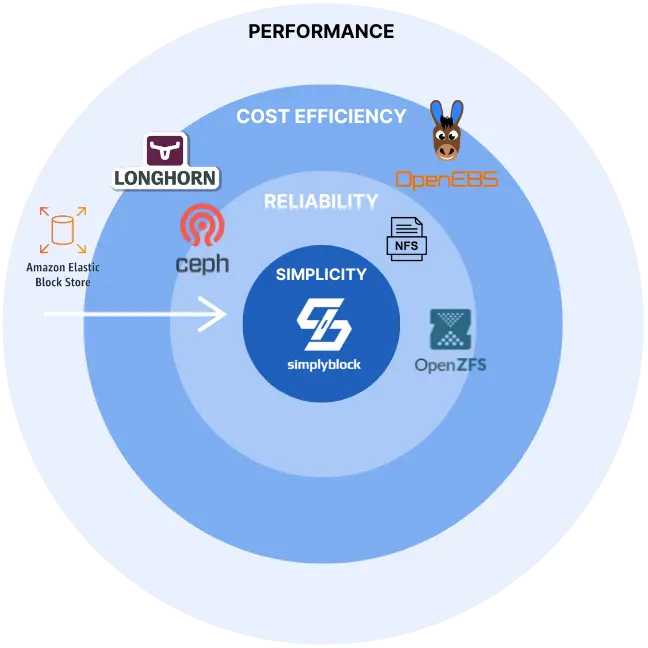
Simplyblock is software-defined storage tuned for NVMe and cloud-native workloads. Its advanced erasure coding cuts overhead while safeguarding data, and built-in multi-tenancy with QoS keeps each tenant on pace. Supports NVMe/TCP and NVMe/RoCEv2 and DPU/IPU offload.
MinIO, centered on S3-compatible object storage, shows slower speeds when drives or erasure-coding settings grow and often proves hard to scale and manage day to day.
Smarter Storage for Modern Infrastructures
Lower TCO for stateful platforms
Cuts TCO by using commodity hardware and removing high-cost licenses, support contracts, and vendor tie-ins.
Deployment Flexibility
Supports hyperconverged, disaggregated, and hybrid setups so you can scale and deploy storage your way.

Enhanced Data Protection
Erasure coding and self-healing ensure durability and availability with lower overhead than triple replication models.

High Performance at Scale
Delivers millions of IOPS per cluster and sub-millisecond latency through NVMe-over-TCP and SPDK-based I/O acceleration.
Simplyblock vs MinIO – Feature Comparison Table
| Simplyblock | MinIO | Details | |
|---|---|---|---|
| Hardware Independence |
 |
| Runs on any x86 or ARM64 server with no vendor lock-in or proprietary hardware requirements. |
| Multi-Tenant QoS |
|
 | Supports per-tenant limits and guarantees on IOPS, latency, and bandwidth for true isolation. |
| Kubernetes Native |
|
| Built to integrate with container-native workflows, scaling easily with Kubernetes. |
| Simple Management |
|
| Minimal overhead through containerized design and automated orchestration tools. |
| Hardware Independence | |
|
Simplyblock
|
MinIO |
| Runs on any x86 or ARM64 server with no vendor lock-in or proprietary hardware requirements. | |
| Multi-Tenant QoS | |
|
Simplyblock
|
MinIO |
| Supports per-tenant limits and guarantees on IOPS, latency, and bandwidth for true isolation. | |
| Kubernetes Native | |
|
Simplyblock
|
MinIO |
| Built to integrate with container-native workflows, scaling easily with Kubernetes. | |
| Simple Management | |
|
Simplyblock
|
MinIO |
| Minimal overhead through containerized design and automated orchestration tools. | |
| Simplyblock | MinIO | Details | |
|---|---|---|---|
| NVMe-over-TCP Support |
|
| NVMe-first architecture with SPDK ensures ultra-low latency and high IOPS per core. |
| Sub-ms Latency |
|
| Consistent 0.1ms response time, ideal for high-performance, IO-intensive workloads. |
| NVMe-over-TCP Support | |
|
Simplyblock
|
MinIO |
| NVMe-first architecture with SPDK ensures ultra-low latency and high IOPS per core. | |
| Sub-ms Latency | |
|
Simplyblock
|
MinIO |
| Consistent 0.1ms response time, ideal for high-performance, IO-intensive workloads. | |
| Simplyblock | MinIO | Details | |
|---|---|---|---|
| Erasure Coding |
|
| Both offer it, but erasure coding here is optimized for performance and storage efficiency. |
| Self-Healing Architecture |
|
| Automatically detects and recovers from disk or node failures without user intervention. |
| RPO-Optimized Recovery |
|
| Built-in write-ahead logging enables near-zero recovery point objectives for mission-critical data. |
| Erasure Coding | |
|
Simplyblock
|
MinIO |
| Both offer it, but erasure coding here is optimized for performance and storage efficiency. | |
| Self-Healing Architecture | |
|
Simplyblock
|
MinIO |
| Automatically detects and recovers from disk or node failures without user intervention. | |
| RPO-Optimized Recovery | |
|
Simplyblock
|
MinIO |
| Built-in write-ahead logging enables near-zero recovery point objectives for mission-critical data. | |
| Simplyblock | MinIO | Details | |
|---|---|---|---|
| Low TCO |
|
| Uses standard hardware, no licensing traps, and lowers overall storage spend. |
| Automated Storage Tiering |
|
| Moves infrequently accessed data to cost-efficient object or HDD tiers with zero manual steps. |
| Low TCO | |
|
Simplyblock
|
MinIO |
| Uses standard hardware, no licensing traps, and lowers overall storage spend. | |
| Automated Storage Tiering | |
|
Simplyblock
|
MinIO |
| Moves infrequently accessed data to cost-efficient object or HDD tiers with zero manual steps. | |
| Simplyblock | MinIO | Details | |
|---|---|---|---|
| Hardware Independence |
|
| Runs on any x86 or ARM64 server with no vendor lock-in or proprietary hardware requirements. |
| Multi-Tenant QoS |
|
| Supports per-tenant limits and guarantees on IOPS, latency, and bandwidth for true isolation. |
| Kubernetes Native |
|
| Built to integrate with container-native workflows, scaling easily with Kubernetes. |
| Simple Management |
|
| Minimal overhead through containerized design and automated orchestration tools. |
| Simplyblock | MinIO | Details | |
|---|---|---|---|
| NVMe-over-TCP Support |
|
| NVMe-first architecture with SPDK ensures ultra-low latency and high IOPS per core. |
| Sub-ms Latency |
|
| Consistent 0.1ms response time, ideal for high-performance, IO-intensive workloads. |
| Simplyblock | MinIO | Details | |
|---|---|---|---|
| Erasure Coding |
|
| Both offer it, but erasure coding here is optimized for performance and storage efficiency. |
| Self-Healing Architecture |
|
| Automatically detects and recovers from disk or node failures without user intervention. |
| RPO-Optimized Recovery |
|
| Built-in write-ahead logging enables near-zero recovery point objectives for mission-critical data. |
| Simplyblock | MinIO | Details | |
|---|---|---|---|
| Low TCO |
|
| Uses standard hardware, no licensing traps, and lowers overall storage spend. |
| Automated Storage Tiering |
|
| Moves infrequently accessed data to cost-efficient object or HDD tiers with zero manual steps. |