
Crunchy Postgres delivers a production-grade, Kubernetes-native PostgreSQL experience with built-in HA, backups, and security features. But as workloads scale and architectures grow more complex, storage becomes the limiting factor—especially when dealing with performance-heavy, multi-zone environments.
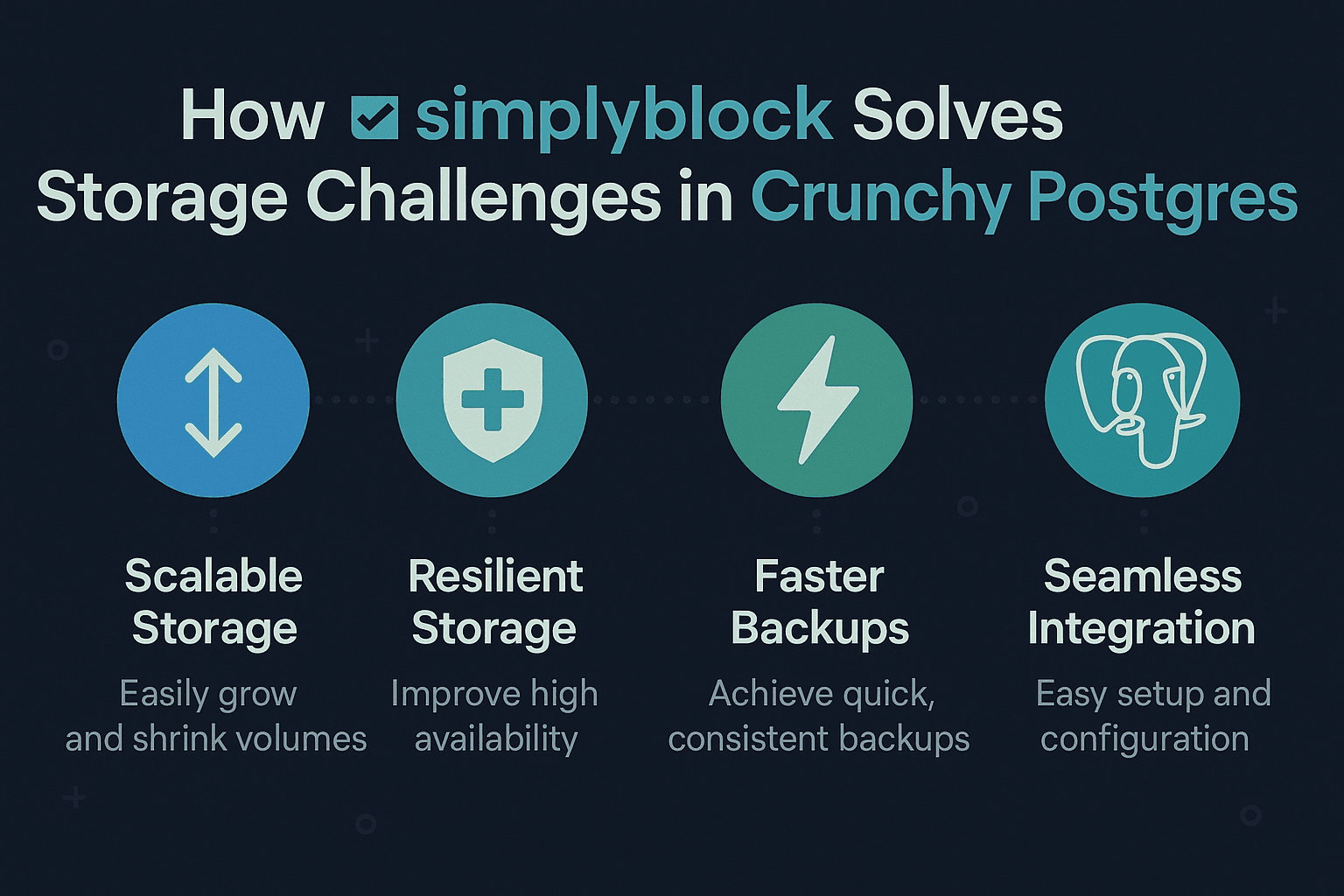
Simplyblock decouples storage from zone constraints, delivers NVMe-level IOPS, and simplifies management through flexible, software-defined volumes. It’s an ideal match for Crunchy Postgres users who need consistent durability, fast failover, and elastic scaling without the hassle of traditional cloud volumes.
Why Crunchy Postgres Deployments Need Better Storage
While Crunchy Postgres handles container orchestration and high availability well, the default storage setup often struggles with scaling and failover. EBS volumes, for example, are tied to zones and can be slow to recover or resize.
Simplyblock removes those limits by offering fast, zone-independent block storage over NVMe-TCP. This unlocks use cases like databases-as-a-service and analytics workloads where fast write speeds and recovery times matter most.
🚀 Run PostgreSQL at Scale with Better Storage
Move past EBS limits with fast, flexible volumes for Crunchy Postgres.
👉 Simplyblock Backing for Kubernetes Storage
Step 1: Provision Simplyblock Volumes for Crunchy Data
To start, create a simplyblock pool and volume:
sbctl pool create pg-pool /dev/nvme0n1
sbctl volume add crunchy-volume 100G pg-pool
sbctl volume connect crunchy-volume
Then, mount it for PostgreSQL:
mkfs.ext4 /dev/nvme0n1
mkdir -p /var/lib/postgresql
mount /dev/nvme0n1 /var/lib/postgresqlFor more details, refer to the simplyblock Documentation.
Step 2: Attach and Mount Simplyblock on Postgres Nodes
Verify the volume has been properly connected:
lsblk
df -h
When deploying in Kubernetes, make sure your storage class reflects simplyblock’s CSI integration. If you’re mounting manually, make it persistent via /etc/fstab. This setup also applies well in Kubernetes storage environments.
For a comparison against common alternatives, see how simplyblock compares to Ceph.
Step 3: Configure Crunchy Postgres to Use Simplyblock Volumes
If you’re deploying via the CrunchyData Postgres Operator, edit your pgcluster spec to include the simplyblock-backed StorageClass:
spec:
storage:
storageClassName: simplyblock-fast
size: 100Gi
This ensures Crunchy Postgres instances are provisioned with simplyblock volumes. You can manage these deployments through the CrunchyData Postgres Operator, which provides automation for HA, upgrades, and backups.
Step 4: Monitor, Resize, and Stay Ahead of Growth
Monitoring storage usage is simple with:
sbctl stats
When more space is needed, expand the volume without disrupting your PostgreSQL pods:
sbctl volume resize crunchy-volume 200G
resize2fs /dev/nvme0n1
This flexibility helps reduce downtime and supports cloud cost optimization and AWS storage tiering by allocating exactly the capacity you need.
For Postgres-level tuning, refer to the official PostgreSQL Performance Tips.
Step 5: Align Crunchy Postgres with Multi-Zone Availability
Crunchy Postgres is often deployed in high-availability topologies, but if the storage layer is tied to a zone, failover can be delayed or even blocked.
Simplyblock solves this by enabling zone-independent volumes that stay consistent even across availability zones. Replication and rebalancing are faster, and RPO/RTO targets are easier to meet—especially in use cases focused on reduction of RPO and RTO.
Ensuring Smooth Scale with Simplyblock and Crunchy Postgres
Crunchy Postgres simplifies Kubernetes-native database operations, but simplyblock ensures your storage can keep up. With fast IOPS, live resizing, and support for multi-zone replication, simplyblock adds durability and flexibility to your Postgres environment—without complex manual storage work.
This pairing ensures your stateful workloads scale cleanly, recover quickly, and remain portable across infrastructure.
Other supported platforms
If you’re running cloud-native PostgreSQL platforms or operators alongside Crunchy Postgres, Simplyblock also strengthens storage for:
Questions and Answers
Crunchy Postgres workloads often involve high-volume transactional writes and complex analytical queries. Simplyblock NVMe over TCP storage boosts I/O performance, reducing latency for both reads and writes, ensuring Crunchy Postgres maintains high throughput even under heavy workloads.
Yes, Crunchy Postgres relies on synchronous and asynchronous replication for high availability. Simplyblock accelerates replication by providing fast NVMe volumes, ensuring minimal lag between primary and standby nodes.
Scaling Crunchy Postgres usually requires careful storage management and balancing multiple volumes. Simplyblock allows dynamic provisioning of NVMe-backed volumes, making it easy to add nodes or scale storage without downtime. Learn more about scaling databases on Kubernetes in Kubernetes Stateful Workloads.
Yes, simplyblock reduces overprovisioning and automates tiering to cut costs while maintaining high performance. It ensures storage is efficiently allocated based on workload needs.
To deploy Crunchy Postgres with simplyblock, attach NVMe over TCP volumes or configure a Kubernetes StorageClass for persistent storage. Simplyblock manages replication, snapshots, and failover automatically.