
MariaDB is a popular open-source relational database used for transactional and analytical workloads. It is chosen for its performance, MySQL compatibility, and scalability. However, the efficiency of MariaDB deployments depends heavily on the underlying storage layer. Without reliable storage, large queries, replication, and backups can lead to performance bottlenecks.
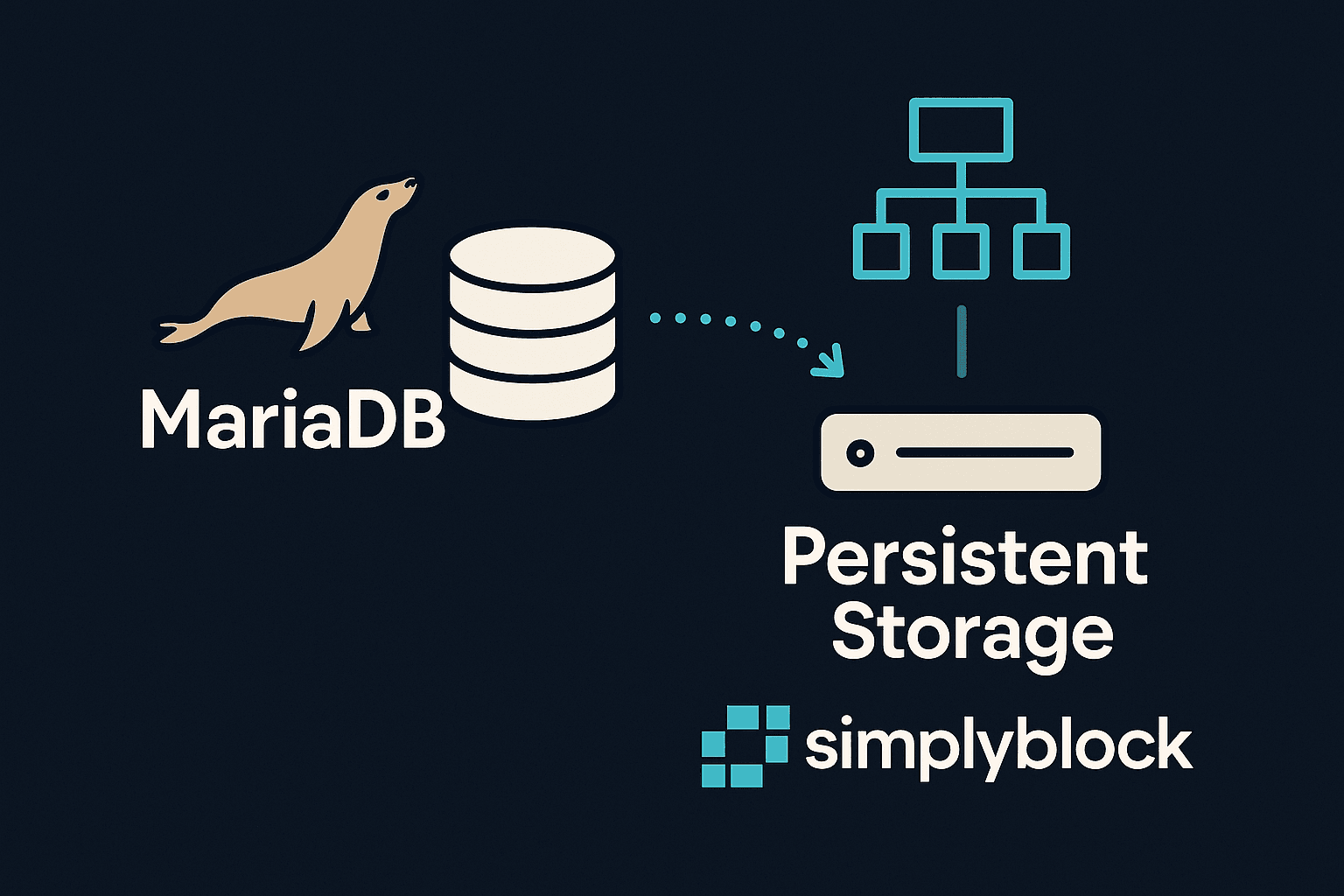
Simplyblock provides NVMe-over-TCP storage and zone-independent volumes that allow MariaDB to scale effectively while ensuring durability. This combination makes it easier to maintain predictable performance even during peak workloads.
Storage Pressures in MariaDB
MariaDB supports features like replication, Galera clusters, and parallel query execution, all of which depend on consistent storage performance. If storage is slow, replication delays increase, and query throughput drops.
With simplyblock, MariaDB clusters gain access to high-throughput volumes that reduce I/O bottlenecks and keep replication stable. Zone independence further ensures that storage remains available during failovers or rescheduling events.
🚀 Use simplyblock with MariaDB for Reliable Storage
Simplyblock ensures durable and scalable storage performance for MariaDB deployments of any size.
👉 Use simplyblock for Database Performance Optimization →
Step 1: Provisioning Volumes for MariaDB
To begin, create a simplyblock pool and volumes for storing MariaDB data files:
sbctl pool create mariadb-pool /dev/nvme0n1
sbctl volume add mariadb-store 100G mariadb-pool
sbctl volume connect mariadb-store
Format and mount the volume:
mkfs.ext4 /dev/nvme0n1
mkdir -p /var/lib/mysql
mount /dev/nvme0n1 /var/lib/mysql
Add it to /etc/fstab:
/dev/nvme0n1 /var/lib/mysql ext4 defaults 0 0
Step 2: Configuring MariaDB to Use Simplyblock Volumes
Point MariaDB to the simplyblock-backed storage by updating its configuration:
In /etc/my.cnf:
[mysqld]
datadir=/var/lib/mysql
innodb_flush_method=O_DIRECT
Restart MariaDB:
sudo systemctl restart mariadb
Further options are available in the MariaDB configuration guide.
Step 3: Expanding Storage for MariaDB Tables
As data grows, simplyblock makes it possible to expand volumes seamlessly:
sbctl volume resize mariadb-store 200G
resize2fs /dev/nvme0n1
This ensures tables and indexes can continue to grow without downtime. Scaling storage aligns well with database-as-a-service use cases, where dynamic expansion is critical.
Step 4: Zone-Independent MariaDB Clusters
MariaDB Galera clusters and replication setups often span multiple zones for fault tolerance. Traditional storage tied to a single zone can become a limiting factor during failovers. Simplyblock eliminates this issue by offering zone-independent volumes that remain available across zones.
This also aligns with enterprise recovery requirements, such as fast backups and disaster recovery.
Step 5: Replicating MariaDB Storage for High Availability
For enterprise-grade durability, simplyblock enables storage-level replication in addition to MariaDB’s own replication:
sbctl volume replicate mariadb-store –zones=zone-a,zone-b
This combination ensures minimal RPO and RTO. More details on clustering are covered in the MariaDB Galera Cluster documentation.
MariaDB Storage for Large Deployments
At enterprise scale, MariaDB requires not just performance but simplified operations. Simplyblock enables administrators to provision, resize, and replicate volumes with a single CLI, reducing operational overhead.
Features like migration from Amazon RDS to PostgreSQL highlight how simplyblock supports database flexibility. Technical guidance for large deployments is documented in the simplyblock Documentation.
Questions and Answers
Simplyblock accelerates MariaDB by providing low-latency, NVMe-based storage that boosts IOPS and throughput. This results in faster query execution, improved concurrency, and reliable performance even under heavy workloads.
Yes, simplyblock enables MariaDB clusters to use durable, replicated storage volumes that ensure high availability and consistent performance. Its software-defined storage approach simplifies scaling without vendor lock-in.
Absolutely. With features like synchronous replication, encryption-at-rest, and instant snapshots, simplyblock makes MariaDB reliable for enterprise production environments where downtime and data loss must be minimized.
Standard cloud-native disks often suffer from inconsistent performance. Simplyblock offers more predictable throughput, better latency, and greater flexibility for MariaDB, especially in hybrid and multi-cloud deployments.
Simplyblock allows MariaDB to run seamlessly across private, public, or hybrid clouds. Its Amazon EBS volume consolidation capabilities reduce costs while delivering high performance and resilience for persistent storage.