
MinIO is a high-performance object storage system designed for unstructured data, compatible with the Amazon S3 API. It is widely used for cloud-native applications, machine learning pipelines, and analytics workloads. While MinIO is lightweight and fast, its durability and scalability depend heavily on the storage backend.
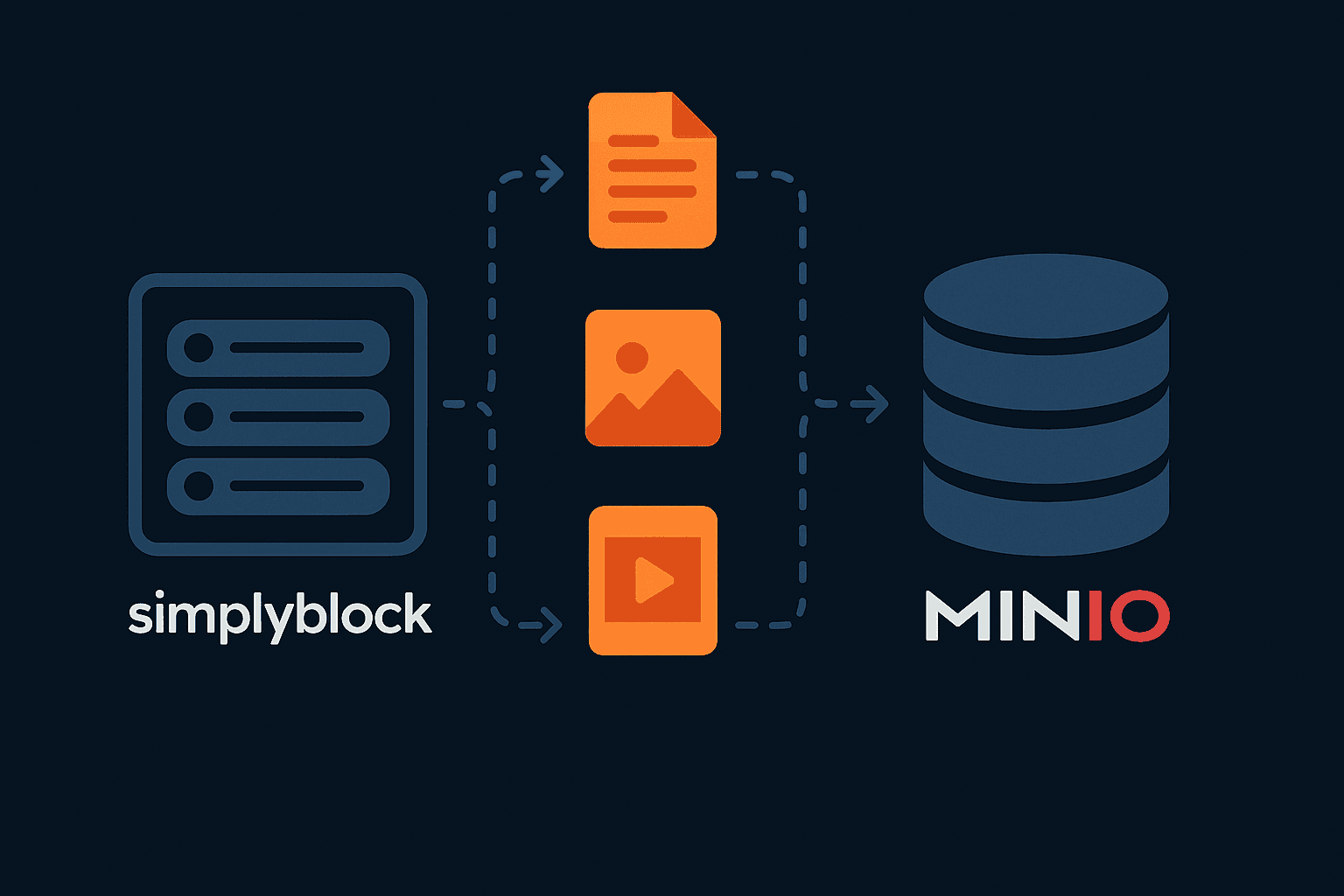
Simplyblock provides NVMe-over-TCP storage with zone independence, allowing MinIO deployments to scale easily while ensuring reliable access to objects across nodes and zones.
MinIO Operations and Storage Essentials
MinIO is often deployed as a distributed cluster. Each node requires durable storage for buckets and metadata. If the storage layer is slow or restricted to a single zone, it can cause replication delays, longer recovery times, and inconsistent performance.
With simplyblock, volumes provide high throughput and remain accessible across availability zones. This ensures MinIO clusters stay responsive and resilient even during node rescheduling.
🚀 Use simplyblock with MinIO for Object Storage Durability
Simplyblock provides reliable, zone-independent volumes for scaling MinIO clusters.
👉 Use simplyblock for Kubernetes Backup →
Step 1: Provisioning Volumes for MinIO
Begin by creating and mounting a simplyblock volume to store MinIO objects:
sbctl pool create minio-pool /dev/nvme0n1
sbctl volume add minio-data 500G minio-pool
sbctl volume connect minio-data
Format and mount the volume:
mkfs.ext4 /dev/nvme0n1
mkdir -p /var/lib/minio
mount /dev/nvme0n1 /var/lib/minio
Persist the mount in /etc/fstab:
/dev/nvme0n1 /var/lib/minio ext4 defaults 0 0
Step 2: Setting Up MinIO with Simplyblock
Configure MinIO to use the mounted directory for storage. Example startup command:
minio server /var/lib/minio –console-address “:9001”
This ensures that buckets and metadata are persisted on simplyblock volumes. For additional options, refer to the MinIO quickstart guide.
Step 3: Expanding Storage for Growing Buckets
As object data grows, volumes may need expansion. Simplyblock allows resizing without downtime:
sbctl volume resize minio-data 1T
resize2fs /dev/nvme0n1
This flexibility supports MinIO clusters handling large workloads such as cloud-native storage deployments.
Step 4: Zone Independence for MinIO Clusters
MinIO typically replicates data across nodes, but if storage is tied to one zone, failovers become complex. Simplyblock solves this with zone-independent volumes, keeping buckets accessible across availability zones.
This directly improves availability and aligns with enterprise setups using hybrid multi-cloud storage.
Step 5: Replicating MinIO Storage with Simplyblock
Beyond MinIO’s built-in erasure coding, storage-level replication adds further resilience. With simplyblock:
sbctl volume replicate minio-data –zones=zone-a,zone-b
This combination ensures faster recovery during outages. Scaling strategies are explained in the MinIO distributed deployment guide.
Enterprise-Ready MinIO Storage Management
As MinIO clusters expand, operational simplicity becomes important. Simplyblock’s CLI-based management reduces complexity, allowing administrators to provision, resize, and replicate volumes quickly.
Capabilities such as cloud cost optimization and integrations with backup workflows make it easier to operate MinIO at enterprise scale. Technical documentation is available in the simplyblock Documentation.
Questions and Answers
Simplyblock accelerates MinIO by delivering NVMe-grade performance with ultra-low latency and high throughput. This ensures faster reads and writes for unstructured object data, making it ideal for analytics, AI/ML pipelines, and backups.
Yes, simplyblock supports cloud storage cost optimization by enabling intelligent tiering. This helps MinIO users balance performance and cost, especially when managing large volumes of object data across hybrid setups.
Absolutely. Simplyblock provides built-in replication, snapshots, and multi-tenant isolation. These features ensure MinIO deployments remain durable and resilient, even during failures in distributed or multi-node clusters.
Conventional cloud disks often introduce unpredictable latency under heavy object storage workloads. Simplyblock offers predictable NVMe performance, making MinIO clusters more consistent and reliable for real-time access to object data.
Simplyblock ensures that MinIO performs consistently across on-prem, private, and public cloud deployments. Its database performance optimization features make it ideal for enterprises running object storage at scale alongside analytics or database workloads.