
TimescaleDB is the leading choice for time-series data, combining a PostgreSQL foundation with the ability to scale efficiently for high-ingest applications. Widely used in IoT, monitoring, financial services, and other real-time analytics, it’s designed to handle high-volume data streams and complex queries. However, as data scales, storage performance becomes critical.
For real-time analysis of billions of time-series points, the storage must be fast, scalable, and consistent. Simplyblock delivers NVMe-over-TCP performance, live scalability, and zone-resilience, ensuring TimescaleDB remains fast and reliable at scale.
Optimizing TimescaleDB for High-Throughput Time-Series Data
Time-series data is unique. It’s typically written in large volumes at high speed, then queried for real-time analytics or historical patterns. TimescaleDB’s ability to scale seamlessly across time-series points makes it ideal for high-throughput workloads. However, its performance is only as good as the storage it relies on.
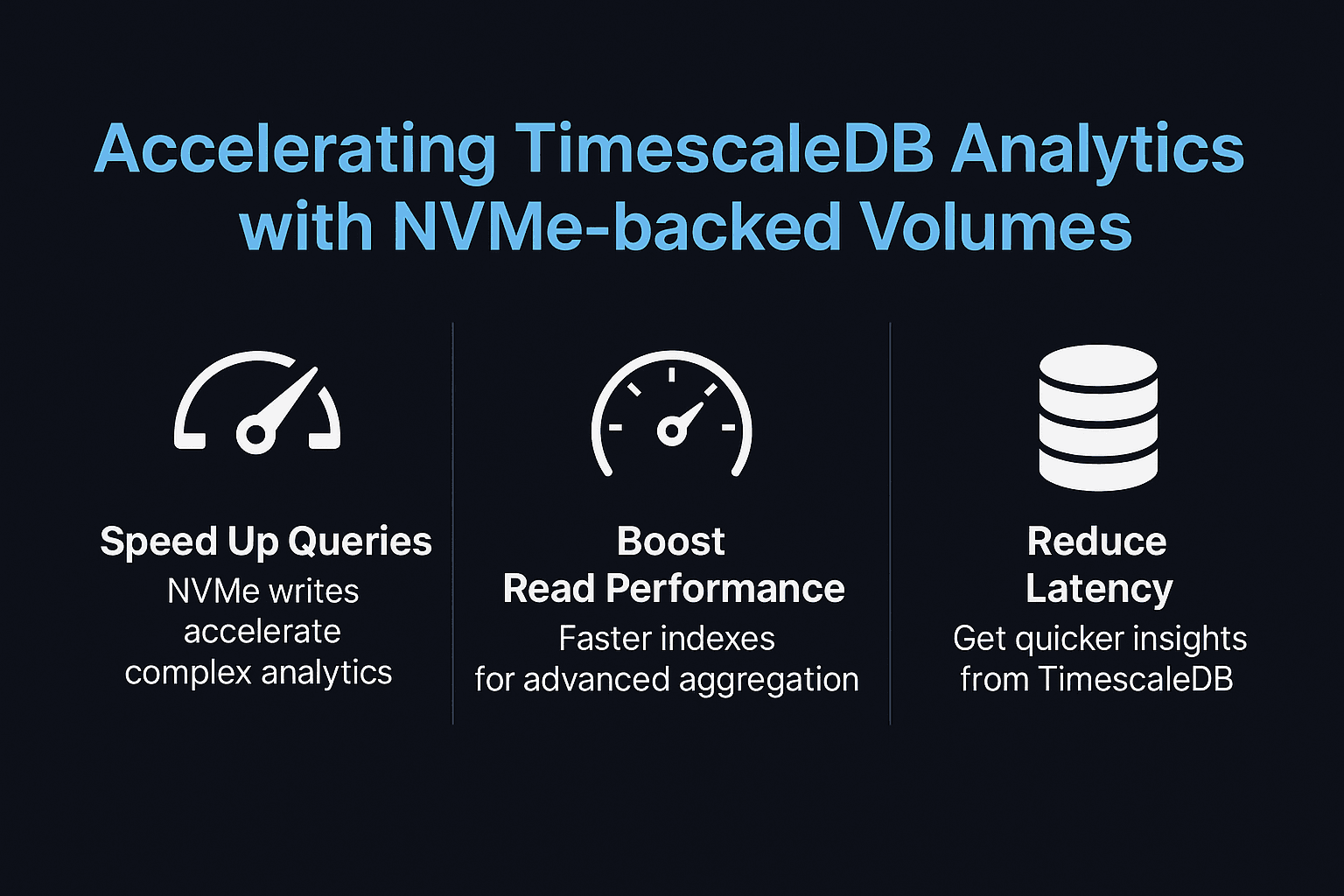
With simplyblock, you get NVMe-backed storage that ensures high-throughput writes and low-latency reads. This means TimescaleDB can process data at scale without experiencing slowdowns during high-volume ingestion or query-heavy workloads.
🚀 Use Simplyblock with TimescaleDB for Lightning-Fast Time-Series Analysis
Ensure your time-series data ingests, queries, and analyzes quickly and efficiently with simplyblock.
👉 Learn more about Disaggregated Storage with simplyblock →
Step 1: Provision Simplyblock Volumes for Time-Series Storage
For optimal performance, TimescaleDB data and time-series logs should be stored on high-performance volumes. Provisioning simplyblock NVMe-backed storage allows TimescaleDB to handle high write-throughput and large-scale queries seamlessly.
sbctl pool create –name ts-pool
sbctl volume create –pool ts-pool –size 1Ti –name ts-data
mkfs.ext4 /dev/simplyblock/ts-data
mount /dev/simplyblock/ts-data /var/lib/timescaledb/data
This setup ensures that the growing time-series data doesn’t choke storage performance, maintaining the speed and responsiveness necessary for real-time analytics.
Step 2: Maximize Query Performance on Large Time-Series Datasets
As datasets grow, querying them for historical trends and real-time analysis becomes more complex. TimescaleDB’s native indexing makes it efficient, but underlying storage must support it. On slow storage, time-series queries can become sluggish, especially when looking across large time spans or granular data.
Simplyblock removes these bottlenecks by delivering high IOPS and low-latency reads. Queries on massive time-series datasets stay fast and consistent, whether running simple aggregations or more complex joins.
For more on optimizing PostgreSQL, including how to size your database effectively, check out this PostgreSQL Performance Tuning Guide
Step 3: Scale Time-Series Data with Live Storage Expansion
One of the challenges of working with time-series data is the exponential growth. New devices, new streams, or more granular data increase storage needs rapidly. Traditional volumes require manual intervention to scale, often causing downtime.
Simplyblock allows you to resize volumes on the fly, which means TimescaleDB can scale storage as your data grows, without stopping production workloads.
sbctl volume resize –name ts-data –size 2Ti
resize2fs /dev/simplyblock/ts-data
This flexibility makes simplyblock’s NVMe storage ideal for disaggregated storage, where you can scale compute and storage independently, based on the size and needs of your time-series data.
Step 4: Ensure High-Availability for Continuous Analytics
Time-series applications often power mission-critical workloads like IoT monitoring, financial reporting, and real-time analytics. For these systems, downtime isn’t just an inconvenience — it’s a disruption.
Simplyblock volumes are zone-independent, meaning TimescaleDB deployments won’t experience disruptions due to rebalancing or failover events.. This zone resilience is essential for ensuring availability across cloud regions, as supported by hybrid multi-cloud storage.
For more detailed guidance on setting up high availability and replication in TimescaleDB, visit the TimescaleDB High Availability Documentation
Step 5: Run Real-Time Analytics with High-Performance Storage
Real-time analytics and time-series forecasting require uninterrupted data ingestion and query performance. On traditional storage, write-heavy workloads can introduce lag, slowing the ingestion process and, in turn, the real-time data analytics.
Simplyblock provides the performance necessary to keep analytics and ingesting workloads running in parallel. With NVMe performance and consistent storage, TimescaleDB can handle real-time analytics while ensuring that data is stored quickly and queried even faster.
For a deeper understanding of how TimescaleDB supports real-time analytics at scale, check out this Timescale Architecture for Real-Time Analytics.
Simplyblock and TimescaleDB for high-performance time-series storage
TimescaleDB is already built to scale and analyze massive time-series datasets, but it requires high-performance storage to deliver on its promise of real-time analytics and insights. Simplyblock removes the storage limitations that slow down ingestion and queries, making TimescaleDB faster, more efficient, and resilient.
Enterprises and developers can pair TimescaleDB with simplyblock to ensure performance, scalability, and availability for time-series data.
Other supported platforms
If you’re running enterprise or PostgreSQL-compatible workloads alongside TimescaleDB, Simplyblock also strengthens storage for:
Questions and Answers
Simplyblock’s NVMe-backed volumes dramatically improve TimescaleDB’s analytics performance by reducing storage latency. With high throughput and low-latency access, simplyblock ensures fast data processing for time-series data, enabling faster insights.
TimescaleDB’s time-series workloads demand high-performance storage. Simplyblock’s NVMe-oF storage enables fast, scalable data access, reducing query times and improving overall performance, especially when working with large-scale time-series datasets and real-time analytics.
Yes. Simplyblock integrates with Kubernetes for database workloads, providing persistent volumes with NVMe-backed storage. This ensures TimescaleDB’s time-series data is processed efficiently with high-speed storage, even during high-throughput queries and scaling operations.
Simplyblock advances TimescaleDB query performance with high-performance storage for database workloads. By minimizing latency and maximizing throughput, it speeds up aggregations and complex queries, ensuring faster data processing for analytics at scale.
Yes. Simplyblock’s cloud storage optimization delivers NVMe-level performance at a lower cost, outperforming traditional cloud-native storage. TimescaleDB benefits from faster queries, reduced latency, and improved scalability for time-series data analytics.