
Table Of Contents
Virtual machines have long dominated enterprise infrastructure, but many are rethinking what modern infrastructure should look like. As the shift toward Kubernetes-native environments accelerates and people look for VMware alternatives, tools like Talos are gaining traction for their lightweight, secure, and API-driven design.
This comparison looks at VMware — the established choice for VM orchestration — versus Talos, a minimal OS built for running Kubernetes clusters at scale. It explains how they differ, where each fits best, and how storage fits into both models.
VMware – A Legacy Powerhouse for Virtualization
VMware has been the go-to platform for running virtual machines in production for over two decades. It abstracts physical hardware, making infrastructure easier to manage, secure, and scale across environments.
But the way infrastructure is built is evolving. As more teams adopt container-native systems, VMware’s VM-heavy architecture is beginning to feel rigid. Operational costs, vendor lock-in, and cloud-native limitations have many teams reconsidering their long-term investments.
Running VMs at scale but stuck with costly vSAN or legacy licensing?
Simplyblock gives you high-performance, software-defined block storage that integrates with VMware — without hardware lock-in or rising costs.
👉 Simplyblock for VMware environments
What VMware Still Does Well
Despite the shift to containers, VMware remains a reliable option for virtual infrastructure with mature enterprise features.
- Proven hypervisor tech with strong workload isolation
- Centralized control of compute, networking, and storage
- Integrates well with tools like vCenter, NSX, and vSAN
- Widely adopted across industries with strict compliance needs
Why Some Teams Stick with It
Many large organizations still choose VMware because of familiarity, existing tooling, and the effort required to replatform.
- Decades of usage means built-in operational knowledge
- Works well for legacy applications not suited for containers
- Maintains uptime and system reliability
- Integrated ecosystem simplifies procurement and management
Where VMware Starts to Fall Short
VMware’s traditional approach can create friction in modern, fast-paced infrastructure workflows.
- Licensing changes and costs have increased post-Broadcom
- Not optimized for DevOps or GitOps-style automation
- Lacks native support for Kubernetes or container lifecycle
- Tightly coupled storage (vSAN) adds expense and complexity
Talos – A Kubernetes-First OS Built for Modern Infrastructure
Talos isn’t a general-purpose operating system — it’s engineered to run Kubernetes and nothing else. It removes unnecessary OS components, eliminates SSH access, and relies entirely on a declarative API for configuration.
For teams focused on cloud-native architecture, Talos simplifies the control plane, improves security, and reduces operational complexity. It’s designed to make Kubernetes feel less like a project and more like an appliance — with predictable, repeatable behavior at scale.
Core Principles Behind Talos Linux
Talos Linux takes a strict stance on security and simplicity, removing the attack surface and operational inconsistencies found in traditional operating systems.
- Immutable file system — no manual config drift
- No SSH, shell, or package manager access
- Managed via API or declarative YAML only
- Bootstrapped for Kubernetes out of the box
Where Talos Fits Best
Talos is a strong match for cloud-native teams who want to automate everything and eliminate OS-level variability.
- Ideal for managing secure, scalable Kubernetes nodes
- Great for edge, cloud, and air-gapped environments
- Reduces manual intervention across lifecycle events
- Enables clean GitOps pipelines with full OS control
What to Consider Before Adopting
Talos is highly opinionated — and teams used to traditional OS control may face a learning curve.
- No interactive shell access; debugging requires a different mindset
- Not suitable for VM-based workloads or legacy apps
- Requires infrastructure automation readiness
- Limited flexibility for mixed or transitional environments
VMware vs Talos Snapshot of Key Differences
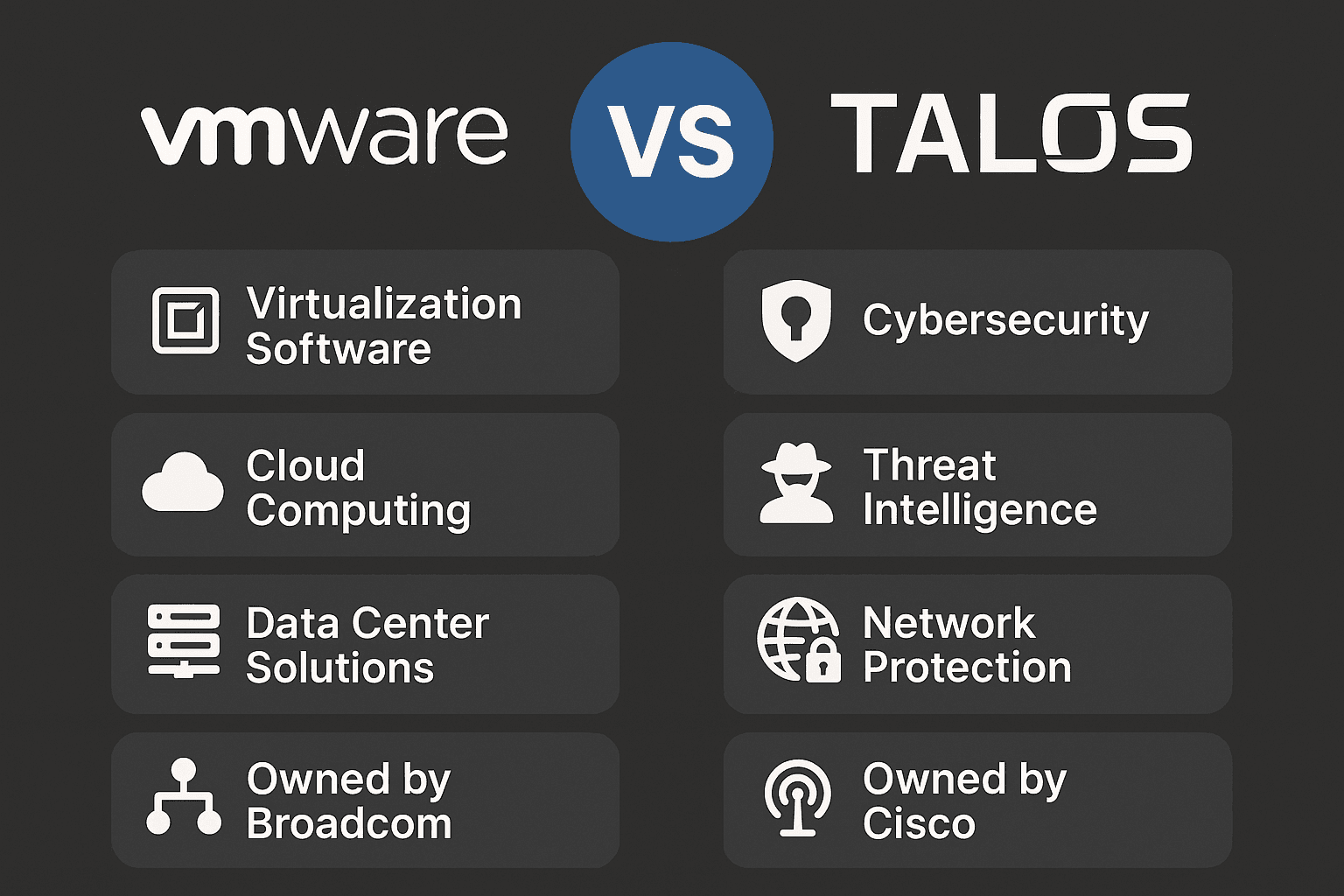
VMware and Talos sit on opposite ends of the infrastructure spectrum. One powers traditional virtualization with layered tooling; the other strips everything down for Kubernetes-native operations. If you’re looking for a VMware replacement built for containers, this breakdown helps clarify the trade-offs:
| Category | VMware | Talos Linux |
| System Type | Hypervisor-based virtualization platform | Minimal OS purpose-built for Kubernetes |
| Architecture | VM-first with GUI, shell access, and layered tooling | Immutable, API-driven, no shell or package manager |
| Primary Use Case | Legacy app hosting, enterprise virtualization | Running secure, automated Kubernetes clusters |
| Security Model | Traditional controls (RBAC, firewall, user access) | Locked down by default, minimal attack surface |
| Operational Model | Managed through vCenter, CLI, and GUI | Managed declaratively via YAML and Talos API |
| Kubernetes Support | Add-on integration via Tanzu or external tools | Native — boots directly into a Kubernetes-ready node |
| Best Fit For | Teams running VMs or migrating slowly to containers | Cloud-native teams needing lightweight, automated infrastructure |
Running Postgres on VMware vs Talos
Both VMware and Talos can host PostgreSQL. With VMware you typically run Postgres in VMs; with Talos you deploy it as a Kubernetes-native workload, leveraging operators and StatefulSets for automation and scalability.
If Postgres is the main workload you care about, it’s often easier to treat it as a platform rather than something you hand-roll on top of your infrastructure choice. Vela is a Postgres platform by Simplyblock that runs on Kubernetes, giving you high-performance PostgreSQL with automation, backups, and scaling built in.
How Simplyblock Fits Into Both Environments?
Whether you run virtual machines or Kubernetes-native clusters, storage is often the bottleneck. VMware bundles storage tightly with compute, while Talos expects external, container-aware volumes.
For teams managing both or transitioning between them, handling performance, resilience, and cost efficiency becomes a complex task. Simplyblock bridges this gap with software-defined block storage that works across both models — virtualized or container-native.
Storage in VMware Environments
Traditional virtualization platforms like VMware depend heavily on their built-in storage stack, which can create inflexible and expensive scaling paths.
- Storage is tied to vSAN or external SAN/NAS systems
- Expanding storage often means expanding compute, too
- Complex storage policies across clusters and hosts
- Cost increases with scale due to licensing and hardware dependencies
Storage in Talos Clusters
Talos relies on Kubernetes’ CSI layer for persistent volumes — but its minimal design expects fast, remote storage that supports dynamic provisioning.
- Works best with scalable, container-native block storage
- Requires reliable volume mounts for stateful sets and operators
- Talos doesn’t manage storage — it depends on external storage classes
Why Simplyblock Strengthens Both Setups
Simplyblock removes the complexity of managing two different storage backends — delivering consistent, high-performance volumes through a unified, software-defined layer.
- Supports VMware (vSphere) and Kubernetes CSI integrations
- Built on NVMe-over-TCP for fast performance across clusters
- Works across on-prem, hybrid, and cloud-native stacks
- Thin provisioning, replication, and QoS baked in
When Each Option Fits Best
Some infrastructure teams need virtual machines to support legacy apps. Others are building for a container-native future. This is where the two tools serve different needs — and why some companies use both during transitions.
- Use VMware when you’re running VM-heavy workloads, need enterprise support, or operate in environments that require centralized control.
- Use Talos when you’re running Kubernetes clusters at scale, want immutable infrastructure, or need a lightweight operating system for secure automation.
- Use both when you’re modernizing in phases — with VMs handling legacy systems and Talos powering your cloud-native workloads.
Simplyblock helps unify these environments with flexible block storage that performs consistently across both platforms.
See Other Comparisons:
Take a look at how these platforms measure up:
- VMware vs Proxmox
- VMware vs OpenShift
- Kubernetes vs Talos
- VMware vs Harvester
- Talos vs OpenStack
- KVM vs VMware
Questions and answers
VMware is a legacy platform designed for running virtual machines, whereas Talos is a Kubernetes-first operating system built for modern infrastructure. Talos provides optimized performance for cloud-native environments, focusing on simplicity, automation, and scalability, whereas VMware relies heavily on virtualization and complex infrastructure management.
Teams may stick with VMware due to its mature infrastructure management, strong ecosystem, and familiarity with traditional workloads. VMware offers advanced VM management features and has a strong user base. However, these benefits come at the cost of flexibility, scalability, and adaptability in modern, containerized environments like Kubernetes.
Talos is designed to be minimal, immutable, and API-driven. Its core principles include simplicity, security, and scalability. Talos eliminates unnecessary components, providing only the essential features required for running Kubernetes clusters. This approach makes it highly efficient and secure, focusing on automation and streamlined management for cloud-native workloads.
Talos is a better option when running modern workloads that require high automation, scalability, and Kubernetes-native environments. It excels in cloud-native infrastructures and microservices-based applications. If you need a lightweight, highly secure, and automated system optimized for Kubernetes clusters, Talos is the ideal choice over VMware’s traditional VM-centric model.
In VMware environments, storage is traditionally managed through virtualized disks and SAN/NAS solutions. Talos, however, integrates with Kubernetes-native storage systems and supports modern solutions like containerized storage with dynamic provisioning. Talos simplifies storage management with cloud-native storage solutions and provides higher flexibility and performance for containerized applications.