
StackGres makes it easier to run PostgreSQL in Kubernetes, combining orchestration, monitoring, backups, and high availability in one platform. However, even the best orchestration can’t overcome poor storage. Slow storage affects WAL archiving, replication, backups, and failovers, causing delays and reliability issues.
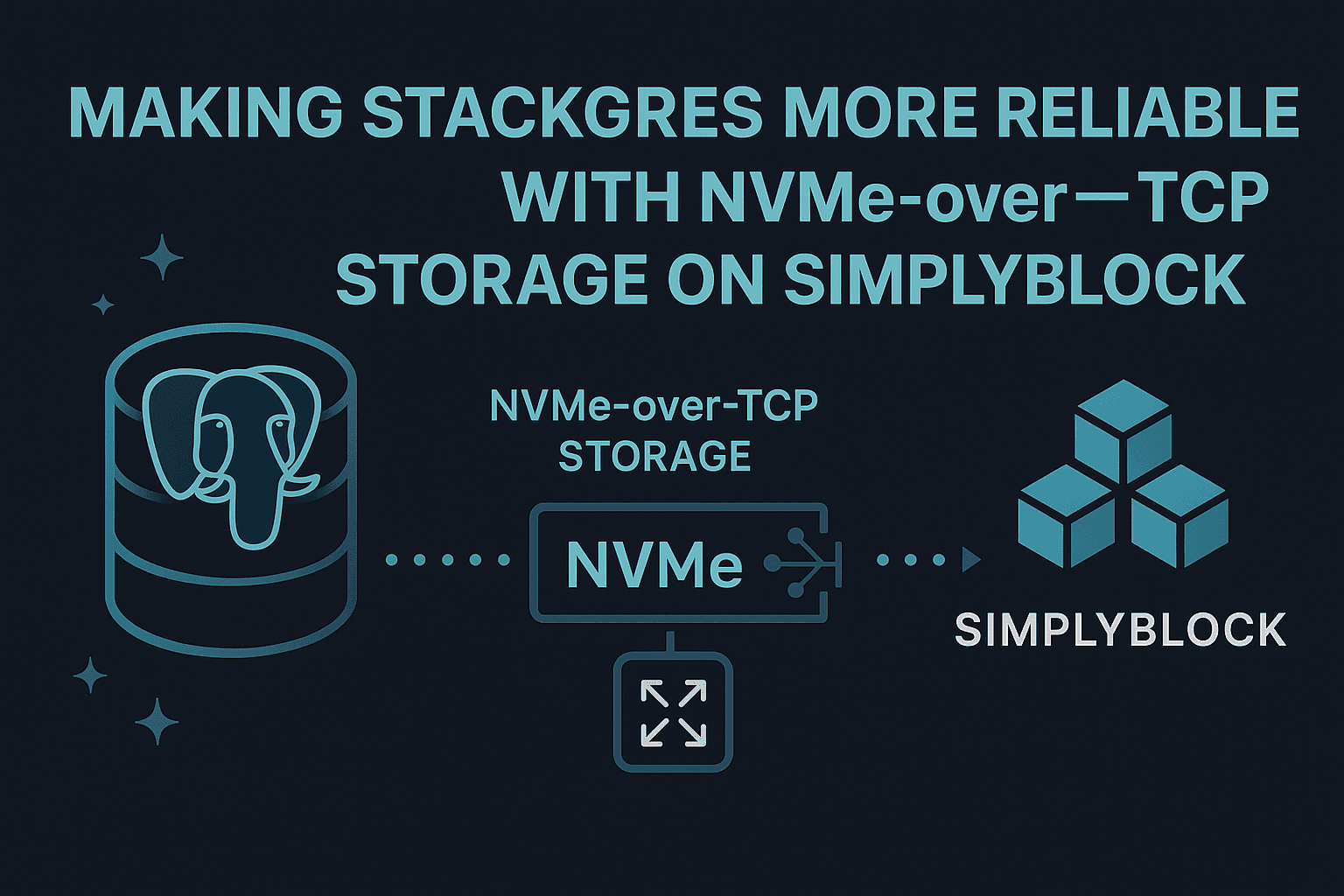
Simplyblock solves this with NVMe-over-TCP, zone-resilient volumes, and live scalability, providing the storage reliability StackGres needs to ensure smooth PostgreSQL operations in Kubernetes, enabling teams to scale efficiently without performance bottlenecks.
Why Storage Bottlenecks Break Kubernetes-Native Postgres
StackGres simplifies Postgres HA and replication by handling it at the operator level. But if underlying storage struggles, even StackGres can’t save the day. WAL archiving stalls, replication lags, and backup jobs collide with queries. In Kubernetes, this translates into longer recovery times, slower autoscaling, and service interruptions.
With simplyblock, PostgreSQL’s storage layer is no longer the weak link. Every pod gets consistent NVMe-level performance, ensuring the StackGres operator can keep databases highly available without being slowed down by I/O bottlenecks.
🚀 Use Simplyblock with StackGres for Reliable Kubernetes Postgres
Keep StackGres fast and resilient with NVMe-backed volumes and cross-zone durability.
👉 Learn more about Software-Defined Storage with simplyblock →
Step 1: Provision Simplyblock Volumes for StackGres Pods
When deploying StackGres, the PostgreSQL pods need reliable persistent volumes. With simplyblock, you can provision NVMe-over-TCP volumes and mount them directly inside pods, ensuring consistent performance across all replicas and primaries.
sbctl pool create –name sg-pool
sbctl volume create –pool sg-pool –size 200Gi –name sg-data
mkfs.ext4 /dev/simplyblock/sg-data
mount /dev/simplyblock/sg-data /var/lib/postgresql/data
This setup gives StackGres clusters a high-performance foundation from day one, with durable volumes that work seamlessly in Kubernetes environments.
Step 2: Keep WAL Archiving Fast in Containerized Workloads
PostgreSQL relies on WAL (write-ahead logs) to guarantee durability and replication. In Kubernetes clusters managed by StackGres, WAL archiving can quickly become a bottleneck on standard storage. Slow WAL writes mean lagging replicas and delayed failovers.
Simplyblock ensures WAL files are written and archived at NVMe speed, even inside containerized workloads. This keeps replicas synced, reduces recovery time, and makes PostgreSQL more predictable inside Kubernetes.
Step 3: Run Backups and Monitoring Without Query Slowdowns
StackGres includes built-in monitoring and automated backups. Both are essential, but they generate additional I/O that competes with active queries. On traditional volumes, this leads to query slowdowns whenever backups run.
With simplyblock, PostgreSQL gets enough throughput to handle both production traffic and background jobs at once. Backups complete quickly, monitoring stays accurate, and queries continue running smoothly. This aligns directly with Kubernetes backup best practices in production clusters.
For more on monitoring in Kubernetes, refer to the StackGres Monitoring guide.
Step 4: Expand StatefulSet Storage Seamlessly as Clusters Grow
Kubernetes StatefulSets make scaling PostgreSQL simple with StackGres, but scaling storage is another story. Outgrowing a volume often means downtime or manual migration.
Simplyblock solves this by letting you resize persistent volumes live. PostgreSQL stays online, StackGres continues managing replicas, and the database simply gains more room to grow.
sbctl volume resize –name sg-data –size 400Gi
resize2fs /dev/simplyblock/sg-data
For teams running databases as a service, this flexibility ensures scaling is smooth and without operational disruption.
Step 5: Ensure HA and Failovers Work Smoothly Across Zones
StackGres automates failovers, but failovers in Kubernetes often involve rescheduling pods across zones. Traditional cloud volumes are zone-locked, which breaks attachments and interrupts availability.
Simplyblock volumes are zone-independent, so StackGres pods retain access to their data even when rescheduled across zones. Combined with reduction of RPO and RTO, this ensures failovers happen quickly and reliably, minimizing downtime.
For more on high availability, check out the StackGres High Availablity guide.
StackGres and Simplyblock – PostgreSQL Made Production-Ready
StackGres handles orchestration, backups, and HA for PostgreSQL on Kubernetes, but storage is the foundation that makes those features work. With simplyblock, PostgreSQL gets NVMe-over-TCP performance, zone-resilient volumes, and seamless scalability.
Together, StackGres and simplyblock make PostgreSQL clusters more reliable, more resilient, and easier to run in production Kubernetes environments.
Questions and Answers
StackGres is a Kubernetes-native platform for running PostgreSQL clusters at scale. Since PostgreSQL workloads are highly I/O intensive, ensuring reliability and low latency is critical. Using NVMe-over-TCP with simplyblock provides the speed, resilience, and scalability StackGres clusters need compared to legacy iSCSI storage.
Simplyblock delivers ultra-low latency and higher IOPS for PostgreSQL clusters deployed with StackGres. By leveraging software-defined storage it removes bottlenecks caused by traditional SANs and allows Kubernetes workloads to scale faster. This ensures database reliability during spikes, backups, or large analytical queries.
Yes. Simplyblock provides replication, snapshots, and data-at-rest encryption for resilient Kubernetes clusters. With StackGres, this means PostgreSQL can be deployed across nodes with synchronous or asynchronous replication, while simplyblock ensures storage-level consistency and high availability for mission-critical workloads.
Unlike standard cloud block storage, simplyblock uses NVMe-over-TCP for near-local disk performance while remaining scalable and cost-efficient. This makes it ideal for StackGres users looking to optimize PostgreSQL on Kubernetes without overpaying for premium cloud storage tiers.
Deploying StackGres with simplyblock is straightforward. Simplyblock integrates via the Kubernetes CSI driver, allowing StackGres clusters to mount persistent volumes backed by NVMe-over-TCP. This gives PostgreSQL clusters instant access to high-performance, resilient storage without special hardware.