Storage High Availability
Terms related to simplyblock
Storage High Availability (HA) is crucial for businesses that require constant access to data without the risk of downtime. This technology ensures that data remains available even during hardware failures, system crashes, or other disruptions.
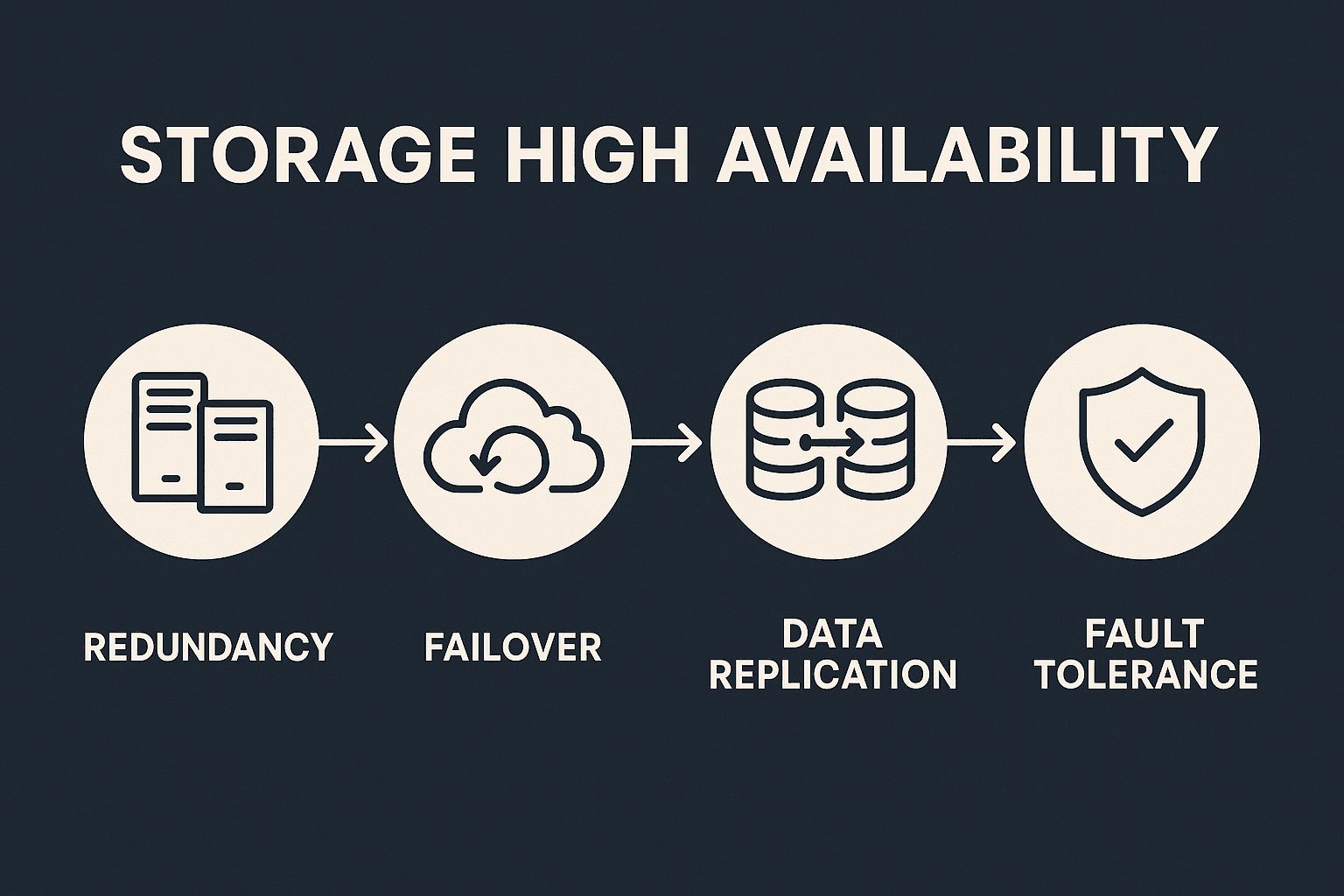
With HA, data is replicated across multiple systems, providing redundancy and enabling automatic failover to backup systems, ensuring business continuity and minimizing service interruptions.
How Storage High Availability Functions in Practice
Storage High Availability ensures data is always accessible by continuously replicating data across multiple storage systems or locations. In the event of a failure in the primary system, the data is instantly available on a backup system, allowing operations to continue without interruption.
Common techniques for implementing HA include data mirroring, RAID (Redundant Array of Independent Disks) configurations, and clustering. These technologies ensure that, even if one storage component fails, the backup system immediately takes over, ensuring seamless data access.
🚀 Reduce Downtime with Storage High Availability
Maintain continuous access to critical data while minimizing recovery time and data loss during failures.
👉 See How to Reduce RPO and RTO →
Why Every Modern Enterprise Needs Storage High Availability
Data is central to every business today, and even the smallest downtime can create substantial operational and financial risks. Storage High Availability is essential in industries like finance, healthcare, and telecommunications, where continuous access to data is critical.
In these industries, even a brief period of downtime can result in loss of transactions, patient data, or service outages. HA systems mitigate these risks by providing constant data access, ensuring business continuity even during system failures.
The Value of Storage High Availability
Implementing Storage High Availability provides several essential benefits for organizations seeking to maintain uninterrupted data access:
- Minimized Downtime: With automatic failover mechanisms, HA ensures that if one system fails, the secondary system takes over, reducing downtime to near-zero.
- Reliability and Redundancy: By replicating data across multiple storage systems, HA increases data reliability, ensuring that data is always accessible, even in the event of hardware failure.
- Business Continuity: HA systems ensure that operations can continue smoothly during system maintenance, unexpected failures, or network issues, preventing service disruptions and ensuring customer satisfaction.
- Enhanced Disaster Recovery: In the event of a disaster, HA systems help quickly restore access to critical data, allowing businesses to recover without significant data loss.
- Compliance with Industry Standards: Many sectors, such as healthcare and finance, require high availability to meet strict regulations. HA helps ensure compliance with these data protection standards.
Storage High Availability in Practical Environments
Storage High Availability is widely used in industries where data is critical to daily operations. Here are some common use cases:
- Financial Services: Banks and other financial institutions use HA to ensure that transactions are processed continuously without disruption, even in the event of system failures.
- Healthcare: Healthcare providers rely on HA systems to ensure that patient data and medical records are always accessible, allowing for timely decision-making and improving patient care.
- E-commerce: Online retailers use HA to keep inventory, order information, and customer data available at all times, even during high traffic periods or system updates.
- Cloud Service Providers: Cloud platforms leverage HA solutions to provide customers with continuous access to cloud applications and services, minimizing downtime and ensuring reliability.
Storage High Availability vs Traditional Storage Systems
When comparing Storage High Availability to traditional storage setups, there are clear differences in terms of performance, reliability, and recovery. Here’s a comparison:
| Feature | Storage High Availability | Traditional Storage Systems |
| Data Availability | Always available, even during system failures | Downtime occurs during failures |
| Failover | Automatic, with minimal interruption | Manual failover, longer recovery time |
| Redundancy | Built-in redundancy, no single points of failure | Limited redundancy, more risk of data loss |
| Performance Impact | Minimal, as backup systems take over seamlessly | Can degrade during failure recovery |
| Ideal For | Mission-critical environments requiring 24/7 uptime | Environments where occasional downtime is acceptable |
Cloud Solutions for Storage High Availability
Storage High Availability plays a vital role in cloud infrastructure, where data must remain available across multiple regions and data centers. Cloud service providers use HA to replicate data and ensure high availability, even when one data center or server experiences a failure.
By implementing HA, businesses can guarantee that their cloud-based applications remain operational without disruption, even during system failures or network outages. This is crucial for businesses using cloud disaster recovery strategies, ensuring that data is continuously protected and accessible.
Simplyblock and Its Contribution to Storage High Availability
Simplyblock helps optimize Storage High Availability by offering advanced integration, automatic failover, and seamless replication for distributed storage systems. With simplyblock, organizations can:
- Simplify Data Protection: Easily set up redundant storage systems with automated failover, ensuring uninterrupted access to critical data and applications.
- Improve System Performance: Simplyblock ensures HA systems work efficiently with minimal performance overhead, keeping your systems running at their best.
- Enhance Disaster Recovery: Quickly recover from failures without data loss, ensuring business continuity with Simplyblock’s high availability solutions.
- Streamline Management: With Simplyblock’s user-friendly interface, managing HA systems becomes simple, minimizing the complexity of storage infrastructure and ensuring proactive monitoring.
How Storage High Availability Will Evolve
As data grows, Storage High Availability continues to evolve, offering scalable and cost-effective solutions that don’t compromise performance. With advancements in cloud infrastructure, data analytics, and distributed systems, storage high availability will play an even more crucial role in ensuring continuous access to data and seamless business operations.
As technology progresses, high availability solutions will become more integrated, reliable, and efficient, ensuring that businesses can meet the increasing demand for data availability and protection.
Related Terms
Teams often review these glossary pages alongside Storage High Availability when they define monitoring signals, replication behavior, and operational guardrails for resilient storage services.
Observability
Tail Latency
Replication
Helm Chart
High Availability
Kubernetes PodDisruptionBudget for Storage
Questions and Answers
Storage high availability ensures uninterrupted data access by implementing redundancy, failover mechanisms, and real-time replication. This minimizes downtime and ensures that businesses can continuously access their critical data, even in the event of hardware or system failures.
Storage high availability protects against data loss by using techniques like mirroring, clustering, and real-time data replication. These methods ensure that if one storage device fails, another device or replica can take over, maintaining data integrity and reducing the risk of business disruption.
Key components of a storage high availability solution include redundant hardware, automated failover processes, and data replication across multiple storage devices or locations. These components work together to ensure that data remains accessible and operational, even in the case of component failure or system crashes.
A business should invest in storage high availability solutions when it requires continuous access to data, such as in critical applications or for compliance with industry regulations. Industries like healthcare, finance, and e-commerce, which cannot afford downtime or data loss, greatly benefit from implementing these solutions.
Challenges in maintaining storage high availability include the complexity of configuring and managing redundant systems, ensuring synchronization across multiple storage devices, and the potential high costs of implementing and maintaining failover infrastructure. Additionally, it requires ongoing monitoring to ensure that failover systems are ready and operational at all times.