StorageClass
Terms related to simplyblock
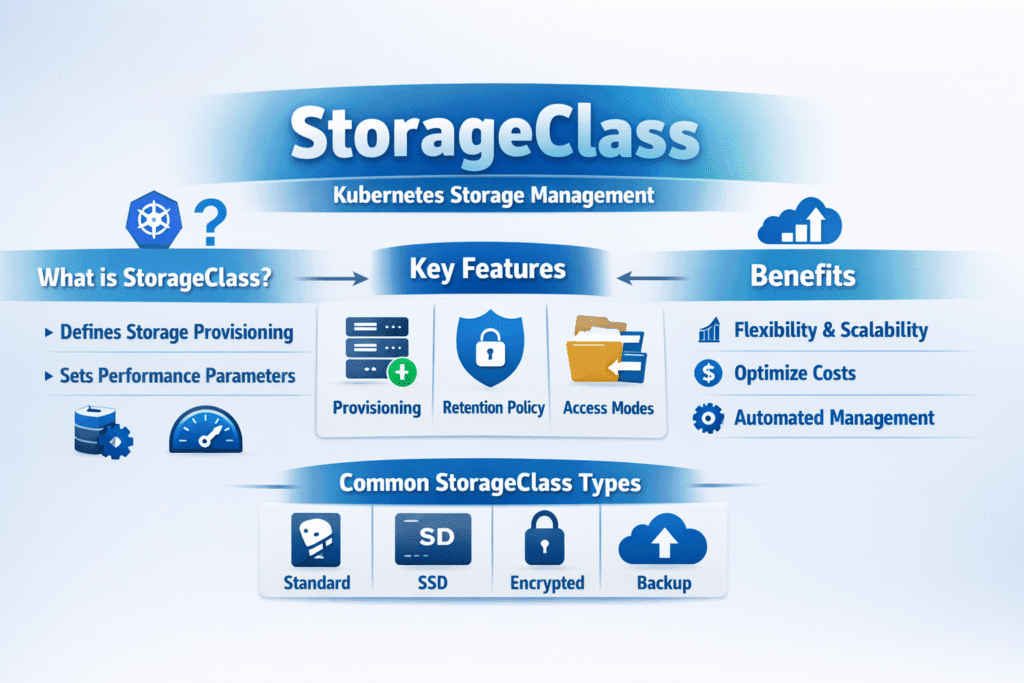
A StorageClass is a Kubernetes object that defines how the cluster provisions persistent storage when a workload requests a PersistentVolumeClaim (PVC). It acts as a policy layer that maps developer intent to backend behavior, such as performance tier, data protection, and lifecycle rules.
Platform leaders use StorageClass to reduce variance across clusters and teams. It turns “tribal knowledge” into a versioned configuration that you can review, approve, and roll out with the same rigor as application code. Operators benefit because they stop hand-building volumes and start relying on predictable automation.
StorageClass also fits naturally with Software-defined Block Storage. Instead of tying service tiers to a specific array or SAN, the platform encodes those tiers as policies that your storage backend can enforce. That model works especially well in shared clusters where multi-tenancy and QoS decide who gets stable p99 latency.
Policy-Driven Provisioning That Keeps Performance Predictable
StorageClass choices show up later as user-visible outcomes. A “fast” class without guardrails can still suffer from noisy neighbors and jitter. A “safe” class with overly strict limits can block throughput during peak jobs.
Treat each class as a contract. Define a small set of tiers, name them clearly, and tie each tier to measurable targets. Keep the number of tiers low so developers actually pick the right one. Most organizations run well with one default tier and two or three purpose-built tiers for databases, streaming, and bulk workloads.
When you run NVMe-first backends, StorageClass becomes even more valuable. It lets you express high IOPS tiers without forcing manual placement or fragile node pinning.
🚀 Define StorageClass Policies for NVMe/TCP Volumes, Natively in Kubernetes
Use simplyblock to set StorageClass parameters that keep performance predictable and ops simple.
👉 Configure StorageClass in simplyblock CSI →
StorageClass in Kubernetes Storage Workflows
Kubernetes Storage follows a clear flow: a PVC asks for capacity and access mode, and the control plane selects a CSI provisioner based on the StorageClass. That flow helps teams scale stateful apps without tickets, spreadsheets, or manual LUN work.
Topology settings also matter. “Wait for first consumer” can align volume provisioning with Pod scheduling, which reduces cross-zone mistakes and avoids surprise latency. That alignment helps during reschedules, node drains, and rolling upgrades.
StorageClass also separates concerns across architectures. One tier can target hyper-converged placement for edge constraints, while another tier can target disaggregated pools for general production. This split gives DevOps teams cleaner guardrails and fewer production incidents.
Tuning Policies for NVMe/TCP Data Paths
NVMe/TCP brings NVMe semantics to standard Ethernet, so your policy design should reflect both performance goals and network realities. A low-latency tier often needs strict QoS limits and clear placement rules. A bulk tier often benefits from higher parallelism and less restrictive bandwidth caps.
NVMe/TCP also supports mobility. You can serve fast remote block volumes while keeping flexible scheduling for StatefulSets. That flexibility reduces operational drag during maintenance and failure events.
In Software-defined Block Storage, this approach matters because the storage layer can isolate tenants with QoS while Kubernetes keeps scheduling freedom. You get fewer “pets” and more repeatable operations.
Measuring StorageClass Impact with Repeatable Benchmarks
Benchmark the class, not just the drives. StorageClass policies can change results as much as the hardware, especially when QoS, protection, and placement rules differ by tier.
Start with workloads that mirror production. Match block size, read/write mix, and queue depth to your real services. Add disruption tests that reflect real operations, such as node drains, reschedules, and rebuild traffic. Those moments often reveal whether a tier stays stable under stress.
Track IOPS, throughput, p95 latency, p99 latency, and CPU usage. Add one metric that leadership understands: cost per stable IOPS. StorageClass exists to make that number repeatable, not theoretical.
Controls That Change Real Outcomes
CSI drivers expose different parameters, but the biggest outcomes usually come from a common set of controls:
- Reclaim behavior changes what happens to data when teams delete PVCs.
- Volume binding mode affects placement and can reduce cross-zone latency spikes.
- QoS limits protect p99 latency by constraining noisy neighbors.
- Compression and encryption add CPU work, so plan headroom for them.
- Replica or erasure coding policy shapes durability, rebuild time, and network load.
Use fewer controls in the default tier. Reserve advanced controls for higher tiers where teams accept tighter rules and stronger SLOs.
StorageClass Strategy Comparison Matrix
Use this comparison matrix to evaluate StorageClass strategies across Kubernetes Storage, multi-tenant operations, and NVMe/TCP performance.
| StorageClass strategy | What it optimizes | Operational benefit | Common downside | Best fit |
|---|---|---|---|---|
| Single default tier | Simplicity | Lowest admin effort | Mixed workloads contend for the same envelope | Early-stage platforms |
| Tiered classes (gold, silver, bronze) | Clarity | Predictable SLOs by tier | Requires governance and audits | Shared enterprise clusters |
| Namespace-specific classes | Isolation | Strong tenant separation | Policy sprawl across teams | Regulated environments |
| “Local-first” tier plus “networked” tier | Latency and mobility | Clear placement rules | Higher test burden | Edge plus core setups |
Governance and Multi-Tenant Control with Simplyblock™
Simplyblock™ integrates with Kubernetes through CSI, so platform teams can express storage policy in configuration and apply it consistently. Simplyblock targets high-performance data paths using SPDK-based user-space design principles, which help preserve CPU efficiency under load. That efficiency matters when your tiers turn on features that add work, such as compression, encryption, snapshots, clones, or strict QoS.
In Kubernetes Storage environments, simplyblock supports hyper-converged, disaggregated, and hybrid layouts. This flexibility lets you place heavy functions where you have headroom, which helps when NVMe/TCP traffic grows or when a cluster absorbs bursty tenants.
Policy Automation and Smarter Defaults
Platform teams want fewer hand-tuned tiers and more policy automation. Expect tighter links between observability and enforcement so the platform can respond to rising tail latency with safer background behavior and clearer limits.
Offload will shape this space as well. DPUs and IPUs can take on parts of the data path, which can reduce host CPU load during high-throughput NVMe/TCP periods. As more enterprises standardize stateful services on Kubernetes Storage, StorageClass design will act as a key lever for both cost control and predictable performance.
Related Terms
Teams often review these glossary pages alongside StorageClass when they standardize provisioning rules, QoS guardrails, and safe lifecycle behavior for Kubernetes Storage.
Persistent Volume Claim (PVC)
Dynamic Provisioning in Kubernetes
Local Node Affinity
QoS Policy in CSI
Dynamic Volume Provisioning
Questions and Answers
A StorageClass in Kubernetes defines how dynamic volumes are provisioned, including backend type, performance tier, and reclaim policy. It enables automation and flexibility for storage provisioning, especially when using container-native storage solutions in production clusters.
StorageClasses automate the creation of PersistentVolumes (PVs) when a PVC is requested. With the right CSI integration, volumes can be provisioned on-demand with specific parameters like encryption or topology. Simplyblock’s CSI driver fully supports this capability.
Yes. You can create different StorageClasses for varying performance needs, such as high-throughput volumes for analytics or encrypted volumes for compliance. This is useful for managing multi-workload environments or hybrid cloud strategies within a single cluster.
By selecting or customizing StorageClasses, platform teams can control backend types (e.g., SSD vs HDD), compression, or replication features—affecting both performance and cost. This is a core tool in Kubernetes cost optimization strategies.
Yes. Simplyblock offers ready-to-use StorageClasses tailored for use cases like encrypted volumes, high IOPS, or NVMe-over-TCP-backed storage. These can be extended or customized through Kubernetes manifests—check the documentation for setup and usage guides.