Kubernetes ReadWriteOncePod
Terms related to simplyblock
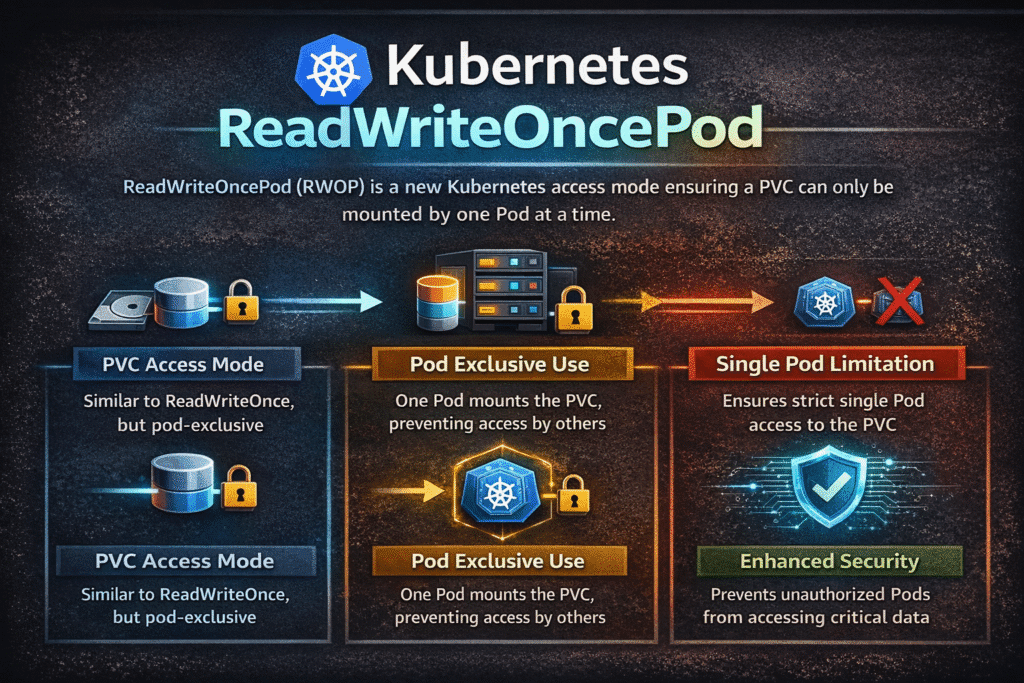
Kubernetes ReadWriteOncePod (RWOP) is a PersistentVolumeClaim (PVC) access mode that allows exactly one Pod in the entire cluster to mount a volume as read-write at any time. It tightens the behavior of ReadWriteOnce (RWO), which limits read-write mounts to a single node but can still allow multiple Pods on that same node to mount the same volume. RWOP gives platform teams a single-writer rule that matches the operational reality of many databases, queues, and stateful services.
RWOP works with CSI-backed volumes and relies on the CSI control plane to enforce the “one Pod” guarantee. That enforcement reduces double-writer risks during reschedules, rollouts, and node failures. It also makes access patterns more predictable because Kubernetes blocks additional Pods from mounting the same claim as read-write
Optimizing RWOP with Modern Storage Design
RWOP prevents multiple writers, but performance still depends on how quickly Kubernetes can attach, mount, and reattach the volume, plus how stable latency stays under load. Storage layers that add jitter, slow volume operations, or compete for CPU can stretch recovery time when Pods move.
Modern Kubernetes Storage strategies focus on fast volume lifecycle operations, low and consistent latency on the data path, and isolation between tenants. Software-defined Block Storage supports that approach by applying consistent policy across baremetal and virtualized clusters, while enforcing per-volume Quality of Service (QoS). NVMe/TCP complements this by delivering NVMe-oF semantics over standard Ethernet, which aligns with common cluster networks.
🚀 Run ReadWriteOncePod Volumes on NVMe/TCP Storage, Natively in Kubernetes
Use Simplyblock to keep single-writer pods stable and reduce latency and jitter for stateful workloads.
👉 Use Simplyblock for ReadWriteOncePod Storage on Kubernetes →
Kubernetes ReadWriteOncePod in Kubernetes Storage
RWOP shapes scheduling behavior in ways that show up during day-two operations. When a Pod starts, Kubernetes must wait until the volume becomes available to that single Pod, and then it proceeds with mount and container startup. When a Pod restarts or relocates due to node drain, Kubernetes must detach and reattach in the correct order, and it must ensure the previous Pod no longer holds the mount.
RWOP pairs well with StatefulSets because StatefulSets already assume stable identity, ordered rollout, and controlled replacement. RWOP also helps when your application cannot tolerate two writers, even for a short interval. That benefit matters most during failure handling because Kubernetes blocks a second Pod from acquiring the same read-write mount.
NVMe/TCP Considerations for Single-Writer Pods
RWOP improves safety, but protocol choice sets the latency and CPU profile of the data path. NVMe/TCP is often practical for Kubernetes Storage because it runs over Ethernet and scales across racks without requiring specialized RDMA fabrics. In disaggregated deployments, NVMe/TCP lets compute nodes access remote NVMe-backed block devices while keeping operational friction lower than many alternatives.
Some teams reserve RDMA-enabled paths for a small subset of strict low-latency workloads and keep NVMe/TCP as the default. That split can preserve simplicity while still meeting tighter p99 targets where they matter.
Measuring and Benchmarking Kubernetes ReadWriteOncePod Performance
RWOP performance measurement should cover both orchestration timing and storage behavior. Orchestration timing describes how long the platform takes to get the Pod back to Ready with the volume mounted. Storage behavior describes latency and throughput once the application runs.
Measure orchestration timing using:
Attach time, mount time, detach time, reattach time, and workload time-to-ready after restarts, rollouts, and node drains.
Measure storage behavior using:
p50, p95, and p99 latency, sustained IOPS and throughput, CPU cost per I/O at different queue depths, and network health indicators for remote paths.
A solid baseline uses repeatable fio profiles, then validates with real application behavior such as WAL writes, fsync patterns, and compaction bursts.
Approaches for Improving RWOP Performance
Use the steps below as the only listicle in this page, and validate each step against the same fio profile and the same failure scenarios.
- Choose a CSI driver that handles attach and detach quickly and enforces single-writer semantics without edge-case mounts.
- Enforce per-volume QoS so noisy neighbors cannot spike tail latency for the RWOP workload.
- Size Ethernet for NVMe/TCP traffic and validate NIC queue and IRQ distribution so the node does not waste CPU on packet handling.
- Align topology rules with storage placement, so Kubernetes avoids avoidable reattachment delays during reschedules.
- Tune application write behavior for the block device and filesystem, including queue depth, fsync grouping, and WAL placement.
- Rehearse failure paths, including node drains and evictions, and treat attach-to-ready timing as an SLO.
RWOP vs Other Kubernetes Volume Access Modes
The table below summarizes the operational differences between common access modes. Use it to set policy for Kubernetes Storage and to document risk in change reviews.
| Access Mode | Who can mount read-write? | Primary risk | Typical use |
|---|---|---|---|
| ReadWriteOnce (RWO) | Pods on one node | Multiple Pods on the same node can write | Legacy single-node writer patterns |
| ReadWriteOncePod (RWOP) | One Pod in the cluster | Depends on CSI enforcement quality | Databases and strict single-writer apps |
| ReadWriteMany (RWX) | Many Pods across nodes | Locking and consistency complexity | Depends on the CSI enforcement quality |
Predictable Single-Writer Pod Storage with Simplyblock™
Simplyblock™ targets predictable behavior for stateful workloads by combining Software-defined Block Storage control with NVMe-first data paths. For RWOP workloads, this combination supports stable tail latency under contention and consistent recovery behavior during reschedules.
Simplyblock uses an SPDK-based, user-space, zero-copy architecture to reduce kernel overhead and improve CPU efficiency in the data path. That design helps RWOP workloads because fsync-heavy write patterns amplify latency spikes. Simplyblock also supports NVMe/TCP for Kubernetes Storage deployments that need scale-out block access on Ethernet. Multi-tenancy and QoS controls isolate tenants and namespaces so another workload cannot distort the single-writer Pod’s latency profile.
What’s Next for Single-Writer Volumes in Kubernetes
RWOP aligns Kubernetes with a clearer single-writer pattern, and upcoming improvements typically center on tighter integration between scheduling, observability, and storage policy. Teams want better visibility into attach and mount timing, plus faster diagnosis when fencing or volume lifecycle events slow recovery.
On the data path, more organizations are standardizing NVMe-oF patterns. Many will keep NVMe/TCP as the default because it scales on existing Ethernet, and they will use RDMA selectively where the business case justifies added fabric requirements. Storage stacks that reduce CPU overhead and stabilize tail latency will remain important because they help meet SLOs without overprovisioning.
Related Terms
Teams often review these glossary pages alongside Kubernetes ReadWriteOncePod when they standardize Kubernetes Storage and Software-defined Block Storage.
- SPDK (Storage Performance Development Kit)
- Asynchronous Storage Replication
- Compression in Block Storage
- Storage Composability
Questions and Answers
ReadWriteOncePod is a newer access mode in Kubernetes that allows a volume to be mounted as read-write by a single pod only, enforcing stricter exclusivity than ReadWriteOnce. This is useful for high-performance storage scenarios where volume contention must be avoided entirely.
Use ReadWriteOncePod when strict volume exclusivity is required—for example, running databases or analytics engines that must not be shared across pods. It helps avoid data corruption in stateful Kubernetes workloads by guaranteeing single-pod access at the node level.
Yes. If the CSI driver supports this access mode, volumes can be dynamically provisioned using ReadWriteOncePod. Simplyblock’s CSI-compatible architecture supports this mode, ensuring secure and reliable storage for single-pod workloads.
The volume can only be attached to one node at a time, which may impact pod rescheduling in case of failure. You need to ensure the node remains available, or implement fast failover with tools like topology hints and replicated storage strategies.
Yes, but it’s more commonly used with StatefulSets where pod identity and stable storage are key. When using Deployments, ensure replicas are set to 1 to prevent conflicts. This is ideal for workloads requiring strict volume isolation, such as single-instance databases.