Replacing vSAN with Software-Defined Storage
Terms related to simplyblock
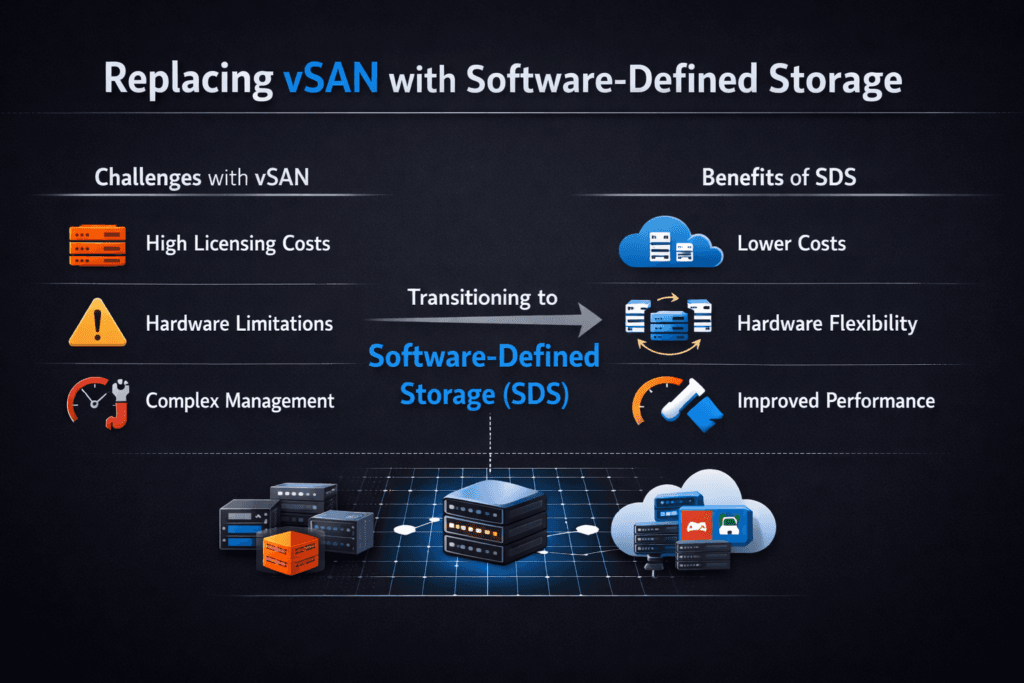
Replacing vSAN with Software-Defined Storage usually comes up when teams need steadier latency, simpler scale, or more freedom on hardware and licensing. vSAN fits well in a VMware-first stack, but it can feel restrictive when the roadmap adds containers, bare metal, or mixed clusters.
Software-defined storage separates the storage logic from the hardware. That shift helps teams refresh servers on their schedule, choose different deployment shapes, and avoid tying every storage decision to one virtualization layer. For many orgs, this change also sets the stage for Kubernetes Storage, Software-defined Block Storage, and NVMe/TCP in the same program, even if the first move starts with VMs.
Why teams move off vSAN and what changes operationally
Most migrations fail when the “why” stays vague. Teams do better when they lock on to a small set of targets, such as p99 latency, rebuild time, and cost per usable TB, then map architecture to those targets.
Operationally, the biggest change is in mindset. vSAN often encourages cluster-level thinking. An SDS alternative pushes you to think in service levels, policies, and clear separation of compute and storage growth. That separation matters when you add nodes for CPU but do not need more capacity, or when you add capacity without buying extra compute.
🚀 Replace vSAN Without Lock-In or Performance Drift
Use Simplyblock to run Software-defined Block Storage with NVMe/TCP and steady p99 latency.
👉 Use Simplyblock as a vSAN Alternative →
Replacing vSAN with Software-Defined Storage for Kubernetes Storage
If your platform plan includes Kubernetes, storage must handle frequent scheduling changes without drama. Pods restart, nodes drain, and upgrades trigger bursts of lifecycle work. Storage should keep up without stretching deploy times or spiking tail latency.
A practical approach is to standardize on CSI-based provisioning and treat storage as an API-driven service. You define classes for performance tiers, protection goals, and placement needs. Your teams then request storage through policy instead of manual datastore work. This model fits Kubernetes Storage because it matches how teams ship apps: repeatable, automated, and measured.
Replacing vSAN with Software-Defined Storage with NVMe/TCP
NVMe/TCP matters because it brings NVMe-style access over normal Ethernet. That helps teams scale performance without requiring a special fabric in every site. It also fits phased migrations, where some nodes run VMs, others run Kubernetes, and some run bare metal.
During a vSAN replacement, NVMe/TCP can also support disaggregation. You can scale compute and storage independently, which often improves both cost control and planning. For performance-sensitive workloads, that separation reduces the “all-or-nothing” feel of hyper-converged expansion.
Proving outcomes with the right benchmarks and SLOs
Treat the migration like a testable business case. Define success with a few numbers, then measure them before and after the move.
Use workload-shaped tests, not only peak IOPS runs. Track p95 and p99 latency, plus rebuild behavior during failures. Measure how long a reschedule takes for a stateful workload, and how often storage events slow down a rollout. These are the points that users feel.
Also, compare apples to apples. Keep block sizes, read/write mixes, and concurrency aligned across systems. If you change the workload while you change the platform, you lose the signal.
Tuning levers that reduce jitter and keep p99 steady
Use one rule: reduce variance first, then chase peak numbers. These steps help teams keep control of performance during and after the switch:
- Set a clear latency SLO, then tune to meet it under load.
- Pick a transport plan early, and keep the network stable before deep tuning.
- Use QoS to stop one tenant from crushing shared pools.
- Test rebuild and failover under real traffic, not during quiet hours.
- Keep the I/O path efficient, so the CPU does not become the hidden limit.
Side-by-side comparison – HCI stack vs SDS approach
The table below summarizes common differences teams evaluate when they compare a vSAN-centric model with a Software-defined Block Storage approach.
| Area | vSAN-centric HCI | Software-defined storage approach |
|---|---|---|
| Scaling model | Add nodes to scale a cluster as a unit | Scale capacity and performance with flexible node roles |
| Hardware choice | Often guided by certified lists | Broader choice on commodity servers and NVMe |
| Kubernetes fit | Works, but VM-first patterns remain | Aligns with CSI and policy-based provisioning |
| Predictability | Can vary during rebuild and mixed load | Targets steady p99 with isolation and QoS |
| Network model | Often stays inside HCI assumptions | NVMe/TCP supports standard Ethernet designs |
| Cost control | Licensing and expansion steps can drive cost | Spend can track capacity and performance needs |
Running predictable workloads with Simplyblock™
Simplyblock™ supports Software-defined Block Storage for platforms that need steady behavior across VMs and Kubernetes. It pairs an NVMe-first design with NVMe/TCP so teams can aim for near-local semantics over standard Ethernet.
For migration programs, this matters because you want fewer moving parts in the hot path and clearer control over tenant noise. Simplyblock also supports multi-tenancy and QoS controls, which help you keep p99 latency stable when multiple teams share the same fleet.
Replacing vSAN with Software-Defined Storage in the next 24 months
Most roadmaps push toward more mixed workloads, more automation, and tighter SLO enforcement. That trend increases the value of clean separation between lifecycle operations and the runtime I/O path.
Expect more interest in disaggregated designs, plus more focus on CPU efficiency per I/O. As NVMe/TCP becomes more common, teams will judge platforms less by peak throughput and more by tail latency under churn, rebuild, and noisy-neighbor pressure.
Related Terms
Quick references for vSAN replacement planning across Kubernetes Storage and Software-defined Block Storage.
Questions and Answers
Replacing vSAN with a software-defined storage solution offers improved flexibility, vendor independence, and better scalability across heterogeneous infrastructure. Platforms like Simplyblock support NVMe over TCP, enabling higher performance without the cost of hypervisor lock-in.
Unlike vSAN, which is tightly coupled to VMware, NVMe over TCP allows storage to be decoupled from compute and run over standard Ethernet. This approach delivers better scalability and performance, especially when used with Kubernetes-based environments.
Yes. Solutions like Simplyblock offer enterprise-grade features such as encryption, replication, snapshots, and CSI integration—all with distributed NVMe performance that matches or exceeds vSAN’s capabilities in many use cases.
Migration involves decoupling storage from the hypervisor, provisioning volumes via CSI, and transitioning workloads to containerized or VM environments. Simplyblock enables hybrid operations during transition with support for both Kubernetes and virtualized workloads.
Yes. Software-defined platforms run on commodity hardware, avoid proprietary licensing, and allow scaling storage independently of compute. This reduces TCO significantly when compared to vSAN, especially in multi-tenant or hybrid deployments.