Total Cost of Ownership for Kubernetes Storage
Terms related to simplyblock
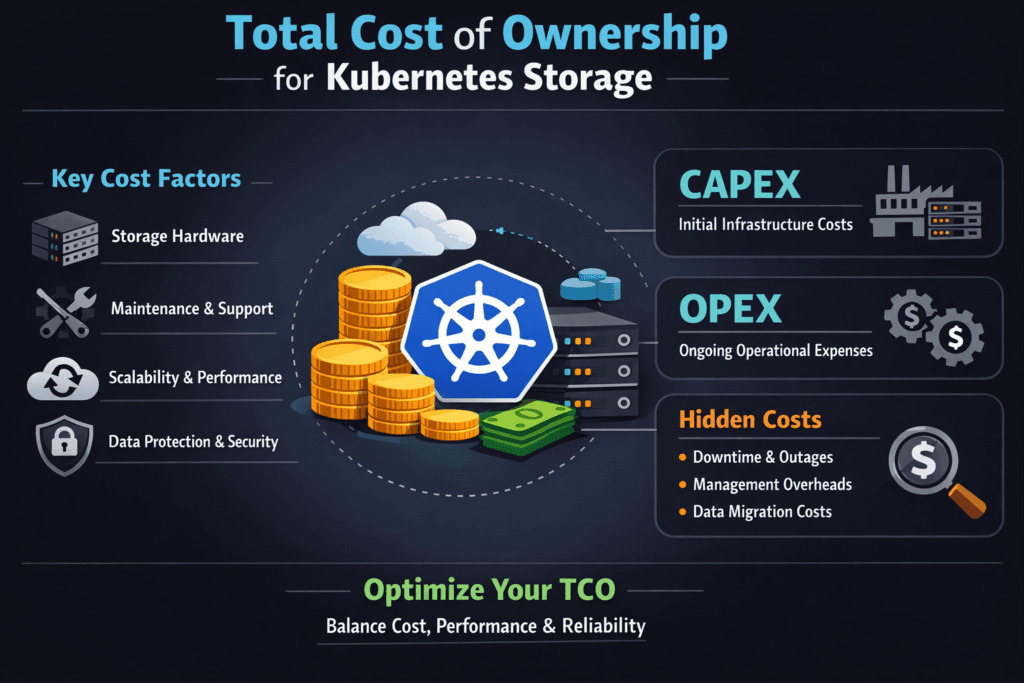
Total Cost of Ownership for Kubernetes Storage (TCO) adds up every cost tied to persistent data in a cluster over time. It includes infrastructure spend, licensing, staffing, downtime risk, and the “hidden tax” of performance variance that forces teams to overbuy capacity.
Kubernetes changes TCO math because it scales fast, it spreads across many teams, and it shifts storage work into day-2 operations. A platform team can spend more time on volume incidents, tuning, and noisy-neighbor fights than on raw capacity growth. When you track TCO well, you can explain trade-offs in plain terms: dollars per app, cost per namespace, and cost per SLO.
Cost levers that shape Total Cost of Ownership for Kubernetes Storage
TCO comes from a small set of repeatable cost levers. Each lever shows up in executive reviews because it links directly to budget, risk, and delivery speed.
Here is the short list most teams use for planning and reviews:
- Hardware or cloud volume spend, including headroom
- Network cost, including cross-zone traffic and egress
- Operator time for provisioning, upgrades, and incident response
- Performance “waste” from overprovisioning to avoid p99 spikes
- Downtime cost from slow recovery and failed upgrades
Track these levers by workload tier. A tier-1 database and a log pipeline do not need the same p99 target, so they should not share the same cost model.
🚀 Size Storage for Real Growth, Not Guesswork
Model usable capacity and parity overhead, then plan spending with fewer surprises.
👉 Use the Erasure Coding Calculator →
Total Cost of Ownership for Kubernetes Storage with Modern Solutions
Modern platforms reduce TCO when they shrink ops work and improve utilization at the same time. “Cheaper disks” rarely fix TCO on their own. Teams save more when they cut noisy-neighbor risk, simplify upgrades, and stop buying extra capacity just to avoid jitter.
This is where Software-defined Block Storage changes the model. It can turn storage into a repeatable service with policy and automation, instead of a set of manual runbooks. You can standardize classes, apply quotas, and enforce quality of service across tenants. That reduces surprise spend and shortens incident time.
Total Cost of Ownership for Kubernetes Storage in day-2 operations
Day-2 work drives a large share of TCO in real clusters. StatefulSets do not “just run” once you hit scale. Teams rotate nodes, patch kernels, replace hardware, and roll platform upgrades. Each event can trigger volume moves, rebuild work, and performance dips.
A storage stack that behaves well during these events saves money fast. Faster attach times cut rollout delays. Cleaner rebuild paths reduce the “slow cluster week” after a failure. Strong isolation prevents one team from causing a cluster-wide incident.
If you run many clusters, standardization matters even more. A consistent storage API, consistent policies, and consistent observability reduce training time and cut mistakes.
NVMe/TCP and the cost of performance per CPU cycle
Transport choice affects TCO because it changes efficiency. NVMe/TCP runs NVMe-oF on standard Ethernet, which keeps networks simpler and avoids specialized fabrics in many environments. At the same time, TCP uses CPU, so efficiency still matters.
SPDK-style user-space design helps here because it can reduce copies and context switches in the I/O path. Lower overhead can translate into fewer cores spent on storage, lower node counts for the same workload, and more predictable p99 latency. Those gains show up as both lower spend and lower risk.
Measuring storage TCO with metrics leaders can trust
TCO tracking works best when you tie cost to outcomes. Start with cost per usable TB, but do not stop there. Add cost per workload tier, cost per namespace, and cost per “healthy day” where you meet p99 targets.
Also measure variance. A platform that forces you to reserve 40% headroom to keep p99 stable costs more than one that runs near steady utilization. Variance drives both spend and frustration because teams lose confidence in forecasts.
Finally, track operational load. Count storage tickets, paging events, time-to-restore, and time-to-expand. Those numbers often explain why “cheap” storage still becomes expensive.
Practical ways to reduce TCO without lowering reliability
You can reduce TCO without taking durability risks when you align policy, topology, and performance. Start by separating tiers so critical databases do not share the same limits as batch jobs. Next, enforce quotas and QoS so one namespace cannot drain a shared pool.
Then take a hard look at cross-zone design. Synchronous durability across zones can raise steady network cost. Some workloads prefer async replication with tighter steady-state latency and lower traffic. A tiered policy approach usually cuts costs while keeping risk visible and controlled.
Comparison table for common Kubernetes Storage cost models
The table below summarizes how different approaches tend to behave when you compare cost, effort, and scaling in production.
| Approach | Cost Pattern | Ops Load | Common TCO Pitfall | Typical Fit |
|---|---|---|---|---|
| Cloud block volumes | Pay-as-you-go often grows fast | Low to moderate | High cost at scale, limits, and burst pricing | Small to mid clusters, fast start |
| Traditional SAN | Large upfront plus support | Moderate | Slow change cycles and specialized skills | Legacy estates, strict change control |
| Open-source SDS | Low license cost | High | Staff time and tuning drive real cost | Teams with deep storage ops skills |
| NVMe/TCP Software-defined Block Storage | Commodity scale-out | Moderate | Needs clear policies for multi-tenancy | High I/O fleets, shared platforms |
Cutting Total Cost of Ownership for Kubernetes Storage with Simplyblock™
Simplyblock™ targets TCO reduction by combining Software-defined Block Storage controls with Kubernetes Storage automation and NVMe/TCP performance on Ethernet. Teams use simplyblock to standardize provisioning, reduce noisy-neighbor impact, and improve utilization without turning every storage change into a project.
A strong TCO story shows up in daily work. Operators spend less time on tuning and firefighting. Platform teams roll upgrades with fewer storage regressions. Execs see fewer “capacity surprise” requests because planning tracks p99 targets, not just raw TB.
Future directions that will reshape Kubernetes storage economics
TCO models will keep shifting toward policy-first platforms. Expect more per-volume QoS, better chargeback, and stronger automation around expansion and recovery. Hardware offloads such as DPUs and IPUs will also matter because they can move protocol work away from host CPUs.
FinOps will push storage teams to report cost per service and cost per SLO. As that pressure rises, platforms that reduce variance and operator time will win more budgets than platforms that only optimize $/TB.
Related Terms
These glossary terms help with Kubernetes storage cost controls and chargeback.
- Storage Resource Quotas in Kubernetes
- Kubernetes Capacity Tracking for Storage
- Storage Tiering
- Storage Quality of Service (QoS)
Questions and Answers
TCO includes hardware, licensing, operational complexity, and scaling costs. Legacy systems often require expensive SANs or proprietary platforms, while software-defined, scale-out block storage solutions offer better cost-efficiency at scale.
NVMe over TCP leverages standard Ethernet and removes the need for specialized fabrics or RDMA. It enables high-performance storage with lower infrastructure and maintenance expenses—especially in Kubernetes clusters.
Software-defined storage decouples storage from hardware, allowing flexibility and reducing vendor lock-in. It simplifies operations, accelerates provisioning, and lowers both CapEx and OpEx over the lifecycle of Kubernetes workloads.
By selecting a solution like Simplyblock, which offers fast, encrypted NVMe/TCP volumes, you avoid overprovisioning and reduce operational overhead. Its support for Kubernetes stateful applications ensures performance without excessive resource consumption.
Yes. Simplyblock offers a SAN replacement architecture built for modern environments. Its efficient use of commodity hardware, CSI integration, and built-in data services reduces both initial and ongoing costs.