SAN Replacement Architecture
Terms related to simplyblock
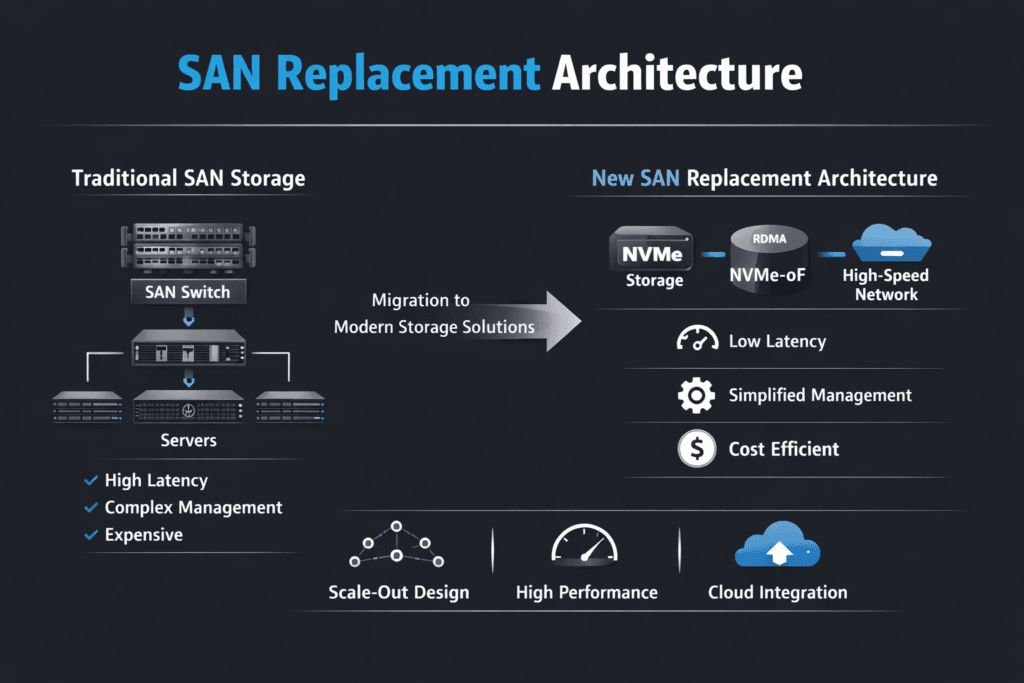
SAN Replacement Architecture describes how teams replace legacy Fibre Channel or iSCSI arrays with a scale-out, software-driven design that still delivers shared block storage. The goal stays the same as a traditional SAN: predictable latency, consistent throughput, and clean operations for many hosts. The difference comes from how the system delivers those outcomes. A SAN replacement design relies on commodity servers, NVMe media, and a storage control plane that automates placement, protection, and performance isolation.
Most programs fail for simple reasons. Teams copy the old SAN model into a new stack, and they keep the same manual workflow. Teams also ignore tail latency until users complain. A strong architecture puts day-2 operations first and treats performance as a policy outcome, not a best-effort result.
Modern Patterns for SAN Replacement Architecture
A practical SAN replacement design starts with clear building blocks: NVMe devices, a fast network, and a control plane that handles provisioning, failure recovery, and growth. Many teams choose a disaggregated layout so they can scale storage nodes and compute nodes on separate curves. Other teams start hyper-converged to keep the network path short and the rollout simple. Both patterns work when you keep one operating model and avoid “one-off” clusters.
The best designs also plan for noisy neighbors. Multi-tenancy and QoS stop one workload from taking over shared queues. Those controls protect the business because they reduce incident volume and limit finger-pointing during outages.
🚀 Standardize SAN Replacement Architecture Across Clusters
Use Simplyblock to simplify day-2 operations and reduce noisy-neighbor incidents.
👉 Deploy Simplyblock Now →
Kubernetes Storage Design Choices
Kubernetes Storage makes architecture visible through everyday actions: provisioning a PVC, draining a node, and rolling out an upgrade. A SAN replacement plan must fit the CSI lifecycle and keep attach, mount, and reschedule behavior steady. When storage timing drifts, platforms lose release speed, and operators burn time on retries and workarounds.
Teams usually improve results when they standardize StorageClasses around intent. They define a default class for general workloads, and they define a high-performance class for strict latency targets. This approach keeps the platform simple while still giving app teams the right knobs.
SAN Replacement Architecture with NVMe/TCP
NVMe/TCP matters because it brings NVMe semantics to standard Ethernet. It supports shared block access without Fibre Channel fabrics and specialized gear. It also fits most network operations teams, which reduces friction during rollout and troubleshooting.
NVMe/TCP also changes how you think about scaling. You can separate compute and storage while keeping a consistent transport. You can also run a mixed environment where some nodes access local NVMe and other nodes access remote NVMe over the network. The design choice comes down to latency targets, failure domains, and how much operational simplicity you need.
How to Measure SAN Replacement Architecture Results
A good scorecard focuses on what users feel and what operators manage. Track p95 and p99 latency under normal load. Track the same metrics during rebuilds, snapshots, and upgrades. Also track recovery time after a node loss, and the time it takes to return to steady performance.
Include efficiency metrics, too. CPU per IOPS often predicts how far you can scale a cluster before you hit hidden limits. If CPU use climbs fast, you pay for it through reduced pod density and higher infrastructure spend. When you compare architectures, use the same workload mix and the same concurrency. Quiet tests hide the risks that show up in production.
Practical Tuning Moves
Small changes often cut the largest operational load. Keep the rules simple so teams can repeat them across clusters.
- Use two or three storage tiers, and map them to StorageClasses by intent, not by team.
- Enforce QoS limits early so noisy neighbors do not set your “normal.”
- Cap background work so rebuilds and snapshots do not crush foreground I/O.
- Standardize your network baseline for NVMe/TCP, and monitor tail latency during churn.
SAN Replacement Architecture Comparison Table
The table below compares common approaches teams consider when they replace a legacy SAN in a Kubernetes-first environment.
| Decision Area | Legacy SAN | DIY Scale-Out SDS | Simplyblock Software-defined Block Storage |
|---|---|---|---|
| Hardware model | Proprietary arrays | Commodity servers | Commodity servers |
| Network model | Fibre Channel or iSCSI | Varies by build | NVMe/TCP-first option |
| Kubernetes Storage fit | Often bolt-on | Depends on integration | CSI-focused operations |
| Day-2 operations | Vendor workflow | Runbooks and tuning | Policy-driven automation |
| Isolation and QoS | Often limited | Often custom | Built-in multi-tenancy and QoS |
Simplyblock™ for Repeatable SAN Replacement
Simplyblock™ supports a SAN alternative model that targets repeatable day-2 operations in Kubernetes Storage. It focuses on Software-defined Block Storage with multi-tenancy and QoS so teams can isolate workloads and keep latency stable. It also supports NVMe/TCP so teams can run shared block storage over standard Ethernet and scale without Fibre Channel complexity.
This approach fits three common rollout paths. Teams can start hyper-converged for quick wins. Teams can shift to disaggregated nodes for cleaner scaling. Teams can also run a mixed layout to match different workload needs without changing the operating model.
Roadmap for SAN-Alternative Networks
SAN replacement designs will keep moving toward simpler networks and stronger automation. More teams will standardize on Ethernet-based fabrics and use policy to control performance.
More teams will also treat storage as a platform service with clear SLOs and clear tenant boundaries. The winners will build an architecture that operators can run on a bad day, not only in a lab.
Related Terms
For SAN Replacement Architecture, these terms support Kubernetes Storage and Software-defined Block Storage.
- SAN vs NVMe over TCP
- NVMe over TCP SAN Alternative
- NVMe over TCP Architecture
- Storage Area Network (SAN)
Questions and Answers
A SAN replacement architecture modernizes legacy Fibre Channel or iSCSI environments with distributed, software-defined storage. Instead of centralized arrays, it uses scalable clusters built on distributed block storage architecture to eliminate single points of failure and improve flexibility.
NVMe over TCP delivers SAN-like block storage over standard Ethernet without requiring proprietary fabrics. It provides low latency, high IOPS, and horizontal scalability, making it ideal for replacing traditional SAN infrastructures.
Scale-out storage allows independent scaling of performance and capacity by adding nodes instead of upgrading controllers. A modern scale-out storage architecture improves resiliency, reduces hardware lock-in, and supports dynamic workloads.
Yes. Modern SAN alternatives integrate with Kubernetes via CSI and also support virtual machine environments. Simplyblock’s Kubernetes-native storage platform enables persistent volumes for containerized and hybrid workloads.
Simplyblock provides software-defined, NVMe-backed block storage that runs on commodity hardware. Its software-defined storage platform combines replication, encryption, and distributed performance to replace traditional SAN arrays without proprietary dependencies.