Crush Maps
Terms related to simplyblock
CRUSH Maps are a core part of how Ceph distributes data across large storage clusters. Instead of depending on a central metadata service to decide where data should go, CRUSH Maps use a deterministic algorithm so every client can calculate placement on its own. This makes the system faster, more predictable, and easier to scale as new hardware is added or old hardware is replaced.
Because CRUSH Maps describe the entire layout of the cluster, they give storage systems the flexibility to handle failures, balance data, and maintain redundancy without heavy manual intervention.
How CRUSH Maps Organize and Place Data
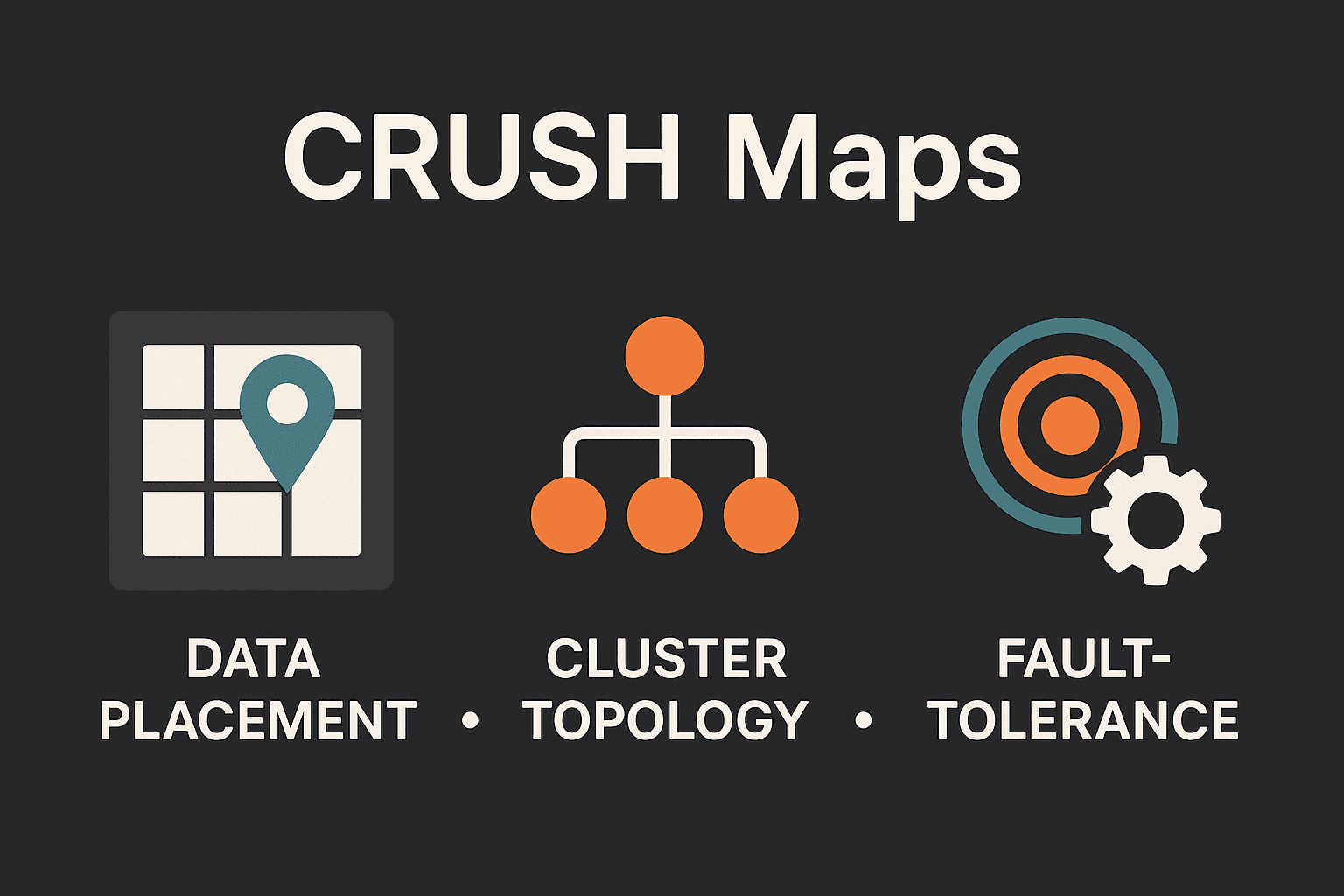
CRUSH Maps define how data is placed across a storage cluster using a set of rules and a hierarchical view of the infrastructure. When a write request is issued, the CRUSH algorithm calculates where data should be stored based on the map, without relying on any external metadata lookup.
The map includes awareness of all storage devices and their relationships to hosts, racks, rows, and data centers, along with rules that control how replicas or erasure-coded chunks are distributed. Because the storage system understands its own topology, it can maintain balance, enforce redundancy, and adjust placement automatically as the cluster grows or changes.
🚀 Improve Data Placement in CRUSH-Style Environments
Strengthen your storage architecture with simplyblock’s software-defined tools that support predictable, rule-driven data distribution.
👉 Find Out More About Software-Defined Storage →
Why CRUSH Maps Matter in Distributed Clusters
Large storage systems deal with constant change. Disks fail. Nodes come and go. Racks are added. Hardware gets upgraded. CRUSH Maps handle these shifts automatically by recalculating placement instead of relying on static tables.
Because clients compute placement themselves, the system avoids bottlenecks and can support thousands of nodes. This is one reason Ceph remains a strong choice for scalable, fault-tolerant storage.
Advantages of CRUSH Maps in Large Storage Deployments
CRUSH Maps bring several benefits that help maintain cluster health and performance:
- Balanced Data Distribution: Data spreads evenly across available resources, reducing hot spots and improving overall throughput.
- Quick Recovery After Failures: When a device or node goes down, CRUSH recalculates placement and rebalances data with minimal delay.
- Flexible Placement Policies: Rule-based placement allows control over how data is replicated across racks, zones, or sites.
- No Metadata Bottlenecks: Eliminating centralized metadata lookup enables CRUSH to scale cleanly as the cluster grows.
Together, these advantages make CRUSH Maps well suited for large-scale storage systems where growth, failure tolerance, and predictable performance must be handled automatically. As clusters expand, CRUSH continues to place data efficiently without increasing operational complexity.
Where CRUSH Maps Are Most Useful
CRUSH Maps support a wide range of environments that depend on predictable, rule-driven storage placement:
- High-capacity analytics platforms that need balanced, scalable storage.
- Multi-rack or multi-zone deployments that must isolate replicas for durability.
- Hybrid clusters that mix different storage types or performance tiers.
- Service providers running multi-tenant infrastructure with strict placement requirements.
These scenarios benefit from CRUSH’s ability to adapt placement automatically as infrastructure changes, ensuring consistent behavior without manual intervention.
CRUSH Maps vs Conventional Storage Placement
Many storage systems rely on centralized metadata services to decide where data is stored, which can become a bottleneck as clusters grow. CRUSH Maps avoids this limitation by removing the central coordinator and using an algorithm to calculate placement directly.
This approach improves scalability, speeds up recovery, and keeps performance predictable as infrastructure changes.
Here’s how CRUSH Maps compare to conventional, metadata-driven storage placement models:
| Feature | Conventional Storage Placement | CRUSH Maps |
|---|---|---|
| Data Lookup | Central metadata service | Distributed algorithm |
| Scalability | Limited by metadata bottlenecks | Scales linearly with cluster size |
| Recovery | Dependent on central controller | Automatic recalculation |
| Failure Domains | Manual configuration | Rule-based placement |
| Performance Impact | Metadata overhead can slow I/O | No lookup overhead |
The differences show how CRUSH Maps simplify data placement while supporting large-scale storage systems.
CRUSH Maps in Cluster Growth and Rebalancing
When a cluster expands, data placement often becomes harder to manage in traditional systems because new hardware must be manually integrated into the storage layout. With CRUSH Maps, the algorithm immediately understands the new topology and adjusts placement rules accordingly.
This means the cluster can rebalance gradually without downtime, and recovery operations stay predictable even during large changes. The same logic applies when nodes fail—CRUSH computes new locations for replicas based on the rules already defined in the map.
How Simplyblock Supports CRUSH-Style Storage Behavior
Simplyblock enhances CRUSH-like placement by making rule management and cluster scaling smoother. It helps teams maintain even distribution, faster recovery, and consistent performance without dealing with heavy manual configuration.
With simplyblock, organizations can:
- Boost Data Placement Efficiency: Maintain predictable distribution across nodes without complicated tuning.
- Speed Up Recovery Processes: Automatic failover and optimized data paths keep rebuild times short.
- Reduce Administrative Overhead: Simple tools for managing placement rules and cluster topology streamline daily operations.
- Support Mixed Deployments: Handle performance tiers, different zones, or tenant isolation with flexible placement controls.
The Future of CRUSH-Based Storage Models
As infrastructure becomes more distributed and storage demands grow, CRUSH-style placement will continue to be vital for large-scale clusters.
Systems need placement logic that adapts instantly to new hardware, failures, and hybrid environments without slowing down. CRUSH Maps provide this foundation, making them essential for future-ready storage architectures.
Related Terms
Teams often review these glossary pages alongside CRUSH Maps when they define failure domains, balance placement during growth events, and keep recovery behavior predictable in Ceph-based clusters.
Hybrid Erasure Coding
Storage Rebalancing
RADOS Block Device (RBD)
Fault Tolerance
Questions and Answers
CRUSH Maps use rules and a hierarchical cluster layout to determine exactly where each piece of data should be placed. Instead of relying on a central lookup table, CRUSH calculates placement on the fly, enabling efficient, scalable, and deterministic data distribution.
You may need to modify a CRUSH Map when adding new nodes, balancing data across hardware, enforcing failure-domain rules, or adjusting performance characteristics. Editing the map ensures the cluster distributes data optimally as infrastructure changes.
CRUSH Maps let you define failure domains such as disks, hosts, racks, or data centers. By spreading data replicas across these domains, Ceph minimizes the chance of losing multiple copies in a single failure event, significantly improving durability.
A poorly configured CRUSH Map can lead to uneven data distribution, hot disks, slow recovery operations, and higher latency. Proper rules and hierarchy ensure balanced workloads and predictable performance across the cluster.
When new hardware is added, CRUSH automatically recalculates placement and redistributes a portion of the data to maintain balance. Only the minimum required data is moved, allowing the cluster to scale with minimal disruption.