CSI Snapshot Controller
Terms related to simplyblock
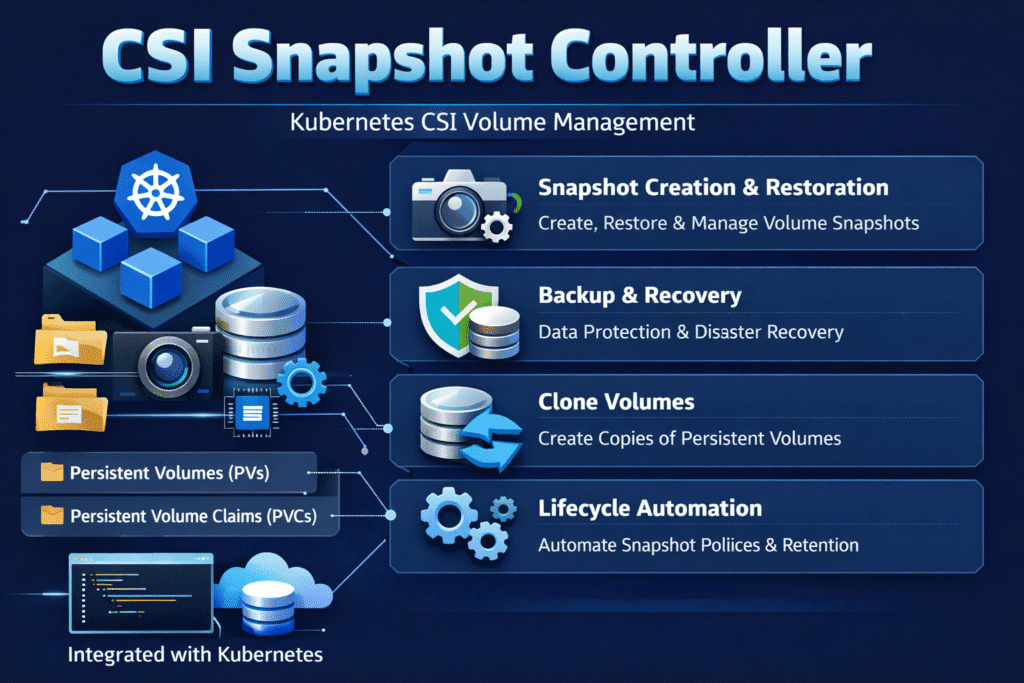
The CSI Snapshot Controller runs inside your cluster and watches VolumeSnapshot objects. When a user requests a snapshot, it coordinates the flow that binds VolumeSnapshot to VolumeSnapshotContent, then drives snapshot create and delete steps through the CSI snapshot sidecar for the right driver.
This controller matters because Kubernetes snapshots are not “just a CRD.” You need the controller and the snapshot CRDs, plus a CSI driver that supports snapshot operations.
How the Snapshot Control Plane Fits Together
Kubernetes splits snapshot support across a few pieces. The API uses snapshot CRDs such as VolumeSnapshot, VolumeSnapshotContent, and VolumeSnapshotClass. The controller watches these objects and manages the binding and lifecycle logic.
The CSI external-snapshotter sidecar runs alongside each CSI driver and calls the driver’s snapshot RPCs. One snapshot controller deployment can serve many CSI drivers in the same cluster.
🚀 Automate CSI Snapshot Controller Backups for Kubernetes Volumes
Use Simplyblock to take fast copy-on-write snapshots and keep restores simple, so backups don’t slow down production clusters.
👉 Use Simplyblock for Kubernetes Backup →
CSI Snapshot Controller in Kubernetes Storage
In Kubernetes, the snapshot workflow starts when someone creates a VolumeSnapshot that points to a PVC and references a VolumeSnapshotClass. The controller picks the right class (or default), creates or binds VolumeSnapshotContent, and keeps status fields updated so tooling can track readiness.
Cluster admins usually treat this as a platform feature. You install the CRDs once, run the controller with leader election, and then enable snapshot classes per CSI driver so teams can self-serve backups and rollbacks safely.
Snapshot Classes, Defaults, and Guardrails
VolumeSnapshotClass work like StorageClass: it selects the driver and passes parameters. Many platforms allow multiple defaults, often one default per CSI driver, so a VolumeSnapshot user can omit the class and still resolve correctly.
Good guardrails prevent surprises. You want clear retention rules, clear RBAC, and a naming pattern that helps teams avoid “snapshot sprawl” in shared clusters.
What to Measure When Snapshots Matter
Snapshot success is not only “did it create.” Teams also track how snapshots affect app latency, especially during busy windows. A solid benchmark checks snapshot create time, restore time, and p95/p99 I/O while the snapshot happens.
Driver behavior makes a big difference. Some backends create snapshots as fast metadata operations, while others need more work behind the scenes, so you should test with your real workload mix.
Operational Checklist for Stable Snapshot Automation
- Install one set of snapshot CRDs and avoid duplicate versions.
- Enable leader election on the controller so it stays reliable during upgrades.
- Create a
VolumeSnapshotClassper CSI driver and set a default where it helps. - Test create + restore under load, not only on an idle cluster.
- Limit who can snapshot sensitive PVCs with RBAC and namespace policy.
- Add cleanup rules so old snapshots don’t pile up and pin capacity.
Snapshot Controller Components Compared
This table shows what each piece does in the snapshot stack and where teams usually troubleshoot first. Use it to pinpoint whether an issue lives in Kubernetes control logic, the CSI sidecar, or the storage backend.
| Component | Runs where | Main job | Common failure signal |
|---|---|---|---|
Snapshot CRDs (VolumeSnapshot*) | API server | Define snapshot objects and status | Missing CRDs or wrong API version |
| Snapshot controller | Cluster control plane | Watches CRDs, binds content, manages lifecycle | VolumeSnapshot stuck unready |
| CSI external-snapshotter sidecar | With each CSI driver | Calls CreateSnapshot/DeleteSnapshot on the driver | Driver errors in sidecar logs |
| Storage backend | Storage system | Implements the snapshot and data handling | Watches CRDs, binds content, and manages lifecycle |
Predictable CSI Snapshot Controller Workflows with Simplyblock
Simplyblock supports Kubernetes volume snapshotting with copy-on-write behavior, which makes snapshots fast and keeps overhead low for many workloads.
That pairing fits real platform goals: quick backups, quick rollbacks, and repeatable snapshot automation through CSI. You can keep results predictable by combining snapshot policies with QoS and clean retention rules.
What’s Next in Kubernetes Snapshot Features
Kubernetes continues to expand snapshot use cases beyond single volumes. Volume group snapshots aim to capture crash-consistent points across multiple PVCs, which helps apps that split data across several volumes.
As these features mature, teams will care even more about clear status reporting, safe cleanup, and predictable restore time under load.
Related Terms
Teams often review these glossary pages alongside the CSI Snapshot Controller when they plan backup targets, restore speed, and failure-safe snapshot workflows.
Questions and Answers
The CSI Snapshot Controller manages the lifecycle of volume snapshots in Kubernetes. It works alongside CSI drivers to enable snapshot-based backups and clones for persistent volumes in stateful workloads.
It allows Kubernetes users to create consistent, point-in-time snapshots of PVCs. These snapshots are crucial for fast rollback, disaster recovery, and cloud cost optimization by reducing restore time and overhead.
Yes, snapshots managed by the CSI Snapshot Controller can be used as sources for new PVCs. This makes it easy to provision zero-copy clones or duplicate environments for dev, test, or analytics.
Yes, as long as the CSI driver supports it. When paired with NVMe over TCP, snapshot operations are fast and efficient, ideal for high-performance Kubernetes clusters.
While the Snapshot Controller itself handles lifecycle operations, scheduled backups can be managed using external tools like Velero. These integrate with CSI to automate persistent volume snapshotting for backup and restore workflows.