DRAID (Distributed RAID)
Terms related to simplyblock
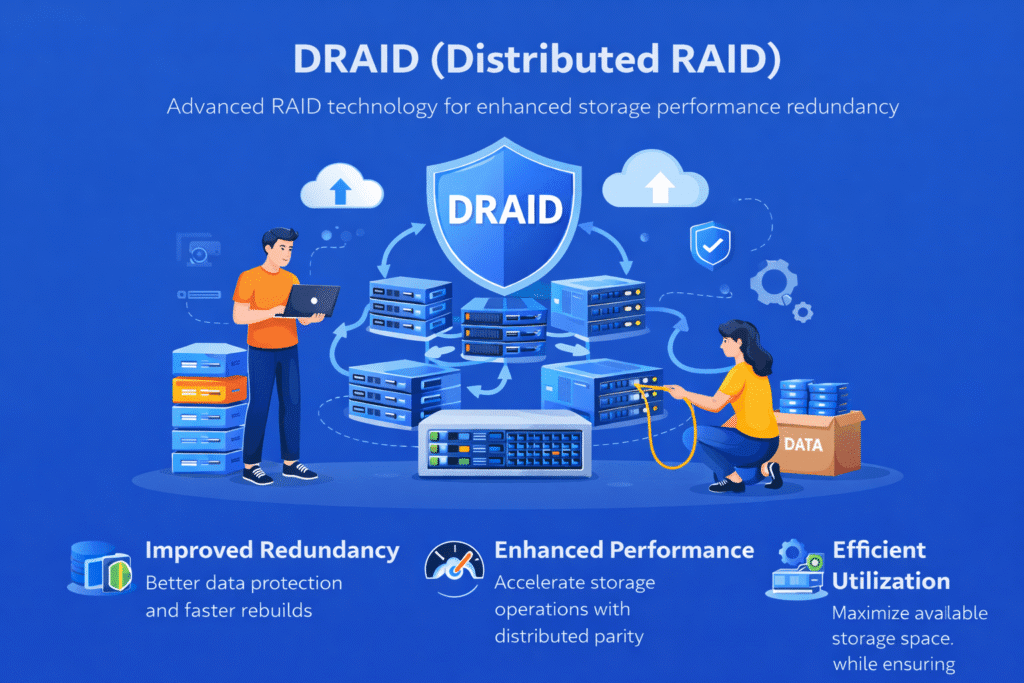
DRAID (Distributed RAID) distributes parity and rebuild work across multiple drives, rather than confining recovery to a small RAID set. Teams use it to cut rebuild time, avoid “hot” disks during recovery, and keep latency more stable when a drive fails.
You’ll see DRAID in two common forms: declustered RAID in some enterprise arrays, and OpenZFS dRAID, which adds distributed spare space to speed resilvering while keeping RAIDZ-style parity.
Getting More from Distributed RAID in Real Systems
Classic RAID rebuilds often hammer a fixed group of drives. Large disks stretch that rebuild the window, and the array spends more time in a degraded state. Distributed RAID spreads recovery work across more devices, so rebuilds finish sooner and foreground I/O stays steadier.
Modern platforms also improve recovery behavior with rebuild pacing and better visibility. Those controls matter because recovery work competes with application I/O.
🚀 Keep DRAID Rebuild Latency Stable in Kubernetes
Use Simplyblock to run NVMe/TCP-backed persistent volumes with QoS, so recovery traffic doesn’t trigger p99 spikes at scale.
👉 Use Simplyblock for Kubernetes Persistent Storage →
Where It Fits in Kubernetes Storage
Kubernetes storage faces bursty jobs, multi-tenant noise, and rescheduling that can shake latency. This approach helps most when you rely on local disks in each node (or a small set of storage nodes), and you want faster recovery after a device failure.
Disk-level protection covers only one failure domain. When apps need node or zone resilience, teams add replication or erasure coding at the system level.
DRAID (Distributed RAID) and NVMe/TCP Data Paths
NVMe/TCP serves block I/O over Ethernet, so apps can feel storage changes quickly, especially in p99 latency. During recovery, parity reconstruction moves a lot of data inside the storage node. That activity shares CPU, PCIe, and device queues with client I/O that arrives over NVMe/TCP.
This design can reduce rebuild hot spots, but it does not automatically protect against latency. You keep performance steady when you reserve headroom and apply QoS so recovery work does not steal the app’s budget.
How to Benchmark Rebuild Impact and Tail Latency
Measure performance in two states: healthy and recovering. Healthy tests show baseline throughput and latency. Recovery tests show risk while the system rebuilds or resiliencies.
Track p95 and p99 latency, sustained IOPS, rebuild duration, and time-to-stability after recovery completes. Run the same workload with active recovery and without it, then compare tail behavior.
Practical Tuning Moves for Faster, Safer Recovery
- Match the layout to your workload, not just capacity goals.
- Protect app latency during rebuilds by reserving IOPS and bandwidth for foreground traffic.
- Use consistent drive classes inside the protection set to avoid one slow member dragging the pool.
- Tune I/O size and queue depth so parity work stays efficient under random write pressure.
- Design for the right failure domain when workloads require node or zone HA.
- Watch tail latency first, since p99 shifts reveal user impact earlier than averages.
DRAID (Distributed RAID) vs Alternatives – Operational Tradeoffs
This table shows how DRAID compares with classic RAID, ZFS RAIDZ, and cluster-level protection methods in day-to-day operations. Use it to match your failure domain needs, rebuild behavior, and latency risk to the right design choice.
| Approach | What it protects against | Recovery behavior | Best fit | Main tradeoff |
|---|---|---|---|---|
| RAID6 (classic) | 2 drive failures in a RAID set | Rebuild load concentrates on the set | Smaller arrays | Long rebuild windows on large disks |
| RAIDZ2 (ZFS) | 2 drive failures in a vdev | Resilver work follows vdev layout | ZFS pools | Recovery load can still spike |
| dRAID (OpenZFS) | Parity + distributed spare space | Spreads work and speeds resilvering | Large pools | Layout planning matters more |
| Distributed erasure coding | Disk/node failures across a cluster | Rebuild spreads across nodes | Scale-out Kubernetes storage | Network + CPU overhead |
| Replication (2–3x) | Node/zone failures (depends on placement) | Fast failover, simpler recovery | Latency-sensitive HA | High capacity cost |
Keeping Predictable Performance with Simplyblock
DRAID improves resilience inside a server, but Kubernetes teams usually care about predictable per-volume latency across tenants and during failure events. Simplyblock targets that goal with NVMe/TCP-based software-defined block storage built for Kubernetes operations, where contention and background work can push p99 latency up.
If you like the recovery-speed goal behind DRAID, apply the same discipline at the platform level: test failure mode, enforce QoS, and keep limits clear per volume. That approach turns “good on average” into “stable under stress.”
Future Directions and Advancements in DRAID (Distributed RAID)
Work in this area keeps moving toward faster recovery with fewer surprises for applications. Expect more focus on rebuild pacing, stronger isolation between recovery traffic and foreground I/O, and clearer guidance on layout choices for real workloads.
Teams will also keep comparing disk-level protection with cluster-level protection, especially in NVMe/TCP and Kubernetes setups where CPU and network headroom shape tail latency.
Related Terms
Teams often review these glossary pages alongside DRAID (Distributed RAID) when they plan rebuild behavior, failure handling, and predictable latency for Kubernetes block storage.
Questions and Answers
DRAID distributes both data and parity across all disks, unlike traditional RAID, which uses dedicated parity disks. This improves rebuild speed and parallelism—beneficial in software-defined storage environments with many drives.
DRAID leverages all available disks to participate in rebuild operations, significantly reducing the time it takes to recover from a disk failure. This helps maintain high storage performance even during degraded states.
Yes, DRAID is ideal for large-scale, distributed storage backends that serve Kubernetes stateful workloads. It supports fast recovery, scalability, and resilience, making it well-suited for modern cloud deployments.
Absolutely. DRAID can enhance the durability and rebuild performance of NVMe over TCP storage clusters. It ensures minimal performance degradation during failures in high-speed, disaggregated setups.
While RAID 6 uses fixed parity and limited rebuild bandwidth, DRAID distributes parity more evenly and rebuilds faster. Unlike erasure coding, DRAID is simpler to implement and better suited for performance-sensitive workloads.