EKS vs ECS
Terms related to simplyblock
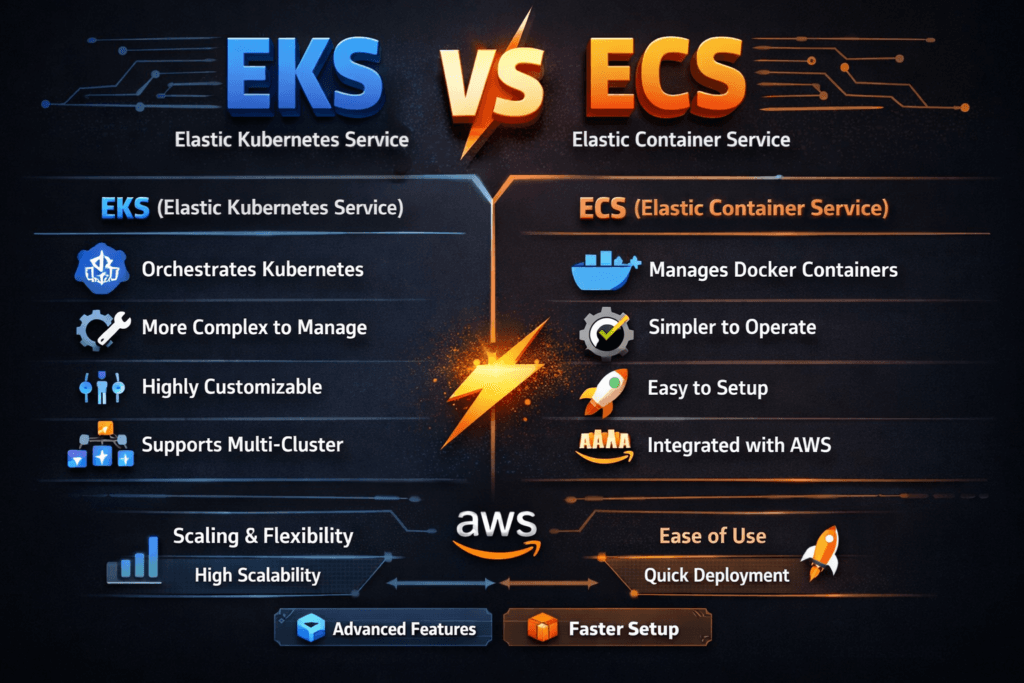
EKS vs ECS compares two AWS-managed methods for running containers. Amazon EKS runs upstream Kubernetes as a managed control plane, allowing you to retain Kubernetes APIs, tooling, and the broader ecosystem. Amazon ECS runs AWS’s own container scheduler, which integrates tightly with AWS services and simplifies some day-2 tasks when you do not need Kubernetes.
For many teams, the real decision shows up around platform standards, team skills, and storage behavior under failure, scaling, and upgrades.
EKS vs ECS – The fastest way to explain the difference
Choose EKS when you want Kubernetes portability, Kubernetes-native extensions, and consistent tooling across clouds or on-prem. Choose ECS when you want a managed AWS-first control model and prefer AWS-native patterns over Kubernetes primitives.
The gap widens as workloads become stateful. Stateless services mostly care about rollout speed and autoscaling. Stateful services care about volume identity, attach rules, and predictable latency.
🚀 Run EKS Stateful Services with NVMe/TCP Storage That Stays Predictable
Use simplyblock to deliver Software-defined Block Storage for Kubernetes Storage, and reduce EBS pressure at scale.
👉 Use simplyblock for AWS Storage →
Kubernetes Storage on EKS – PVCs, StorageClasses, and CSI
EKS inherits Kubernetes Storage patterns: StorageClasses describe policy, PersistentVolumeClaims request capacity, and CSI drivers handle provisioning and attachment. This model lets platform teams standardize storage tiers once, then let app teams self-serve volumes with guardrails.
EKS also makes it easier to adopt advanced storage behaviors that live in the Kubernetes ecosystem, such as topology-aware placement, snapshot automation, and policy checks in CI. Those controls matter when you run multi-tenant clusters or strict service level targets.
ECS storage behavior – tasks, mounts, and service-level tradeoffs
ECS can run on EC2 or on AWS Fargate, and each mode shapes storage options and limits. ECS often works best when you keep services stateless or when you attach storage in a way that matches the ECS runtime you chose.
When teams move databases or queue systems into ECS, they typically spend more time designing around placement, failure domains, and storage limits at the service level. That can still succeed, but it pushes more app-specific work into the platform plan.
EKS vs ECS and NVMe/TCP for lower-latency block I/O
NVMe/TCP matters when you want high IOPS and stable latency over standard Ethernet without specialized fabrics. It also fits Kubernetes Storage well because CSI-based provisioning can present fast block volumes to pods while keeping operations consistent.
If you run EKS, you can combine NVMe/TCP, Kubernetes Storage, and Software-defined Block Storage to build a SAN alternative that scales on commodity nodes. This approach helps when EBS performance-per-dollar or multi-tenant contention becomes a limiter.
Benchmarking EKS and ECS for stateful performance
Benchmark the platform in the way your business consumes it. Start with tail latency (p95/p99), not just peak IOPS, because tail behavior drives user impact during node drains and scaling events. Next, test steady load plus burst load, since burst behavior exposes queueing and noisy-neighbor problems.
Track three layers together: application latency, node CPU usage, and storage latency. This combination shows whether the bottleneck lives in the app, the host, or the storage path. It also helps executives tie performance risk back to cost and staffing.
Decision checklist for executives and platform owners
- Pick EKS when you need Kubernetes portability, strong ecosystem coverage, and consistent Kubernetes APIs across environments.
- Pick ECS when you want an AWS-native scheduler and prefer fewer Kubernetes moving parts.
- Favor EKS for multi-tenant Kubernetes Storage standards, because StorageClasses and CSI make policy easier to enforce across teams.
- Favor NVMe/TCP plus Software-defined Block Storage when your stateful tier needs better latency stability or higher throughput density than a basic cloud volume tier.
EKS vs ECS – Comparison table for storage, ops, and portability
This table summarizes the practical differences that show up after the first production rollout.
| Dimension | EKS | ECS |
|---|---|---|
| Orchestration model | Upstream Kubernetes control plane | AWS-native scheduler |
| Kubernetes Storage fit | Native PVC/StorageClass/CSI workflow | Storage choices depend on launch type and task design |
| Portability | High portability with Kubernetes APIs | Lower portability; AWS-first patterns |
| Day-2 operations | Strong Kubernetes tooling, but more knobs | Fewer Kubernetes knobs; AWS integration-first |
| Stateful performance path | Works well with NVMe/TCP + Software-defined Block Storage tiers | Often best with simpler stateful footprints or tighter app design |
Simplyblock™ storage strategy for EKS and ECS teams
Simplyblock™ supports Software-defined Block Storage for Kubernetes Storage with NVMe/TCP, so platform teams can standardize a high-performance storage tier for stateful services and reduce dependence on one cloud volume class.
This model fits three common goals: keep latency predictable for databases, scale storage without a forklift upgrade, and simplify multi-tenant controls with QoS and policy-based provisioning.
Where EKS and ECS decisions are heading
AWS keeps adding managed features to reduce cluster ops overhead, while teams keep pushing for portability and standard tooling.
That mix typically increases EKS adoption for platforms that run many internal teams. ECS continues to fit well for AWS-first orgs that favor a simpler container control model for mostly stateless services.
Related Terms
Teams often review these glossary pages alongside EKS vs ECS when they standardize Kubernetes Storage and Software-defined Block Storage.
- IO Path Optimization
- Zonal vs Regional Storage
- Kubernetes Node Affinity
- Storage Resource Quotas in Kubernetes
Questions and Answers
EKS (Elastic Kubernetes Service) runs Kubernetes natively, while ECS (Elastic Container Service) is AWS’s proprietary container orchestration platform. EKS offers more flexibility and is ideal for teams already using Kubernetes, while ECS simplifies deployment for tightly integrated AWS workloads.
EKS provides more robust support for persistent volumes through the Kubernetes CSI interface, enabling integration with dynamic NVMe over TCP storage and advanced features like encryption. ECS is more limited in volume management and better suited for stateless workloads.
EKS is better suited for stateful applications, thanks to its CSI support and compatibility with advanced Kubernetes-native storage. It allows better control over storage provisioning, backups, and multi-tenant isolation—especially for databases or AI pipelines.
Choose ECS when you need a fully managed, AWS-native solution with minimal operational overhead. It’s ideal for simple stateless services or organizations unfamiliar with Kubernetes. However, EKS is more future-proof and compatible with hybrid and multi-cloud architectures.
Storage on ECS is often limited to Amazon EBS and requires manual setup, whereas EKS supports CSI drivers like Simplyblock for dynamic provisioning, encryption at rest, and NVMe/TCP performance—making it more scalable for production workloads.