Fibre Channel over Ethernet (FCoE)
Terms related to simplyblock
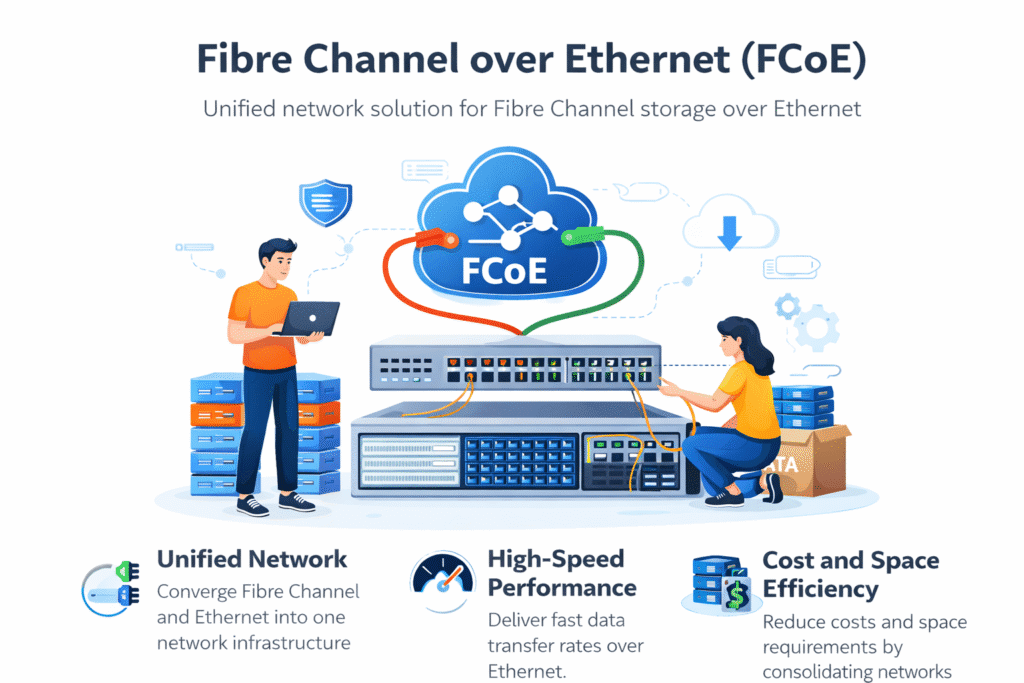
Fibre Channel over Ethernet (FCoE) carries Fibre Channel frames over Ethernet, so teams can run storage traffic and LAN traffic on the same physical network. FCoE keeps the Fibre Channel protocol intact, and it relies on Data Center Bridging (DCB) features to reduce loss on Ethernet.
Many enterprises evaluated FCoE as a bridge from classic Fibre Channel SANs to converged networks, but the industry never adopted it at broad scale. That history matters when you compare it with NVMe/TCP, Kubernetes Storage, and Software-defined Block Storage options that aim for simpler operations and better scale economics.
Where FCoE Fits in SAN Designs
FCoE fits best when a team already runs a Fibre Channel SAN and wants to converge cabling and switch ports in the access layer while keeping Fibre Channel tooling and zoning. Fibre Channel itself focuses on in-order, lossless delivery for block storage traffic, which helps explain why teams built separate SAN fabrics in the first place.
Even in those cases, operators still manage SAN concepts, plus Ethernet QoS and congestion behavior. That combined scope often drives the real cost.
🚀 Replace FCoE with NVMe-oF on Standard Ethernet
Use Simplyblock to run Software-defined Block Storage for Kubernetes Storage with NVMe/TCP and SPDK efficiency.
👉 See NVMe over Fabrics & SPDK →
Fibre Channel over Ethernet (FCoE) and Data Center Bridging
FCoE depends on DCB, so Ethernet behaves more like a storage fabric under load. DCB features commonly include Priority Flow Control (PFC) and Enhanced Transmission Selection (ETS), plus negotiation through DCBX on many platforms. Cisco’s operational guidance highlights how teams use DCBX to keep PFC and ETS settings aligned between peers.
FCoE also uses the FCoE Initialization Protocol (FIP) to discover and log in to the fabric over Ethernet, which keeps the Fibre Channel control model while the Ethernet network carries the frames.
Fibre Channel over Ethernet (FCoE) vs NVMe/TCP for Kubernetes Storage
When platform teams run Kubernetes Storage, they usually prioritize automation, predictable upgrades, and simple troubleshooting. NVMe/TCP fits that operational model because it runs NVMe over standard TCP/IP networks and avoids the lossless-Ethernet tuning that FCoE needs.
FCoE can work in virtualized environments, but Kubernetes-native stacks more often standardize on Ethernet-based storage protocols that align with cloud-native workflows and CSI integration.
How FCoE Compares to NVMe/FC and iSCSI for Software-defined Block Storage
FCoE typically competes in the same conversation as iSCSI and Fibre Channel refreshes. iSCSI runs over standard Ethernet, but it carries SCSI semantics and often adds more protocol overhead than NVMe transports.
If an enterprise wants to keep Fibre Channel investments while raising performance, NVMe/FC (NVMe over Fibre Channel) offers an NVMe command path on existing FC fabrics. Still, many teams now treat Ethernet-based Software-defined Block Storage as the long-term direction, especially when they want flexible deployment in hyper-converged or disaggregated models.
Operational Checklist for Reliable FCoE
- Define one DCB policy for storage traffic, and keep it consistent across switches, NICs, and host profiles.
- Limit PFC to the intended priority, and validate buffer thresholds to avoid pause spreading during bursts.
- Separate storage and general traffic classes with clear QoS markings, then test under contention before rollout.
- Track p95 and p99 latency, not just throughput, because microbursts often show up in tail latency first.
- Document failure modes and rollback steps, including what happens when a DCB setting drifts on one hop.
Comparing FCoE with Ethernet-Based SAN Alternatives
Executives often ask, “What replaces this cleanly?” The table below compares FCoE with common options teams use when they want a SAN alternative that supports Kubernetes Storage and Software-defined Block Storage goals.
| Option | Transport and model | Fabric requirements | Ops profile | Fit for Kubernetes Storage | Notes |
|---|---|---|---|---|---|
| FCoE | Fibre Channel frames over Ethernet | DCB (lossless features) | Higher | Low–Medium | Converges cabling, keeps SAN concepts |
| Fibre Channel | Native FC fabric | FC switches, HBAs | Moderate | Low–Medium | Strong legacy fit for SAN workloads |
| iSCSI | SCSI over TCP/IP | Standard Ethernet | Medium | Medium | Broad support, more protocol overhead |
| NVMe/TCP | NVMe over TCP/IP | Standard Ethernet | Low–Medium | High | Strong path for cloud-native block storage |
Simplyblock™ as a SAN Alternative to FCoE
Simplyblock™ targets Ethernet-based storage with NVMe/TCP, Kubernetes Storage integration, and Software-defined Block Storage control. That combination helps teams retire the “special fabric” mindset that FCoE introduced, while still meeting performance and isolation goals.
Simplyblock builds on SPDK-style user-space principles to reduce CPU overhead on the dataplane, which matters when you consolidate many tenants and volumes on baremetal nodes. For readers comparing Fibre Channel paths, simplyblock also covers NVMe/FC and NVMe over Fabrics using Fibre Channel in its glossary.
What Comes Next After FCoE in Enterprise Storage Networks
Most teams now choose between two clean paths. Some keep Fibre Channel and adopt NVMe/FC to raise performance while staying inside the SAN operating model.
Others move to Ethernet-first designs that favor NVMe/TCP for scale and simpler operations, especially in Kubernetes-centric environments.
Related Terms
Teams often review these glossary pages alongside Fibre Channel over Ethernet (FCoE) when they plan SAN alternatives for Kubernetes Storage and Software-defined Block Storage.
Storage Area Network (SAN)
ISCSI
NVMe over FC
Kubernetes Block Storage
Data center bridging (DCB)
Questions and Answers
FCoE transports Fibre Channel frames over Ethernet networks, enabling SAN connectivity without separate cabling. It’s a legacy alternative to protocols like NVMe over TCP in converged infrastructure environments.
FCoE is being phased out in favor of more flexible and scalable protocols like NVMe/TCP. NVMe/TCP runs on standard Ethernet without requiring lossless networks, offering better adoption in cloud-native environments.
FCoE is rarely used in Kubernetes due to its complexity and hardware requirements. Instead, Kubernetes storage typically relies on CSI drivers and protocols like NVMe/TCP or iSCSI for dynamic volume provisioning.
While FCoE can offer low-latency SAN access, it requires a lossless Ethernet fabric (DCB), which adds complexity. Modern alternatives like software-defined storage using NVMe/TCP offer similar or better performance with easier deployment.
No, FCoE is better suited for legacy enterprise setups. Cloud-native infrastructures benefit more from flexible, TCP-based protocols like NVMe over TCP that scale across containerized and virtualized environments.