Five Nines Availability
Terms related to simplyblock
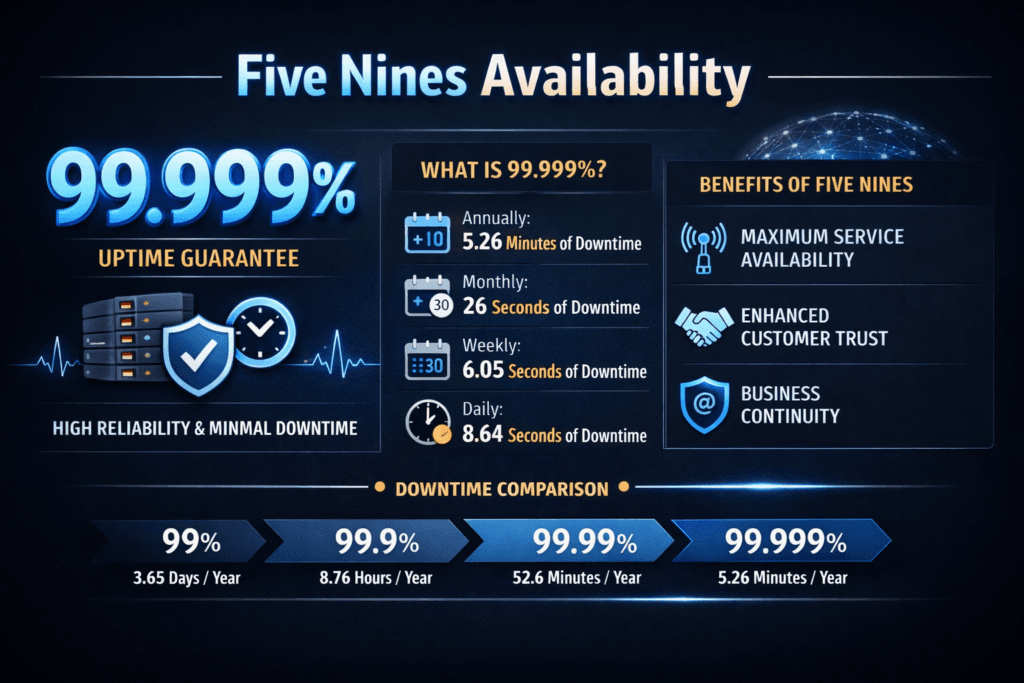
Five Nines Availability means a service stays up 99.999% of the time over a defined window. Over a year, that target leaves about 5 minutes of total downtime. Most teams treat this as a business control, because a single slow recovery can burn the full budget.
Storage often decides whether users see “up” or “down.” If storage latency spikes, apps hit timeouts, retries surge, and request queues collapse. Leaders then see an outage even when servers still run. For that reason, teams track uptime together with MTTR, RTO/RPO, and p99 latency.
In practice, Five Nines Availability comes from design choices that limit blast radius and speed up recovery. Software-defined Block Storage helps because it standardizes operations on commodity hardware and supports automation-first workflows.
Engineering Higher Uptime with Today’s Platforms
High uptime needs repeatable operations under stress. A platform that behaves well only during calm periods will fail the moment you patch nodes, drain hosts, or roll a cluster upgrade.
Teams typically improve uptime by shrinking the “unknowns.” They isolate failure domains, reduce manual steps, and enforce resource controls so one workload cannot starve another. They also keep changes safe by using rolling updates and fast rollback paths.
When storage follows the same control model as the rest of the stack, operators can respond in seconds, not hours. That is the difference between a minor event and a reportable outage.
🚀 Protect Your Five Nines Availability With Faster Recovery
Use Simplyblock to cut MTTR with high-availability design, rapid failover, and predictable storage performance in Kubernetes.
👉 Reduce RTO and RPO With Simplyblock →
Five Nines Availability in Kubernetes Storage
Kubernetes Storage adds churn by design. Pods move, nodes rotate, and upgrades happen often. Stateful apps still expect consistent volumes and stable performance through those events.
To hit Five Nines Availability in Kubernetes, the storage layer must handle failure without human intervention. CSI-based provisioning keeps volume lifecycle consistent. Clear topology rules prevent scheduling dead ends when nodes fail. Policy-based controls also matter because shared clusters amplify noisy-neighbor risk.
Many teams choose between hyper-converged and disaggregated layouts based on their failure model. Hyper-converged can reduce network hops. Disaggregation can reduce correlated failures and make maintenance easier. Mixed layouts can work when the platform enforces placement and QoS.
Five Nines Availability and NVMe/TCP
NVMe/TCP carries NVMe commands over standard Ethernet, which helps teams keep a consistent storage path across environments. That consistency reduces operational drift, and it makes failover behavior easier to predict.
NVMe/TCP also fits disaggregated designs where compute and storage scale separately. A compute node can fail while storage nodes keep serving volumes. Storage nodes can roll through maintenance while applications keep running on other compute.
When teams pair NVMe/TCP with Software-defined Block Storage, they get a practical SAN alternative that still delivers low latency and strong control. That mix supports uptime goals because it reduces protocol overhead and keeps queue handling more direct.
Measuring and Benchmarking Availability Performance
Uptime becomes real only when teams measure what burns the downtime budget. Start with the budget, then track the signals that predict budget loss.
Measure more than “is it up.” Track time to detect failure, time to fail over, and time to return to steady performance. Watch tail latency (p95 and p99), not just averages, because tail events trigger timeouts and retries.
Benchmarking should include failure tests under load. Run realistic I/O, then remove a node, cut a network path, or restart a service. Record recovery time and the latency impact during rebuild or resync. Repeat the same test after every upgrade so you catch regressions early.
Practical Ways to Improve Uptime Outcomes
Most availability gains come from fewer surprises and faster recovery. These steps tend to pay off in production.
- Define fault domains at node, rack, and zone levels, then spread replicas or erasure sets across them.
- Enforce multi-tenancy and QoS so critical volumes keep their I/O budget during contention.
- Automate failover and healing, and test those paths on a schedule.
- Keep upgrades rolling and reversible, and reduce one-shot change windows.
- Monitor tail latency, queue depth, and rebuild speed to catch overload before timeouts spread.
High-Availability Mechanisms Compared
The table below shows how common protection methods affect recovery behavior and operational risk for stateful workloads.
| Method | What it protects | Recovery behavior | Main tradeoff | Fit for Kubernetes Storage |
|---|---|---|---|---|
| Local RAID (single node) | Drive failure in one host | Fast for single-disk issues | Weak for node loss | Limited for HA apps |
| Synchronous replication | Node or device failure | Fast failover, near-zero loss | Write overhead | Strong for strict uptime |
| Asynchronous replication | Site or zone events | Recovery depends on lag | Non-zero RPO | Strong for DR planning |
| Erasure coding | Multiple failures (policy-based) | Rebuild varies by layout | More complex rebuilds | Strong at scale when tuned |
Simplyblock™ Controls for Consistent Uptime
Simplyblock™ targets predictable uptime by combining high-performance I/O with controls that fit platform teams. Its SPDK-based, user-space data path reduces overhead and helps keep latency tight under load. Stable latency matters during failover because apps often fail from timeouts, not from hard crashes.
Simplyblock supports NVMe/TCP and flexible deployment models across hyper-converged, disaggregated, and mixed layouts. Multi-tenancy and QoS help protect tier-1 volumes from noisy neighbors, which reduces “performance outages” that users experience as downtime. For teams standardizing Kubernetes Storage, these behaviors align with day-two operations such as node drains, rolling upgrades, and capacity growth.
Simplyblock also delivers Software-defined Block Storage on standard servers, which helps teams scale availability without a fixed appliance roadmap.
Trends Shaping High-Availability Storage
Availability targets keep rising as more databases move into Kubernetes. Teams will push more policy into automation, including error-budget gates for risky changes. Continuous fault testing will also become a standard control, not a special project.
On the data path, more vendors will shift work into the user space and offload parts of networking and storage to DPUs/IPUs. That trend can reduce CPU pressure and help keep tail latency stable during spikes. NVMe-oF adoption will grow alongside these changes, and NVMe/TCP will remain a practical choice when teams want broad compatibility and consistent operations.
Related Terms
Teams often review these glossary pages alongside Five Nines Availability when they set measurable targets for Kubernetes Storage and Software-defined Block Storage.
CSI NodePublishVolume Lifecycle
NVMe-oF Target on DPU
Storage Rebalancing
IO Contention
Questions and Answers
Five Nines Availability refers to 99.999% uptime, which translates to just 5.26 minutes of downtime per year. It’s a benchmark for mission-critical systems, especially in distributed storage environments that require continuous access and redundancy across Availability Zones.
Achieving 99.999% uptime requires fault-tolerant architecture, redundant components, and automated failover. Solutions like software-defined storage and synchronous replication across zones help minimize downtime and maintain availability during hardware or network failures.
Yes, Simplyblock is designed with high availability in mind. It offers built-in replication, instant failover, and Kubernetes-native storage support—enabling highly available volumes that meet Five Nines SLAs even in dynamic, containerized environments.
The difference in availability tiers is exponential in impact. 99.9% allows for 8.76 hours of downtime per year, while 99.999% (Five Nines) limits it to just over 5 minutes. For critical workloads like database performance optimization, Five Nines ensures the highest reliability.
Storage failures are a leading cause of downtime. Low p99 latency, real-time replication, and fast recovery mechanisms are essential to meet Five Nines targets. Using NVMe-based solutions helps ensure performance doesn’t drop during failovers or peak load.