Hybrid Cloud Block Storage Architecture
Terms related to simplyblock
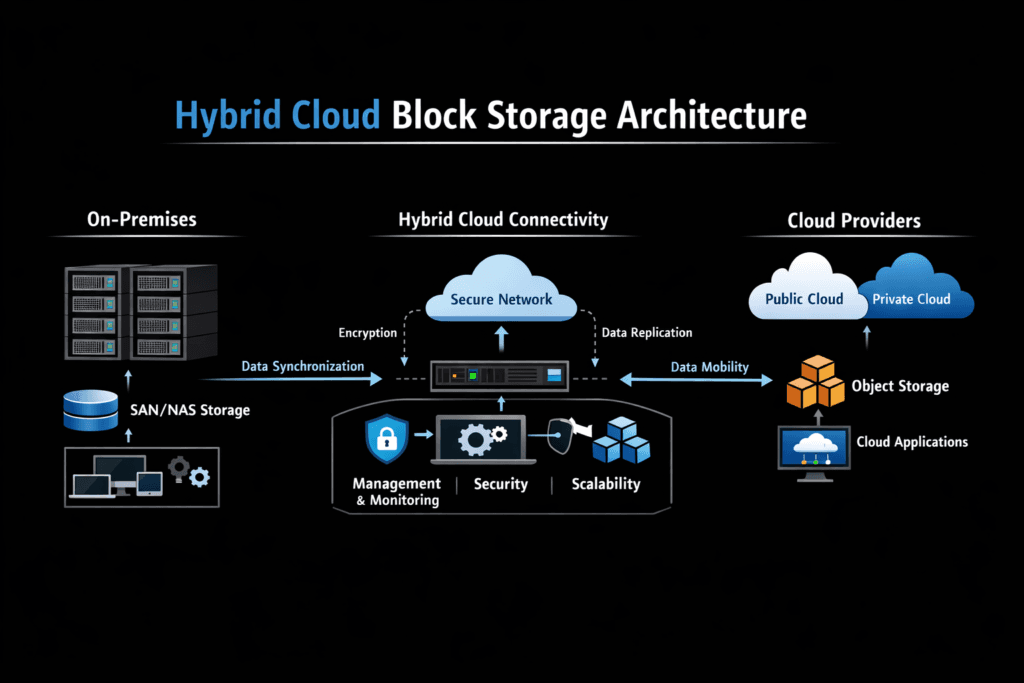
Hybrid Cloud Block Storage Architecture is a design pattern that delivers block volumes across on-prem systems and public cloud, while keeping one control model for provisioning, policy, and data services. Teams use it to keep sensitive data close to regulated sites, burst compute into the cloud, and still run the same persistence layer for databases, VMs, and Kubernetes Storage.
A solid architecture keeps latency and failure behavior clear. It also keeps day-two work predictable, such as upgrades, migrations, and DR tests. When the design hides network hops or mixes failure domains, storage becomes the bottleneck long before compute does.
Why This Architecture Matters in Real Hybrid Operations
Hybrid storage plans often start with cost or compliance goals, then turn into a performance problem. Block I/O hates surprise latency. Database commits, VM boot storms, and rebuild jobs amplify small delays into major slowdowns.
Hybrid Cloud Block Storage Architecture helps when it sets clear rules for where data lives, how it replicates, and how apps access volumes during failover. It also reduces tool sprawl by keeping one storage model across sites instead of running separate stacks per cloud.
🚀 Run Hybrid Cloud Block Storage, Without Split Tooling
Use Simplyblock to unify NVMe/TCP volumes across on-prem and public cloud with one control plane.
👉 Use Simplyblock for Hybrid Cloud Storage →
Hybrid Cloud Block Storage Architecture for Kubernetes Storage
Kubernetes Storage adds its own constraints. The CSI layer expects fast volume lifecycle actions, consistent attach behavior, and clean rollback paths during reschedules. A hybrid design must also respect topology so workloads do not “stretch” across links that cannot hold p99 latency targets.
The most common platform patterns include hyper-converged nodes for low-latency tiers, disaggregated pools for shared capacity, and hybrid layouts that run both in one cluster. Those patterns matter more in a hybrid cloud because the network between sites defines the real performance ceiling.
To keep Kubernetes Storage steady, the platform should separate the control plane from the data path, enforce quotas, and prevent one tenant from taking the whole I/O budget. That is where Software-defined Block Storage fits, because it can apply policy and QoS without forcing hardware lock-in.
Hybrid Cloud Block Storage Architecture with NVMe/TCP
NVMe/TCP provides an NVMe-oF transport over standard Ethernet. That makes it a practical choice when you want high-performance block access without making RDMA a hard requirement everywhere. For hybrid cloud, NVMe/TCP also helps standardize the storage access method across on-prem racks and cloud instances.
NVMe/TCP works best when the rest of the stack keeps copies and context switches low. That is why SPDK-based data paths matter. They run in user space, reduce CPU overhead, and help sustain higher IOPS per core, which becomes critical when you run storage services on shared nodes or DPUs.
How to Measure Hybrid Cloud Block Storage Architecture Performance
Hybrid performance work fails when teams only look at average IOPS. Hybrid links and multi-tenant clusters punish the tail. Measure percentiles, not just totals.
Start by testing the storage layer with small-block random read/write mixes and queue depth sweeps. Capture p50, p95, and p99 latency, plus bandwidth under sustained load. Then test the full app path using the same client placement you run in production, including cross-zone or cross-site traffic if you plan to failover that way.
Also measure during change events. Run tests during node drains, rolling upgrades, snapshot creation, and rebuild work. Those moments often define real user impact, not the calm baseline.
Engineering Moves That Improve Hybrid Storage Consistency
Use these actions to reduce latency spikes and avoid “it worked in one site” problems:
- Set clear locality rules so hot workloads stay close to their data path, and keep cross-site reads as an exception.
- Enforce multi-tenant QoS, so backup jobs and batch apps do not crush transactional workloads.
- Keep the data path lean, and favor architectures that reduce copies and kernel overhead.
- Use replication policies that match business RPO and RTO, and test them under load.
- Track p99 latency targets per tier, and fail builds that miss them.
Comparing Common Hybrid Block Storage Designs
Before picking a design, compare how each option handles latency, scale, and operations across sites. The differences show up most during failover tests and noisy-neighbor incidents, not during a light benchmark.
| Design option | Where it fits | Strengths | Typical drawbacks |
|---|---|---|---|
| Separate storage stacks per site | Fast start, isolated teams | Clear blast radius, simple routing | Tool sprawl, uneven policy, hard migration |
| Cloud block volumes + on-prem SAN | Traditional hybrid apps | Familiar ops model, mature tools | Higher overhead, split policy, cost spikes for performance tiers |
| Unified Software-defined Block Storage across sites | Platform teams, shared services | One control model, flexible topology, consistent policy | Needs solid network planning and tier rules |
| NVMe/TCP-based unified block layer | Performance-critical hybrid | High parallel I/O, better CPU efficiency potential | Requires careful latency budgets and QoS controls |
Simplyblock™ for Hybrid Cloud Block Storage Architecture
Simplyblock™ focuses on high-performance block volumes for Kubernetes Storage and hybrid deployments, using NVMe/TCP and an SPDK-based user-space data path. That combination targets low overhead and better CPU efficiency, which helps when you run dense clusters or want to offload parts of the data path to DPUs.
Platform teams also use simplyblock when they need Software-defined Block Storage features that matter in hybrid cloud: multi-tenancy, QoS, scale-out growth, and flexible layouts that support hyper-converged, disaggregated, or mixed deployments. That flexibility lets you keep latency-sensitive tiers near compute while scaling capacity pools on their own timeline.
Where Hybrid Block Storage Architecture Is Headed
Hybrid storage is moving toward stronger policy control and clearer topology signals. Expect more automation around placement, rebuild pacing, and replication targets, because hybrid failures demand repeatable outcomes.
Expect more focus on CPU-per-IOPS efficiency as DPUs and IPUs take on more storage work. Expect NVMe-oF adoption to grow, with NVMe/TCP staying attractive where teams want a standard Ethernet path. The practical goal stays the same: stable latency, clean operations, and one storage model that works across sites.
Related Terms
These glossary pages help teams align Kubernetes Storage, NVMe/TCP, and Software-defined Block Storage choices in hybrid cloud setups.
- Hybrid Cloud Storage
- Storage Quality of Service (QoS)
- Scale-Out Block Storage
- Distributed Block Storage Architecture
Questions and Answers
A hybrid cloud block storage architecture connects on-prem and cloud environments using distributed block storage with unified management. It enables consistent performance and portability across infrastructures. Platforms built on a distributed block storage architecture allow seamless data mobility between sites.
NVMe over TCP enables high-performance block storage over standard IP networks, making it ideal for hybrid cloud deployments. It allows enterprises to extend NVMe performance across data centers and cloud regions without specialized hardware.
Key challenges include latency between sites, replication consistency, and workload portability. A well-designed scale-out storage architecture ensures resilience, data synchronization, and performance consistency across hybrid environments.
Yes. With CSI integration, persistent volumes can be provisioned consistently across on-prem and cloud clusters. Simplyblock’s Kubernetes-native storage platform supports stateful workloads in hybrid deployments with replication and encryption built in.
Simplyblock delivers software-defined, NVMe-backed storage that operates across environments. Its software-defined storage platform allows unified provisioning, replication, and performance management for hybrid cloud block storage architectures.