Hybrid Erasure Coding
Terms related to simplyblock
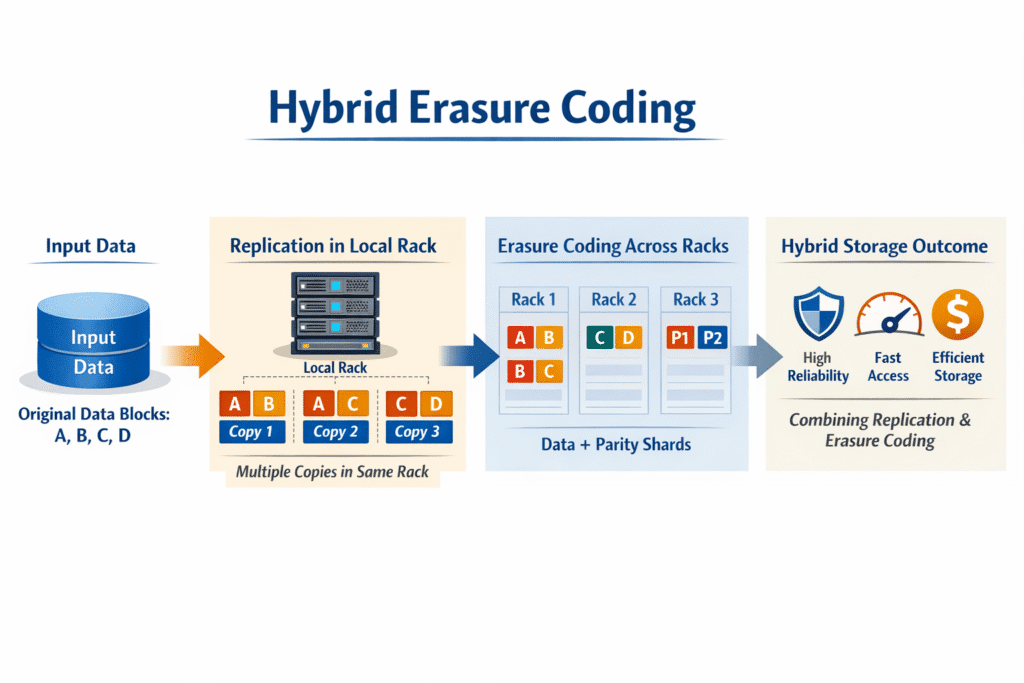
Hybrid erasure coding combines replication and erasure coding in one design. Teams often keep hot data on replicas for fast writes and steady reads, then move cold data into erasure-coded stripes to save capacity.
Some systems also use hybrid-style codes that cut repair work, so failures cost less bandwidth and time.
Why Hybrid Protection Beats One-Size-Fits-All
Replication stays simple and quick, but it uses a lot of space. Pure erasure coding saves space, but it can raise CPU use, add network reads, and push up tail latency during repair.
A hybrid plan aims for balance – low latency where apps need it, and lower cost where they don’t.
🚀 Run Hybrid Erasure Coding for Kubernetes Storage Without the Overhead
Use Simplyblock to simplify durable block storage and keep performance predictable while repair traffic runs in the background.
👉 Use Simplyblock for Advanced Erasure Coding →
Using Hybrid Schemes in Kubernetes Stateful Storage
Kubernetes adds noisy neighbors, reschedules, and bursty jobs. Those patterns can hurt tail latency when rebuilding or repairing starts. A hybrid policy helps when you split workloads by behavior: keep write-heavy or latency-sensitive volumes replicated, and encode calmer data to reduce overhead.
Disk loss and node loss also matter. Kubernetes teams often design for node failure first, then tune protection inside that boundary so apps stay stable during recovery.
Hybrid Erasure Coding on NVMe/TCP Storage Paths
NVMe/TCP moves block I/O over Ethernet, so it can deliver strong performance in disaggregated setups. Hybrid protection still needs care because repair traffic competes with client I/O. When repairs pull many chunks across nodes, the network and CPU can bottleneck before the drives do.
QoS and pacing make the difference. If you cap repair rates and isolate tenants, you can keep app latency steady while background repair runs.
How to Measure Hybrid Behavior Under Stress
Test two modes: steady state and active repair. Steady state shows baseline throughput and latency. Repair tests show what users feel during the worst moments.
Track p95 and p99 latency, write amplification, repair bandwidth, and time-to-stability after the system heals. Run the same workload with the same limits so you can compare results cleanly.
Tuning Checklist for Hybrid Erasure Coding
- Set clear “hot vs cold” rules so you don’t encode data that still changes a lot.
- Rate-limit repair work to protect p99 latency during failures.
- Pick the right k+m profile for your failure domain and rebuild budget.
- Avoid tiny-write pain by batching writes or aligning I/O to stripe width.
- Use QoS per volume or tenant so one workload can’t steal the whole budget.
- Retest after changes because hardware and workloads shift over time.
Durability Options Compared – Cost, Latency, and Repair Traffic
This table helps you choose the right protection method based on what you value most: steady latency, low capacity cost, or fast recovery. It also highlights how much repair work each method can push onto your network and CPUs.
| Approach | Capacity cost | Typical latency feel | Repair behavior | Best fit |
|---|---|---|---|---|
| Replication (2x/3x) | High | Very steady for writes | Simple, fast rebuild | Hot data, tight latency targets |
| Pure erasure coding | Lower | Can rise under small writes | Repair can read many chunks | Cost-first scale-out storage |
| Hybrid erasure coding | Medium–low | Steady for hot set | Controlled repair + lower overhead | Mixed workloads, shared clusters |
| Repair-optimized coding | Low–medium | Similar to EC on writes | Fewer reads during repair | Large fleets, repair-heavy setups |
Achieving Steady Hybrid Erasure Coding Performance with Simplyblock
Hybrid protection pays off only when performance stays stable during repair. Simplyblock focuses on Kubernetes-ready block storage with controls that help isolate tenants, apply QoS, and protect tail latency while background work runs.
If you plan hybrid erasure coding, pair it with strict repair pacing and clear per-volume limits. That combo lowers cost without turning failures into incidents.
What to Expect Next in Hybrid Erasure Coding
Hybrid designs keep moving toward lower repair traffic and steadier tail latency. More systems will automate policy decisions, so data can shift between replicas and coded stripes based on access patterns and risk windows.
Better observability will also help teams prove their p99 targets during failures, not just on quiet days.
Related Terms
Teams often review these glossary pages alongside Hybrid Erasure Coding when they plan durability policies, repair speed, and predictable performance in shared clusters.
- Storage High Availability
- Asynchronous Storage Replication
- Synchronous Storage Replication
- Storage Pools
Questions and Answers
Hybrid Erasure Coding lowers costs by using erasure coding for cold data and replication for hot data. This combination is ideal for cloud cost optimization, reducing capacity needs while maintaining high availability.
It reduces redundancy overhead by applying erasure coding only to less frequently accessed data. This provides better efficiency than full replication, especially in software-defined storage systems with tiered access patterns.
Yes, Hybrid EC can optimize persistent storage in Kubernetes stateful workloads, balancing performance and durability by adapting to data access patterns automatically.
Traditional erasure coding can slow down hot data access due to reconstruction overhead. Hybrid EC improves performance by replicating hot data, making it more efficient for I/O-sensitive applications in cloud-native setups.
Yes, pairing Hybrid EC with NVMe over TCP enables fast, cost-efficient storage that’s ideal for disaggregated cloud environments, ensuring low latency and high throughput even during failures.