NVMe over Fabrics using Fibre Channel (FC-NVMe)
Terms related to simplyblock
As storage needs continue to evolve, ensuring ultra-fast data access and low-latency performance is critical for modern IT environments. NVMe over Fabrics using Fibre Channel (FC-NVMe) extends NVMe performance across a high-speed Fibre Channel network.
This integration enables enterprises to scale their storage systems without sacrificing performance, offering faster data access, reduced latency, and greater flexibility to handle growing data demands.
How FC-NVMe Drives Storage Efficiency
FC-NVMe leverages the NVMe protocol over Fibre Channel networks, enabling NVMe’s low-latency, high-throughput benefits to extend beyond local systems and into enterprise-wide storage environments. Unlike traditional storage systems, where bottlenecks often occur due to slower data transfer protocols, FC-NVMe enables direct, high-speed communication between servers and storage devices, drastically improving performance and scalability.
By combining Fibre Channel’s reliable, reliable network with the NVMe protocol’s speed, FC-NVMe offers organizations the ability to access massive datasets in real time, minimizing delays and ensuring that even the most data-heavy applications perform seamlessly across multiple systems.
🚀 Supercharge Your FC-NVMe Storage for Maximum Performance
See how Simplyblock optimizes FC-NVMe and other NVMe over Fabrics solutions for better performance and faster data access.
👉 Learn More About NVMe over Fabrics →
Role of FC-NVMe in Modern Data-Intensive Environments
In modern data centers, where applications demand rapid access to large datasets, FC-NVMe plays a pivotal role by providing high-performance, low-latency storage solutions. This is particularly beneficial in industries like finance, healthcare, and media, where real-time data access is critical.
By utilizing FC-NVMe, organizations can ensure that applications such as databases, data analytics platforms, and high-performance computing systems maintain consistent, high-speed access to storage. With the ability to scale easily across large infrastructures, FC-NVMe enables enterprises to meet the performance requirements of their growing data needs without compromising on reliability.
Key Advantages of FC-NVMe
FC-NVMe offers several critical benefits, making it a compelling choice for enterprise environments:
- Low Latency: With NVMe running over Fibre Channel, data access speeds are dramatically improved, reducing the time spent waiting for data retrieval.
- High Throughput: The high data transfer rates supported by FC-NVMe are ideal for applications requiring rapid processing of large volumes of data.
- Reliability and Proven Performance: Fibre Channel is a highly reliable protocol with decades of proven performance in mission-critical applications. When combined with NVMe, FC-NVMe offers unparalleled reliability, ensuring that businesses can trust their storage systems to deliver consistent performance even under high loads or challenging conditions.
These capabilities ensure that FC-NVMe is not only faster but also more efficient and reliable than older protocols, providing businesses with the performance needed to stay competitive in data-intensive sectors.
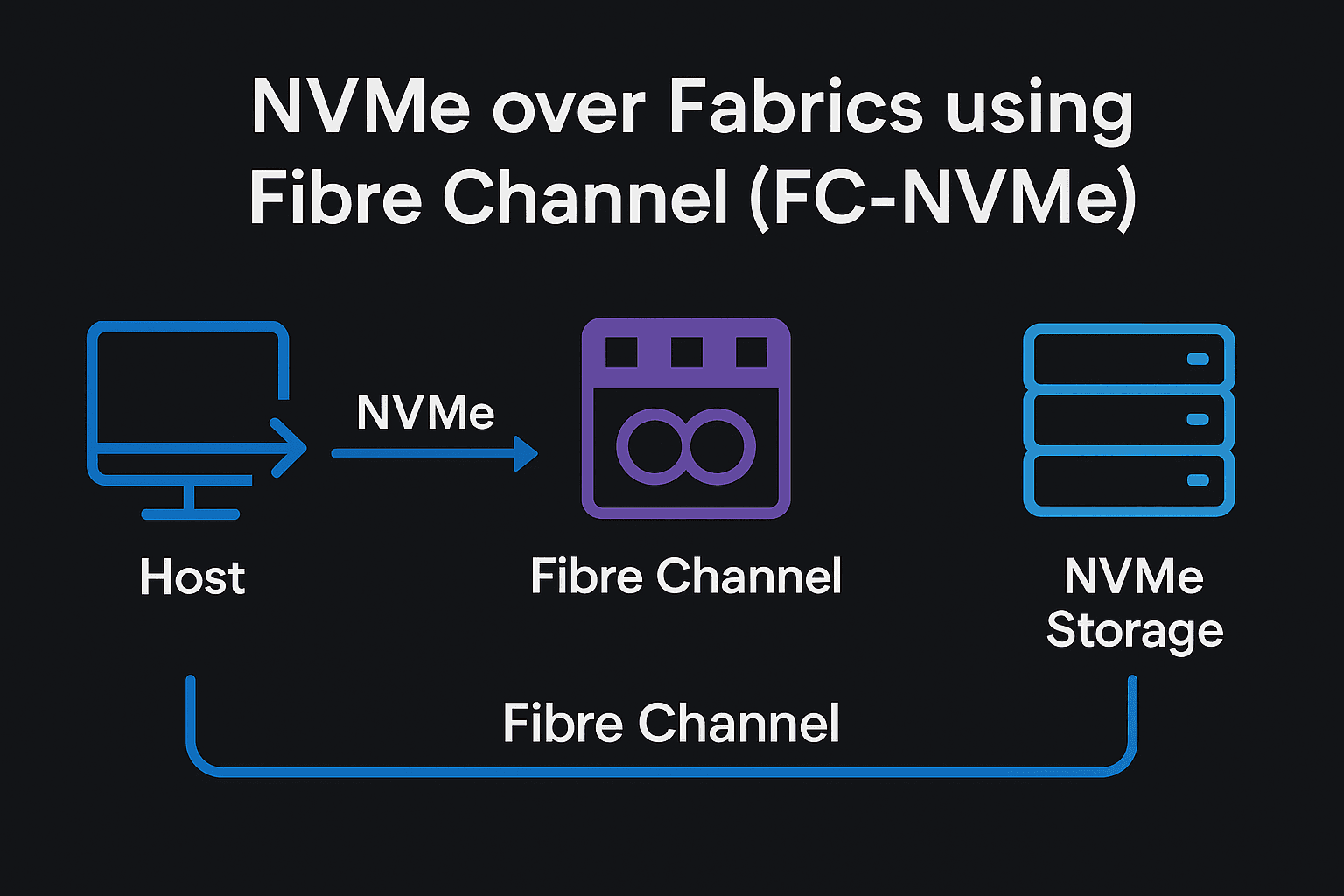
Maximizing Storage Efficiency with FC-NVMe Technology
The combination of FC-NVMe and Fibre Channel proves particularly effective in a variety of real-world applications:
In financial institutions, where split-second access to data can impact decisions, FC-NVMe accelerates database queries and transactions, making it possible to handle thousands of requests per second with minimal delay. Similarly, in the media industry, where data needs to be accessed quickly for video production and rendering, FC-NVMe ensures seamless data handling even under heavy workloads.
Additionally, FC-NVMe is invaluable in AI and machine learning environments, where large volumes of data are processed for model training. The high throughput and low latency characteristics of FC-NVMe enable faster training times, which are essential for timely and accurate results in AI-driven applications.
FC-NVMe and Other Storage Technologies Compared
When comparing FC-NVMe to other storage technologies, it stands out for its low latency and consistent performance. By combining NVMe with Fibre Channel, it delivers predictable I/O behavior without relying on TCP-based networking.
The table below highlights how FC-NVMe differs from other common storage options.
| Feature | FC-NVMe | SATA/SAS | iSCSI |
| Latency | Ultra-low latency | Higher latency due to protocol overhead | Higher latency compared to FC-NVMe |
| Throughput | Very high throughput (up to 32 Gbps) | Lower throughput (6-12 Gbps) | Moderate throughput (1-10 Gbps) |
| Scalability | Highly scalable across large networks | Limited scalability in large environments | Scalable but with reduced performance at scale |
| Reliability | High, with Fibre Channel’s reliability | Lower reliability, especially over long distances | Dependent on network stability |
| Cost | Higher due to Fibre Channel hardware | Lower cost for standard servers | Lower cost but requires additional infrastructure |
Improving Kubernetes Performance with FC-NVMe
In Kubernetes environments, where applications are distributed across multiple nodes, FC-NVMe provides fast and reliable access to persistent storage for containerized applications. FC-NVMe delivers low-latency storage solutions that are essential for stateful applications running in containers.
- Persistent Volumes: FC-NVMe enables Kubernetes clusters to access persistent volumes with minimal latency, providing consistent performance as workloads grow.
- High-Availability: Ensures that Kubernetes workloads have uninterrupted access to high-performance storage, even when containers are moved across nodes.
- Improved Resource Utilization: By utilizing the high throughput and low latency of FC-NVMe, Kubernetes environments can maximize the efficiency of storage resources, reducing bottlenecks and enabling applications to process data faster, even under heavy loads.
Taking FC-NVMe Storage to the Next Level with Simplyblock
Simplyblock enhances FC-NVMe environments by streamlining the integration and management of storage resources.
- Optimized Data Access: By leveraging FC-NVMe, the solution ensures faster and more reliable data retrieval across the entire storage network, optimizing performance for high-demand workloads.
- Seamless Integration: The solution simplifies the deployment and management of FC-NVMe, enabling smooth integration with existing infrastructure while supporting future growth.
- Scalable Infrastructure: Automated provisioning and resource management ensure that your FC-NVMe storage scales effortlessly to accommodate increasing data needs, minimizing manual intervention.
With these capabilities, simplyblock makes managing FC-NVMe storage more efficient and effective, ensuring businesses can focus on their growth without worrying about underlying storage complexities.
The Future of FC-NVMe in Enterprise Storage
As enterprises continue to scale and modernize their infrastructure, the need for faster, more efficient storage solutions becomes critical. FC-NVMe is poised to play a central role in this evolution, offering the performance, scalability, and reliability necessary to meet the growing demands of data-driven applications.
Whether you’re managing large databases, real-time analytics, or AI workloads, FC-NVMe ensures that your storage environment can meet the demands of tomorrow.
Related Terms
Teams often review these glossary pages alongside NVMe over Fabrics using Fibre Channel (FC-NVMe) when they map fabric behavior, failover expectations, and replication targets in Fibre Channel storage environments.
Storage Area Network
Storage High Availability
Synchronous Storage Replication
NVMe-oF (NVMe over Fabrics)
Questions and Answers
FC-NVMe enhances traditional Fibre Channel networks by integrating the low-latency and high-throughput capabilities of NVMe storage, allowing faster data access and significantly improved performance. This upgrade enables higher IOPS and reduced latency compared to the SCSI-based protocols used in traditional Fibre Channel systems.
FC-NVMe offers significant improvements over traditional Fibre Channel, with much lower latency and higher throughput. It can handle more IOPS (Input/Output Operations Per Second) than legacy systems, making it ideal for high-demand applications like real-time data analytics, financial transactions, and high-performance computing.
To integrate FC-NVMe, you need Fibre Channel switches and storage devices that support the NVMe protocol. Upgrading or replacing existing SCSI-based devices and adapters with NVMe-compatible hardware, along with configuring the Fibre Channel network to support NVMe traffic, will be necessary to fully leverage the benefits of FC-NVMe.
FC-NVMe is perfect for applications that require ultra-low latency and high-throughput storage, such as big data analytics, AI/ML workloads, and real-time financial systems. It also excels in database-driven applications where performance and responsiveness are crucial for processing large amounts of data.
While FC-NVMe offers tremendous speed and efficiency, its implementation can be costly due to the need for specialized hardware, including NVMe-capable storage devices and Fibre Channel switches. Additionally, it may not be necessary for environments with lower performance demands, where Ethernet-based solutions like iSCSI or NVMe over TCP could be more cost-effective.