Persistent Storage
Terms related to simplyblock
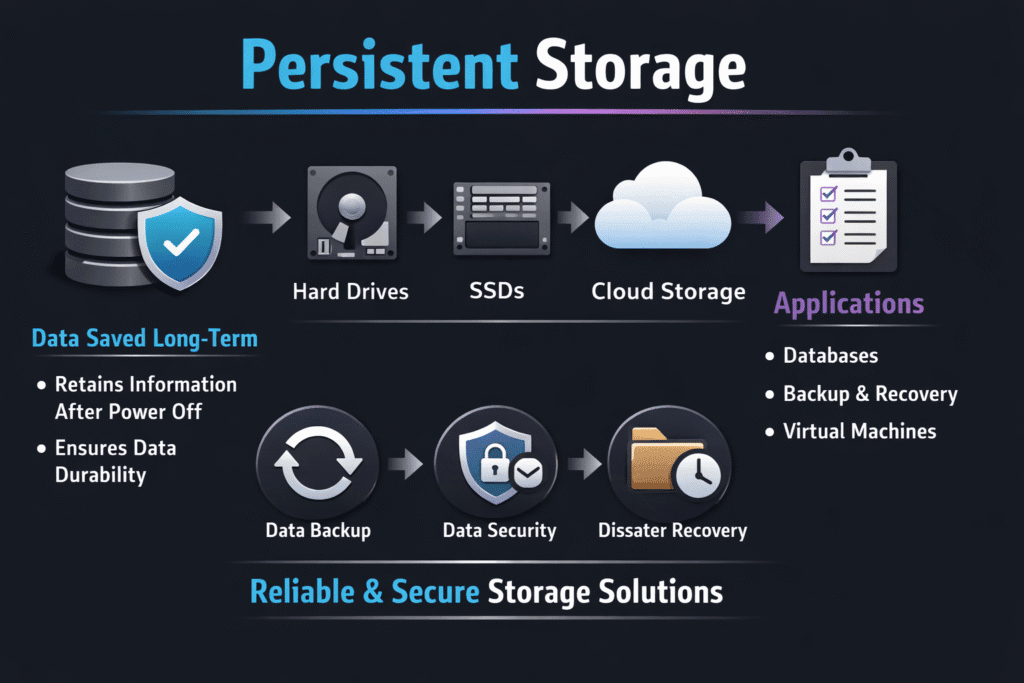
Persistent storage is designed to keep data intact beyond the lifetime of applications, containers, or virtual machines. Unlike temporary storage, it ensures that information remains available after restarts, failures, or infrastructure changes.
For modern systems that scale dynamically, persistent storage is what keeps applications dependable even when compute resources change.
How Persistent Storage Fits Into Modern Infrastructure
Persistent storage operates independently from compute. Whether workloads run on bare metal, virtual machines, or containers, the data they depend on must stay accessible when those workloads move or restart.
This separation allows infrastructure teams to scale, upgrade, or replace compute resources without disrupting application data or requiring complex migrations.
🚀 Protect Long-Lived Data with Persistent Storage
Support reliable backups and recovery workflows using storage designed for durability and consistent access.
👉 See Fast Backups and Disaster Recovery →
How Persistent Storage Differs from Ephemeral Storage
Ephemeral storage exists only for the lifetime of a workload. Once a container or virtual machine is removed, the data disappears. Persistent storage avoids this limitation by keeping data independent of application lifecycles.
This distinction is especially important in environments where workloads are frequently rescheduled, such as Kubernetes or cloud-native platforms.
Defining Characteristics of Persistent Storage
Persistent storage provides several traits required for production workloads:
- Durability Over Time: Data remains intact across restarts and failures.
- Independent Lifecycle: Storage exists separately from applications and compute resources.
- Consistent Reattachment: Workloads reconnect to the same data without reconfiguration.
- Scalable Capacity: Storage grows without forcing application changes.
These characteristics make persistent storage suitable for long-running systems.
Typical Use Cases for Persistent Storage
Persistent storage is used anywhere data must be retained reliably. Databases depend on it to preserve records, analytics systems store historical datasets, and monitoring platforms retain metrics over time.
It is also widely used for shared file systems, audit logs, and application state that must survive restarts or failures.
Persistent Storage Compared to Temporary Storage Models
Choosing the right storage model depends on how long data must live. Persistent storage ensures data remains intact even after application restarts or system failures, making it ideal for critical data. In contrast, temporary storage is suited for short-lived data that doesn’t need to persist beyond the current session or task.
Choosing the right storage model depends on how long data must live.
| Feature | Temporary Storage | Persistent Storage |
| Data Lifetime | Short-lived | Long-lived |
| Failure Recovery | Data lost | Data retained |
| Workload Mobility | Limited | High |
| Typical Use | Caches, scratch data | Databases, logs |
| Operational Risk | Higher | Lower |
This comparison shows why persistent storage is required for critical data.
Persistent Storage in Containerized and Cloud Platforms
In containerized environments, persistent storage allows data to survive pod restarts and rescheduling. In cloud platforms, it ensures applications remain stable even as the underlying infrastructure changes.
This makes it possible to combine the flexibility of cloud-native systems with the reliability required for stateful workloads.
How Simplyblock Supports Persistent Storage Workloads
Simplyblock supports persistent storage by providing a platform built for long-running, data-intensive workloads.
- Stable Performance Under Load: Consistent throughput and latency during sustained operations.
- Flexible Deployment Options: Works across on-premises and cloud environments.
- Efficient Scaling: Capacity grows without added operational overhead.
- Strong Fit for Stateful Systems: Designed to support databases and persistent services.
This helps teams run persistent storage without unnecessary complexity.
Why Persistent Storage Remains Critical as Systems Grow
As infrastructure becomes more distributed, protecting data becomes more challenging. Persistent storage provides the stability needed to scale applications while keeping information safe and accessible.
When paired with modern storage platforms, persistent storage supports growth without sacrificing reliability.
Related Terms
Teams often review these glossary pages alongside Persistent Storage when they design stateful database deployments that must keep data durable through restarts, upgrades, and failover events.
PostgreSQL
MySQL
MongoDB
Apache Cassandra
CouchDB
Questions and Answers
Persistent storage ensures that data remains available even when containers, pods, or VMs restart. This is critical for databases, message queues, and any application that must preserve state across failures or scaling events.
Persistent storage retains data beyond the lifecycle of a container or virtual machine, while ephemeral storage is temporary and deleted when the workload ends. Choosing between them depends on whether the application must keep data long-term.
Key considerations include performance requirements, durability, scalability, failover capabilities, and cost. The workload’s I/O profile—such as latency sensitivity or high write volume—also plays a major role in selecting the right backend.
Persistent storage access modes can limit or enable scaling. For example, ReadWriteOnce restricts a volume to a single node, while ReadWriteMany allows multiple pods to share storage, which is essential for horizontally scaled applications.
Risks include data loss due to misconfigured reclaim policies, insufficient backups, performance bottlenecks, and improper replication settings. Regular monitoring and well-defined data protection strategies are essential for avoiding downtime.