Persistent Volume (PV)
Terms related to simplyblock
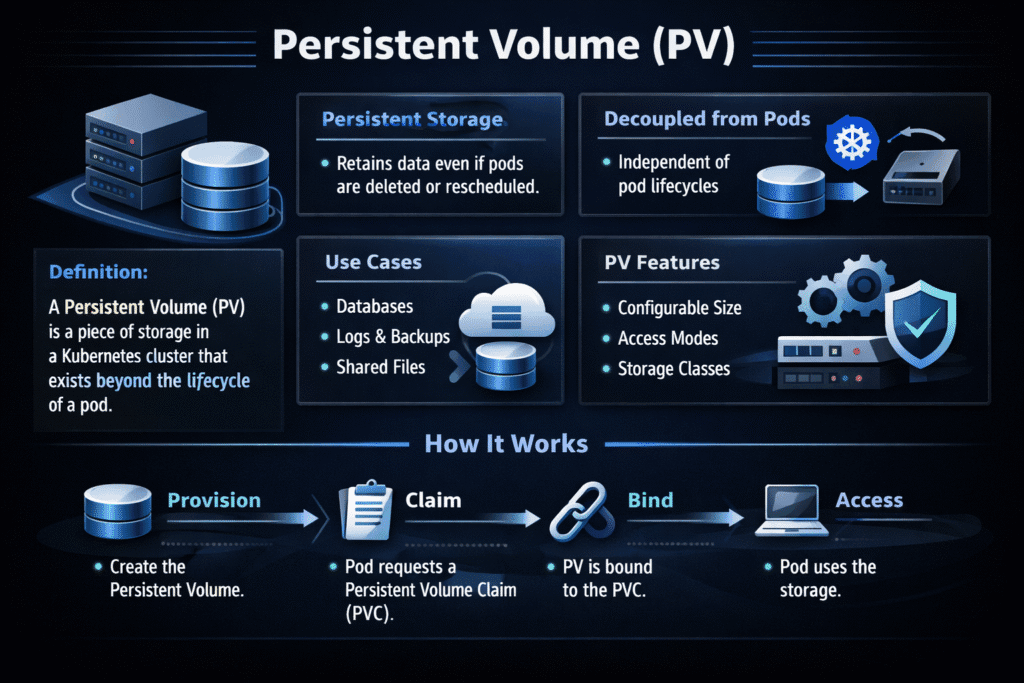
A Persistent Volume (PV) is a core Kubernetes resource that provides storage independent of pods and containers. Containers are temporary by design, but application data usually isn’t. Persistent Volumes solve this gap by allowing data to survive pod restarts, rescheduling, and replacements.
By separating storage from compute, PVs make Kubernetes suitable for stateful workloads such as databases, message queues, and analytics systems.
What a Persistent Volume Represents Inside a Cluster
A Persistent Volume is a cluster-level storage resource that abstracts the underlying storage system. It may be backed by local disks, network-attached storage, or cloud volumes, but Kubernetes treats it as a consistent object regardless of the backend.
Applications never interact with the storage device directly. Instead, Kubernetes manages access through defined interfaces, which keeps storage behavior consistent across environments.
🚀 Understand Persistent Volumes in Kubernetes
See how Kubernetes Persistent Volumes work and how they support stateful workloads across clusters.
👉 Read About Kubernetes Persistent Volumes →
How Persistent Volumes Are Provisioned and Bound
Persistent Volumes can be created manually or provisioned automatically. In static provisioning, administrators define PVs ahead of time. In dynamic provisioning, Kubernetes creates PVs on demand when a Persistent Volume Claim (PVC) is submitted.
During binding, Kubernetes matches a PVC to a suitable PV based on size, access mode, and storage class. Once bound, the relationship remains fixed until the claim is released, ensuring predictable access for applications.
Key Capabilities of Persistent Volumes
Persistent Volumes bring several essential capabilities to Kubernetes storage:
- Decoupled Storage Management: Storage exists independently from applications, reducing operational risk.
- Flexible Backend Support: Works with block, file, and object-backed storage systems.
- Policy-Based Allocation: StorageClasses define performance, replication, and availability behavior.
- Stable Data Access: Applications retain data even when pods move or restart.
These capabilities make PVs a foundation for reliable Kubernetes deployments.
Where Persistent Volumes Are Commonly Used
Persistent Volumes are used wherever applications depend on durable data. Common scenarios include databases running inside Kubernetes, log aggregation systems, monitoring stacks, message brokers, and analytics platforms.
They are also critical in backup pipelines and disaster recovery setups, where data persistence must survive node-level or cluster-level failures.
Persistent Volumes vs Pod-Attached Storage
Pods can use temporary storage, but that data disappears when the pod is deleted or rescheduled. Persistent Volumes remove this limitation by keeping data independent from the pod lifecycle.
| Feature | Pod-Attached Storage | Persistent Volume |
| Lifecycle | Tied to pod | Tied to the pod |
| Data Durability | Temporary | Persistent |
| Pod Rescheduling | Data lost | Data retained |
| Scalability | Limited | Scales with backend |
| Typical Use | Caches, temp files | Databases, stateful apps |
This separation is what enables Kubernetes to run production-grade stateful workloads.
Persistent Volumes in Stateful Kubernetes Workloads
Stateful applications require predictable storage behavior. Persistent Volumes provide this by keeping data attached to claims rather than pods. When a database pod is rescheduled, it reconnects to the same volume without manual reconfiguration.
Capabilities such as snapshots, volume expansion, and replication support backups, scaling, and recovery workflows, making PVs suitable for long-running production systems.
How Simplyblock Improves Persistent Volume Performance
Simplyblock enhances Persistent Volume deployments by providing a storage backend optimized for Kubernetes data paths.
- Consistent I/O Performance: Volumes maintain steady throughput and latency under load.
- Dynamic Provisioning Support: Works cleanly with CSI-driven PV and PVC workflows.
- Efficient Resource Usage: Storage scales without creating unnecessary CPU or operational overhead.
- Better Fit for Stateful Applications: Designed for databases and storage-heavy Kubernetes workloads.
This helps teams operate Persistent Volumes with fewer bottlenecks and simpler management.
How Persistent Volumes Support Long-Term Kubernetes Growth
As Kubernetes environments expand, storage must scale without becoming fragile or complex. Persistent Volumes provide a stable abstraction that allows clusters to grow, nodes to change, and workloads to migrate without redesigning storage each time.
When paired with modern storage platforms, PVs support long-term application growth while keeping data safe and accessible.
Related Terms
Teams often review these glossary pages alongside Persistent Volume when they define how storage is requested, provisioned, attached, and retained across pod rescheduling in production clusters.
Persistent Volume Claim (PVC)
Dynamic Provisioning in Kubernetes
Container Storage Interface (CSI)
Kubernetes StatefulSet
Retain vs Recycle vs Delete Policy
Questions and Answers
A PV provides storage that exists independently of pod lifecycles, ensuring data persists even when pods are recreated or rescheduled. This is essential for stateful workloads like databases and message queues.
Key factors include performance requirements, durability, latency, access mode compatibility, and cost. Workloads like databases may require high-IOPS storage, while logs or backups can use slower, cheaper storage.
Access modes—such as ReadWriteOnce, ReadWriteMany, or ReadOnlyMany—define how pods can attach to a PV. Choosing the wrong mode can limit scaling or prevent multiple pods from accessing shared data.
The outcome depends on the PV’s reclaim policy. “Retain” keeps the data, “Delete” removes the storage resource, and “Recycle” clears it for reuse. Selecting the right policy is critical for data protection.
Use snapshots, backups, or volume cloning before making changes. For production workloads, ensure storage classes support features like dynamic provisioning, replication, and volume expansion to minimize downtime and risk.