Persistent Volume Claim (PVC)
Terms related to simplyblock
A Persistent Volume Claim (PVC) is the mechanism Kubernetes uses to let applications request storage without handling storage infrastructure directly. Instead of binding workloads to disks or volumes, PVCs allow teams to define what storage is needed and let Kubernetes handle how it’s provided.
This separation keeps application manifests clean and makes storage behavior consistent across clusters.
How a Persistent Volume Claim Fits into the Kubernetes Storage Model
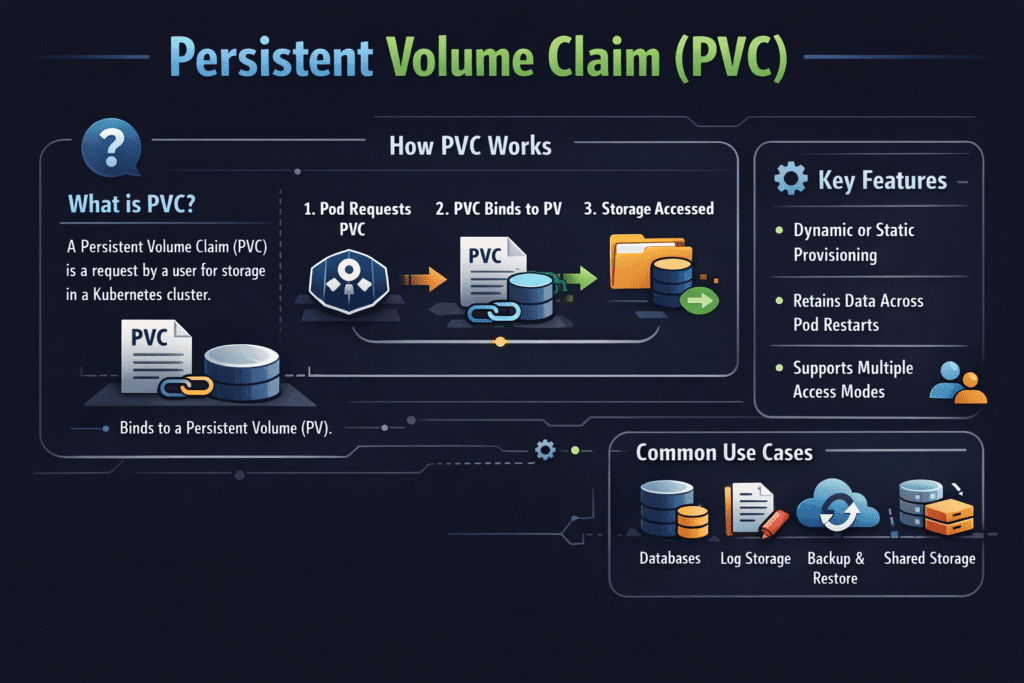
A PVC acts as a contract between an application and the storage layer. It specifies requirements such as capacity, access mode, and storage class, while Kubernetes finds or creates a matching Persistent Volume (PV).
Once the claim is satisfied, the application uses the PVC as its stable storage reference, even if pods restart or move between nodes.
🚀 Run Stateful Databases with Persistent Volume Claims
Use PVC-backed storage built for consistent performance and smooth scaling in Kubernetes environments.
👉 See Databases on Kubernetes →
What Happens When a Persistent Volume Claim Is Created
When a PVC is submitted, Kubernetes evaluates its requirements and looks for a compatible PV. If none exists and dynamic provisioning is enabled, Kubernetes automatically creates a new volume using the defined StorageClass.
After binding, the PVC and PV remain linked until the claim is deleted. This prevents accidental reassignment and helps protect application data.
Core Functions Provided by Persistent Volume Claims
Persistent Volume Claims introduce several important storage behaviors in Kubernetes:
- Storage Abstraction for Applications: Workloads request storage without referencing disks or vendors.
- Policy-Controlled Provisioning: StorageClasses define performance and availability characteristics.
- Consistent Storage Attachment: Pods reconnect to the same data after restarts or rescheduling.
- Elastic Capacity Support: Volumes can grow without changing application definitions.
These functions make PVCs essential for production-grade Kubernetes storage.
Common Workloads That Depend on Persistent Volume Claims
PVCs are used by any application that needs data to persist beyond the pod lifecycle. This includes databases, message queues, monitoring tools, CI systems, logging pipelines, and analytics workloads.
They are also commonly used in backup and restore processes where predictable volume allocation is required.
Persistent Volume Claims Compared to Hard-Coded Volume Usage
Without PVCs, applications would need to reference specific storage resources directly. This tightly couples workloads to infrastructure and limits portability.
| Feature | Hard-Coded Volumes | Persistent Volume Claims |
| Storage Awareness | Application-level | Cluster-managed |
| Portability | Low | High |
| Provisioning Method | Manual | Automated |
| Rescheduling Safety | Risky | Safe |
| Operational Effort | High | Lower |
PVCs remove this tight coupling and simplify storage operations.
How PVCs Make Stateful Kubernetes Deployments Practical
Stateful services require stable storage even when pods change. PVCs provide this stability by maintaining a consistent claim to data, regardless of pod placement.
Combined with snapshots, backups, and expansion features, PVCs allow databases and other stateful workloads to run reliably inside Kubernetes.
How Simplyblock Improves PVC-Based Storage Operations
Simplyblock enhances PVC-driven workflows by aligning storage performance with Kubernetes-native behavior.
- Predictable Throughput and Latency: PVC-backed volumes remain stable under load.
- Clean CSI Integration: Supports dynamic provisioning without added complexity.
- Scalable Storage Growth: Capacity increases without operational friction.
- Optimized for Stateful Services: Designed for databases and persistent workloads.
This helps teams avoid storage bottlenecks while using PVCs at scale.
Why Persistent Volume Claims Support Scalable Cluster Design
As clusters grow, storage must scale without breaking application definitions. PVCs allow teams to resize volumes, move workloads, and expand clusters without rewriting manifests.
By using PVCs with modern storage platforms, organizations can keep storage flexible while maintaining predictable behavior.
Related Terms
Teams often review these glossary pages alongside Persistent Volume Claim (PVC) when they align storage requests with provisioning behavior, scheduling constraints, and lifecycle controls for stateful workloads.
Block Storage CSI
Dynamic Provisioning in Kubernetes
Storage Affinity in Kubernetes
Stateful Application in Kubernetes
Dynamic Volume Provisioning
Kubernetes AccessModes vs VolumeModes
Kubernetes ReadWriteOncePod
Questions and Answers
A PVC allows applications to request storage without knowing backend details. Kubernetes automatically binds the PVC to a suitable Persistent Volume, enabling seamless and consistent storage provisioning for workloads.
If no PV meets the PVC’s size, access mode, or storage class requirements, the claim remains unbound. In clusters with dynamic provisioning, Kubernetes will attempt to create a PV automatically using the specified storage class.
Yes, PVCs can be expanded if the associated storage class supports volume expansion. After resizing the PVC, the filesystem inside the mounted volume typically needs to grow, which Kubernetes can handle automatically for supported file systems.
Deleting a PVC triggers the PV’s reclaim policy. Depending on configuration, the PV may be deleted, retained for manual recovery, or recycled. Choosing the right policy prevents unintended data loss.
PVC access modes determine how many pods can mount a volume simultaneously. For example, ReadWriteOnce limits scaling to a single node, while ReadWriteMany enables shared storage, which is essential for horizontally scaled workloads.