SmartNIC
Terms related to simplyblock
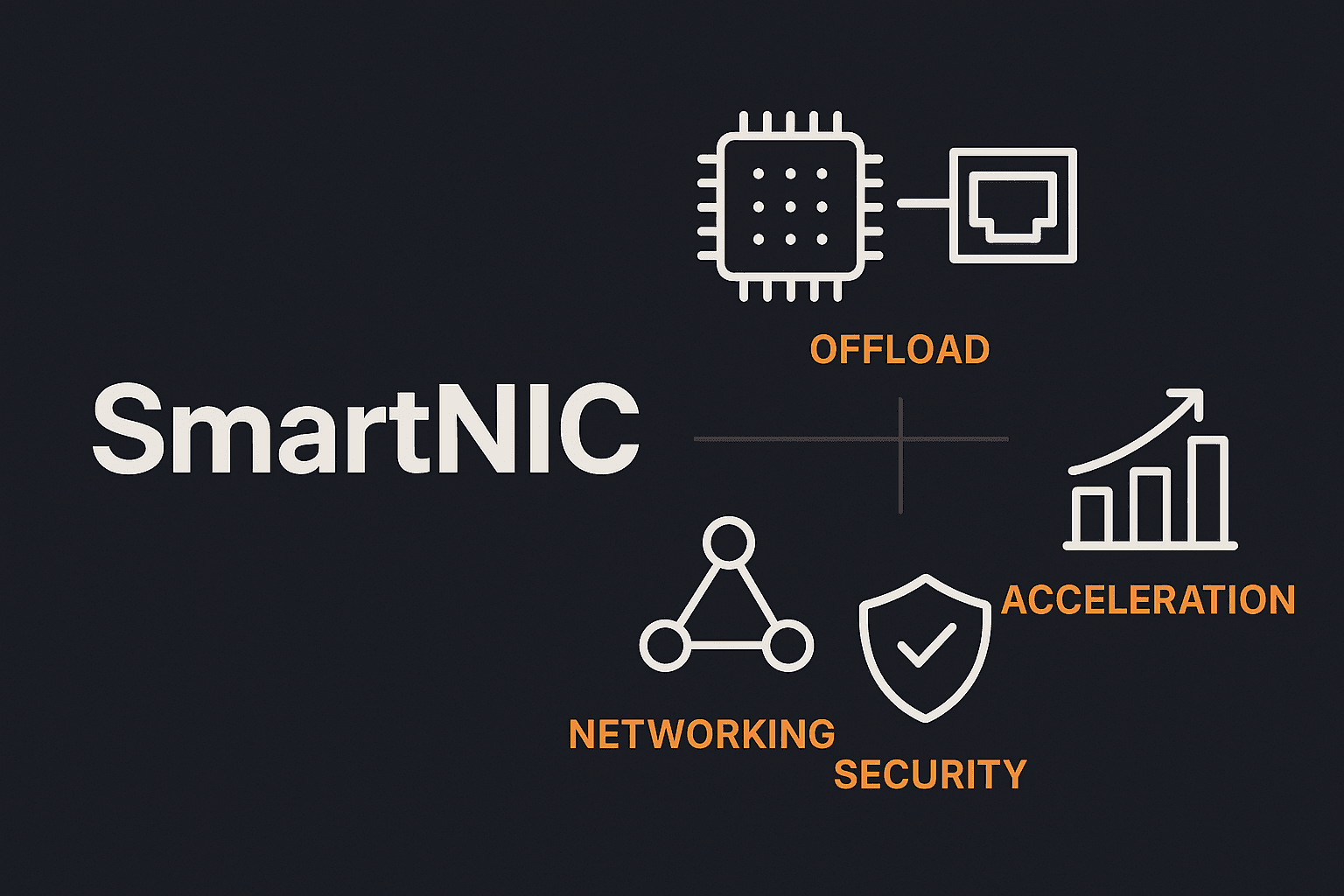
A SmartNIC is a programmable network interface card built to take over infrastructure tasks that normally consume valuable CPU resources. It handles functions such as packet routing, encryption, storage traffic processing, and tenant separation directly on the NIC. This setup helps servers run applications more efficiently and keeps network performance stable under heavy load.
SmartNICs are becoming increasingly important as organizations face growing demands for higher throughput, lower latency, and more predictable system behavior.
What a SmartNIC Does Behind the Scenes
Instead of relying on the server CPU for every networking operation, a SmartNIC uses onboard compute units, accelerators, and memory to handle much of the traffic independently. It can manage virtual switches, filters, security policies, and data movement without interrupting application workloads.
This approach reduces context switching, keeps CPU usage lower, and maintains steady data flow even during peak network activity.
🚀 Boost Network Throughput in SmartNIC-Driven Setups
Pair your SmartNIC environment with Simplyblock’s high-speed storage engine for more predictable performance under heavy I/O and network load.
👉 See Disaggregated Storage Solutions →
Why SmartNIC Technology Is Gaining Momentum
Standard NICs depend on the server CPU to handle network operations, which becomes a bottleneck when workloads scale. SmartNICs solve this problem by running infrastructure tasks directly on the interface card, resulting in improved consistency and less overhead for the main system.
For environments with real-time traffic, distributed applications, or containerized workloads, SmartNICs help maintain stable performance and reduce the strain on compute resources.
Advantages SmartNICs Bring to High-Demand Workloads
SmartNICs deliver several benefits that help organizations support modern, data-heavy environments:
- Lower CPU Load: Infrastructure processing runs on the NIC, freeing CPU cycles for application execution.
- Steadier Latency: On-NIC processing helps reduce delays during high-traffic periods.
- Enhanced Isolation: Security enforcement, tenant separation, and routing rules operate independently from the server.
- Smoother Scaling: Systems can grow without overwhelming the CPU with infrastructure overhead.
These advantages are key for data centers handling unpredictable or high-volume workloads.
Where SmartNICs Deliver a Strong Advantage
SmartNICs play a valuable role in environments that require fast, reliable network performance:
- Cloud platforms with high virtualization demands.
- AI and analytics clusters are exchanging large amounts of data.
- Distributed storage systems handling replication and heavy I/O.
- Financial platforms where low latency is crucial.
- Kubernetes deployments that rely on overlay networking and fast service routing.
These systems rely on SmartNICs to keep operations running smoothly under pressure.
SmartNICs Compared to Standard NIC Designs
Standard NICs depend heavily on the CPU for network handling, while SmartNICs bring processing directly to the network interface. This leads to more predictable performance and reduced CPU overhead.
| Feature | Standard NIC | SmartNIC |
| Traffic Handling | CPU-managed | Offloaded to NIC firmware/cores |
| CPU Impact | High during load | Much lower |
| Latency Behavior | Can become unstable under load | More consistent |
| Security Controls | Limited | Programmable and isolated |
| Scaling Capacity | Bound by CPU capability | Scales more effectively |
How SmartNICs Improve Data Movement Across Distributed Systems
Distributed infrastructures often struggle when the CPU is overloaded with networking or storage-related tasks. SmartNICs help solve this by taking over traffic routing, policy enforcement, and data movement directly at the network interface.
This reduces pressure on the main CPU and keeps data flowing smoothly across the cluster. As a result, replication runs faster, congestion is reduced, and throughput between nodes becomes more consistent. SmartNICs also make failover responses quicker and help maintain efficient communication across large distributed systems.
How Simplyblock Works Alongside SmartNIC Architectures
Simplyblock helps SmartNIC environments achieve higher performance by optimizing data paths and reducing overhead in distributed storage workflows. Organizations using SmartNICs benefit from:
- Higher Data Path Efficiency: Simplyblock improves I/O throughput without adding CPU pressure.
- Consistent Response Times: Performance remains stable during intensive read/write operations.
- Reduced Management Effort: Straightforward monitoring and configuration reduce manual tuning.
- Compatibility with Modern Infrastructure: Works seamlessly with SmartNICs, IPUs, Kubernetes, and hybrid deployments.
How SmartNIC Adoption Will Shape Future Infrastructure
As systems become more distributed and workload demands grow, SmartNICs will take on a larger role in server design. Their ability to offload infrastructure work, maintain steady throughput, and improve network consistency makes them essential for next-generation data centers.
SmartNICs will also help organizations support larger workloads without redesigning their entire compute layer, making growth far easier to manage.
Related Terms
Teams often review these glossary pages alongside SmartNIC when they define programmable NIC capabilities, decide what to offload from host CPUs, and validate RDMA-ready networking paths.
Network offload on DPUs
vSwitch / OVS offload on DPU
RoCEv2
NVIDIA BlueField DPU
Questions and Answers
A SmartNIC offloads networking tasks—such as packet processing, encryption, load balancing, and storage traffic—directly onto the NIC hardware. This frees CPU resources for application workloads, improving throughput and system efficiency.
SmartNICs are ideal for cloud-native, virtualized, and containerized workloads that require efficient networking. They improve performance in environments running NFV, Kubernetes, microservices, distributed storage, and high-density virtualization.
A traditional NIC only handles basic packet transmission, while a SmartNIC includes programmable compute resources like ARM cores or FPGAs. This allows it to run networking, security, and storage services directly on the NIC, reducing latency and CPU overhead.
Yes. SmartNICs can enforce security policies, isolate network traffic, and offload virtual switching at the hardware level. This prevents noisy-neighbor effects and ensures predictable performance for tenants sharing the same physical infrastructure.
Deploying SmartNICs may require new orchestration workflows, updated drivers, and application awareness of hardware offloads. They also introduce additional management layers, so teams need operational expertise with programmable NIC technologies.