Storage Area Network (SAN)
Terms related to simplyblock
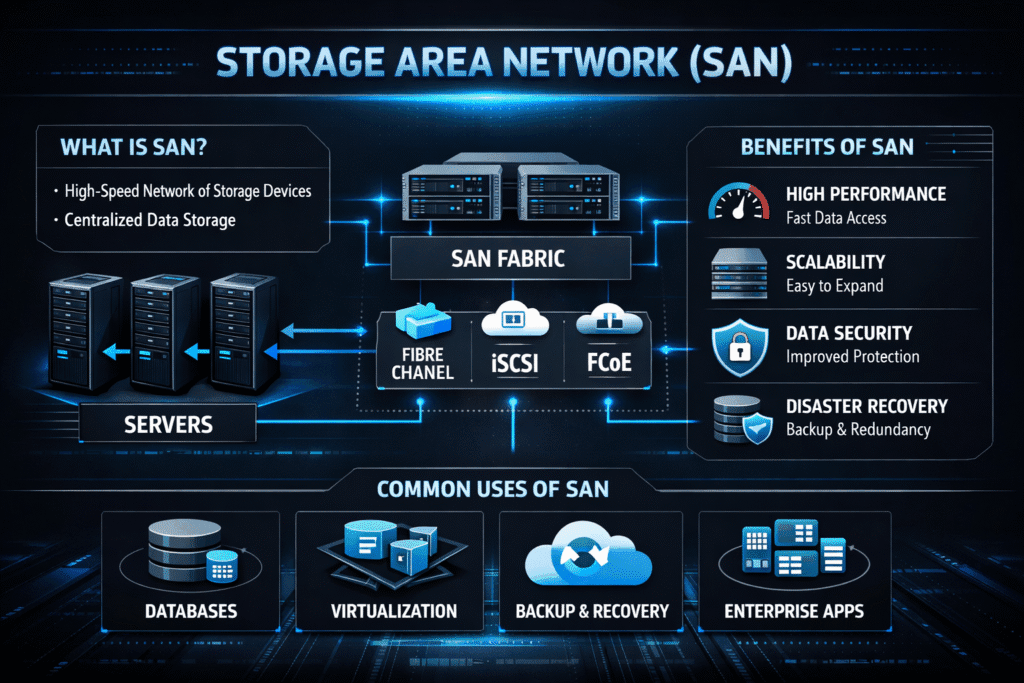
A Storage Area Network (SAN) is a dedicated network that provides block-level storage access to servers. Instead of relying on local disks, systems connect to shared storage over high-speed links such as Fibre Channel or iSCSI.
SANs were designed for environments where performance consistency, centralized control, and reliability are more important than simplicity. That’s why they remain common in enterprise data centers.
How a Storage Area Network Is Built
A SAN consists of three main components: storage arrays, network fabric, and host systems. The fabric connects servers to shared storage using specialized switches and protocols designed for low latency and high reliability.
Because storage traffic is isolated from regular network traffic, SANs deliver predictable performance. This separation is a key reason SANs have been widely adopted in enterprise environments.
🚀 Support High-Performance Block Storage Across Your Infrastructure
Run scalable block storage with a modern platform that integrates cleanly with existing SAN-based environments.
👉 See Software-Defined Storage Solutions →
How SAN Access Works at the Block Level
SANs operate at the block level, meaning storage volumes appear to servers as raw disks. Applications and file systems control how data is written and read, giving teams fine-grained control over performance and layout.
This block-level access makes SANs suitable for databases, virtualization platforms, and workloads that require consistent I/O behavior.
Key Capabilities Provided by Storage Area Networks
Storage Area Networks offer several defining capabilities:
- Centralized Block Storage: Multiple servers access shared storage pools.
- Dedicated Storage Fabric: Storage traffic remains isolated from general network usage.
- High Availability Options: Redundant paths and controllers reduce downtime risk.
- Consistent Performance: Predictable latency under steady workloads.
These capabilities have made SANs a standard choice for enterprise storage.
Where SANs Are Commonly Deployed
SANs are typically found in enterprise data centers, where they run databases, virtual machines, and business-critical applications. They are also used in environments where storage must be tightly controlled and monitored.
In some cases, SANs support legacy systems that cannot easily migrate to newer storage models.
Storage Area Networks Compared to NAS and Local Storage
SANs are often evaluated alongside Network-Attached Storage (NAS) and direct-attached storage (DAS). Each serves different needs.
| Feature | SAN | NAS | Local Storage |
| Access Type | Block-level | File-level | Block-level |
| Shared Access | Yes | Yes | No |
| Performance Control | High | Moderate | High |
| Scalability | High | Moderate | Limited |
| Typical Use | Databases, VMs | File sharing | Single-host apps |
This comparison highlights why SANs are chosen for workloads that require shared, high-performance block storage.
SANs in Modern Virtualized Environments
In virtualized infrastructures, SANs provide a centralized storage layer that supports live migration, clustering, and high availability. Virtual machines can move between hosts while maintaining access to the same storage volumes.
This capability remains valuable in environments that rely on traditional virtualization platforms.
How Simplyblock Fits into SAN-Based Storage Strategies
Simplyblock complements SAN-based setups by introducing software-defined flexibility on top of block storage environments.
- Modern Data Path Support: Works alongside existing block storage protocols.
- Improved Resource Utilization: Helps reduce inefficiencies common in traditional SAN setups.
- Scalable Storage Management: Allows storage capacity to grow without major reconfiguration.
- Better Fit for Mixed Environments: Supports hybrid infrastructures combining SAN and cloud-native workloads.
This approach helps teams modernize without replacing everything at once.
The Role of SANs in Evolving Storage Architectures
While newer storage models emphasize flexibility and software control, SANs remain relevant in environments that prioritize stability and predictable performance.
Organizations often integrate SANs with modern storage platforms to balance control, scalability, and operational simplicity.
Related Terms
Teams often review these glossary pages alongside Storage Area Network (SAN) when they compare host connectivity constraints, back-end media interfaces, and cost drivers in block-storage environments.
PCI Express
SAS
SATA
TCO (Total Cost of Ownership)
Direct Attached Storage (DAS)
Questions and Answers
A SAN provides high-speed, low-latency access to shared storage by using dedicated network fabrics. This offloads storage traffic from the main network and delivers consistent performance for databases, virtual machines, and other heavy workloads.
SAN is ideal for block-level, high-performance workloads like databases, while NAS suits file-based collaboration and shared directories. Key considerations include latency requirements, scalability, cost, and application compatibility.
SANs support redundant controllers, multi-pathing, and failover mechanisms to ensure continuous access to storage. If one path or component fails, traffic automatically reroutes, minimizing downtime for critical applications.
SANs typically use Fibre Channel, iSCSI, or NVMe-over-Fabrics. The choice depends on performance needs, existing infrastructure, and budget—Fibre Channel for low-latency environments, iSCSI for cost-effective Ethernet-based deployments, and NVMe-oF for next-gen performance.
Challenges include complex configuration, dependency on specialized hardware, and higher operational costs. As storage demands grow, expanding a SAN requires careful planning to maintain performance, redundancy, and compatibility with existing storage arrays.