Synchronous Storage Replication
Terms related to simplyblock
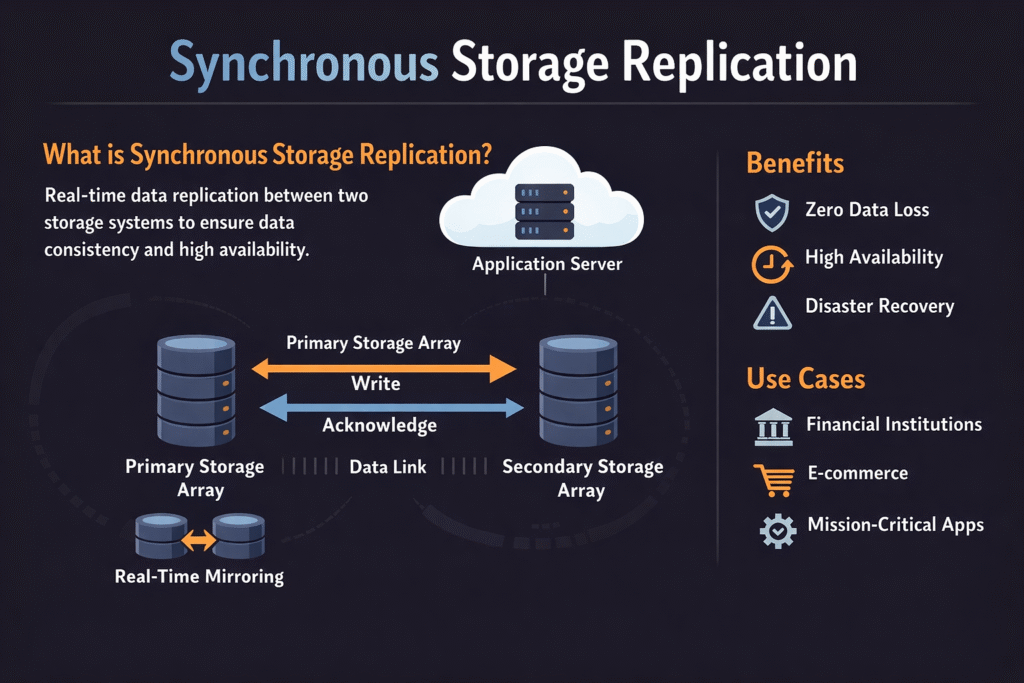
Synchronous Storage Replication is a vital technology that ensures data consistency and high availability by replicating data in real time between storage systems.
Unlike asynchronous replication, which can result in data delays, synchronous replication ensures that data changes are instantly mirrored across multiple locations, providing immediate data protection and eliminating the risk of data loss during system failures.
The Process Behind Synchronous Storage Replication
Synchronous Storage Replication operates by continuously mirroring data between two or more storage systems in real time. When a write operation occurs on the primary storage system, the data is immediately replicated to the secondary storage system(s) before the operation is considered complete. This ensures that both the primary and secondary systems always contain identical copies of the data.
For this to happen efficiently, replication must occur within a very short timeframe (usually milliseconds). This fast transfer ensures that there’s no performance degradation and allows organizations to maintain a high level of operational efficiency without sacrificing data consistency.
🚀 Maximize Data Availability with Synchronous Storage Replication
Enhance your storage infrastructure with simplyblock, ensuring real-time data consistency and protection across your systems.
👉 Learn More About Fast Backups and Disaster Recovery →
The Role of Synchronous Storage Replication in Mission-Critical Environments
In mission-critical environments, where downtime is not an option, Synchronous Storage Replication plays a key role in ensuring high availability and data consistency. Industries such as finance, healthcare, and telecommunications rely heavily on real-time data availability, where even a slight delay can result in significant consequences.
By maintaining an up-to-date replica of the data at secondary locations, synchronous replication ensures that organizations can recover from disasters with minimal disruption. If a failure occurs at the primary location, the secondary system takes over without data loss, providing business continuity and reducing downtime.
Key Benefits of Synchronous Storage Replication
Synchronous Storage Replication offers several crucial benefits for organizations aiming to maintain high data availability and protection:
- Real-Time Data Consistency: Data is immediately mirrored between systems, ensuring both locations are synchronized at all times.
- Zero Data Loss: Because changes are reflected instantaneously, there is no risk of data loss even if the primary system fails.
- Disaster Recovery: Synchronous replication ensures that a secondary system is ready to take over if the primary system experiences a failure, ensuring business continuity.
- Regulatory Compliance: Many industries require strict data protection and consistency standards. Synchronous Storage Replication helps meet these regulatory requirements by ensuring data integrity.
These benefits make Synchronous Storage Replication particularly valuable in high-availability environments, where maintaining consistent, up-to-date data is non-negotiable.
Use Cases for Synchronous Storage Replication in High-Performance Environments
Synchronous Storage Replication is essential for environments where real-time data consistency and high availability are critical. Some notable use cases include:
- Financial Services: Banks and financial institutions rely on synchronous replication to ensure that transaction data remains consistent across locations. The ability to process real-time transactions without any delay or risk of loss is crucial for compliance and business operations.
- Healthcare: In healthcare, patient data and medical records must be accessible at all times. Synchronous replication guarantees that patient information is consistent and available across healthcare facilities, enabling timely medical decisions and compliance with regulations.
- E-commerce Platforms: For e-commerce platforms, real-time access to customer data, inventory management, and transaction records is crucial. Synchronous Storage Replication ensures that data is always up-to-date, even during high-traffic periods, preventing service disruptions.
Synchronous Storage Replication vs Other Replication Techniques
When comparing Synchronous Storage Replication to other replication methods, such as Asynchronous Replication, there are distinct differences in terms of speed, reliability, and use cases.
Here’s a comparison:
| Feature | Synchronous Replication | Asynchronous Replication |
| Data Consistency | Real-time ensures data consistency across systems | Potential for data lag, not always consistent |
| Latency | Low, usually in milliseconds | Higher, depending on the replication delay |
| Data Loss | Zero data loss, all writes are replicated | Risk of data loss if the primary system fails before replication |
| Performance Impact | Can impact system performance during heavy writes | Generally has less performance impact |
| Ideal for | Mission-critical environments requiring high availability and zero data loss | Environments where slight delays are acceptable |
Synchronous Storage Replication Enhancing Cloud Infrastructure
Cloud environments, particularly multi-cloud and hybrid cloud infrastructures, greatly benefit from Synchronous Storage Replication. By replicating data across multiple locations or cloud providers in real time, businesses can ensure that data is always available, no matter where it’s needed.
This replication model is particularly useful in scenarios where data needs to be synchronized between cloud-based and on-premises systems. With Synchronous Storage Replication, businesses can achieve seamless continuity and disaster recovery across different environments, ensuring uptime and resilience even in complex infrastructures.
How Simplyblock Optimizes Synchronous Storage Replication
Simplyblock enhances the effectiveness of Synchronous Storage Replication, offering a platform that ensures high-performance storage management across distributed systems. With this optimization, organizations can:
- Improve Data Protection: Ensure real-time data consistency across multiple locations, reducing the risk of data discrepancies or loss during system failures.
- Simplify Disaster Recovery: Provide seamless failover capabilities for rapid recovery from primary system failures, minimizing downtime.
- Boost Performance: Minimize the operational impact of synchronous replication, ensuring that critical systems continue to perform optimally, even during high-volume data writes.
By leveraging Simplyblock’s optimizations, enterprises can rely on high-performance, real-time data protection across their systems.
The Future of Synchronous Storage Replication in Modern IT Environments
As data-driven applications continue to evolve and the need for real-time data grows, Synchronous Storage Replication will play an increasingly important role in ensuring continuous availability and data consistency. The technology will continue to integrate with emerging IT innovations like edge computing, AI-driven storage management, and blockchain to further enhance data integrity and availability.
For businesses that depend on 24/7 data access, Synchronous Storage Replication will remain a core component of their IT strategy, ensuring that systems are always synchronized, and data remains secure and consistent across all locations.
Related Terms
Teams often review these glossary pages alongside Synchronous Storage Replication when they set write-acknowledgement expectations, validate failure handling, and define recovery and performance targets.
Storage Controller
Storage Pools
Fault Tolerance
SLO (Service Level Objective)
Questions and Answers
Synchronous storage replication ensures that data changes are immediately mirrored between primary and secondary storage locations. By writing to both storage systems simultaneously, it guarantees that both sites have identical, up-to-date data at all times, ensuring data consistency even during failures or disruptions.
Synchronous storage replication is particularly useful for high-availability environments, such as financial services, healthcare, and e-commerce platforms, where data integrity and zero data loss are paramount. It’s also critical in disaster recovery scenarios, ensuring business continuity and minimizing downtime in case of system failure.
Network latency plays a significant role in the performance of synchronous storage replication. Since data must be written to both the primary and secondary storage in real-time, any delays in the network can lead to slower replication times and may impact overall system performance, particularly for geographically dispersed locations.
To implement synchronous storage replication effectively, organizations need high-bandwidth, low-latency networks between data centers or storage sites. Additionally, they must ensure that both primary and secondary storage systems are capable of handling real-time data synchronization without affecting performance, particularly for mission-critical applications.
While synchronous storage replication provides real-time data consistency, it does not protect against application-level failures or logical errors. It’s also sensitive to network performance issues and requires significant infrastructure investment. For comprehensive data protection, it’s important to complement it with other strategies like regular backups or off-site storage.