VMware Tanzu
Terms related to simplyblock
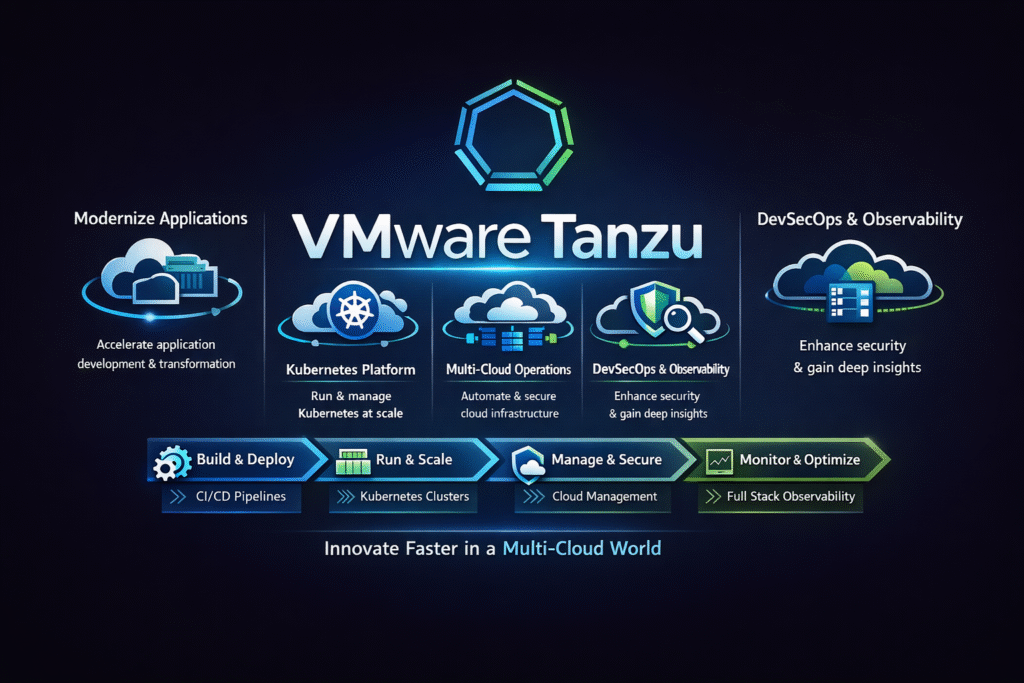
VMware Tanzu is a portfolio of products for building, running, and operating Kubernetes-based platforms across private cloud and public cloud, with a strong focus on governance, lifecycle management, and enterprise operations.
In practice, VMware Tanzu often shows up as Tanzu Kubernetes Grid (TKG), Tanzu Kubernetes Grid Integrated Edition (TKGI), and application platform tooling that standardizes how clusters and workloads are delivered.
What problems does VMware Tanzu solve?
VMware Tanzu is used when an organization needs Kubernetes at scale with consistent lifecycle operations, RBAC controls, policy enforcement, and integration into existing vSphere processes.
Executives typically care about risk reduction and platform consistency across business units, while platform and operations teams care about standard cluster builds, upgrades, compliance controls, and predictable day-2 operations.
🚀 Standardize Kubernetes Storage on VMware Tanzu with NVMe/TCP
Use Simplyblock to simplify persistent storage and keep performance predictable at scale.
👉 Use simplyblock for VMware Tanzu →
How VMware Tanzu handles Kubernetes Storage
Kubernetes Storage in a Tanzu environment follows upstream Kubernetes primitives: PersistentVolumes (PVs), PersistentVolumeClaims (PVCs), and StorageClasses. StorageClasses define how volumes are provisioned and which “class” of storage a workload receives.
Tanzu clusters commonly integrate with the vSphere CSI driver for dynamic provisioning, snapshots, and lifecycle operations. CSI, the Container Storage Interface, is the standard way Kubernetes talks to storage systems, whether they are cloud, hypervisor-integrated, or external.
Where NVMe/TCP fits in Tanzu environments
Many Tanzu deployments start with hypervisor-attached storage, but performance-sensitive workloads (databases, analytics pipelines, AI feature stores) often need a different I/O profile than general-purpose VM storage. NVMe/TCP is an NVMe-oF transport that delivers networked NVMe block access over standard TCP/IP and Ethernet, making it a practical path to disaggregated storage without RDMA-only requirements.
When NVMe/TCP is paired with Kubernetes Storage semantics (StorageClasses, PVCs, topology controls), teams can separate compute scaling from storage scaling while keeping operational workflows aligned to Kubernetes and Tanzu.
Quick comparison – Tanzu storage patterns
The table below summarizes common Tanzu-aligned storage approaches and how they tend to differ in operations and performance characteristics.
| Storage approach in Tanzu | Typical deployment model | Performance path | Operational trade-off |
|---|---|---|---|
| vSphere-integrated storage via vSphere CSI | Hyper-converged with vSphere storage policies | Hypervisor and datastore dependent | Strong vSphere alignment, but scaling and performance isolation depend on underlying datastore design |
| Legacy network block (iSCSI-based) | Often disaggregated, SAN-style | SCSI stack over TCP | Familiar tooling, but higher protocol overhead versus NVMe transports |
| simplyblock with NVMe/TCP | Hyper-converged, disaggregated, or hybrid | NVMe/TCP with SPDK acceleration | Kubernetes-native provisioning and high throughput over Ethernet, designed for performance-centric clusters |
Simplyblock™ with VMware Tanzu – Software-defined Block Storage for cloud-native operations
Simplyblock provides Software-defined Block Storage designed for Kubernetes-first operations, including environments built on VMware Tanzu. Rather than tying performance and capacity to a fixed appliance footprint, simplyblock is built around an NVMe-first architecture and can present storage to Tanzu clusters through CSI workflows that match how platform teams already provision storage.
Simplyblock’s NVMe/TCP approach is attractive in Tanzu environments because it aligns with standard Ethernet designs and reduces friction when platform teams are standardizing on Kubernetes-native provisioning. For performance engineering teams, simplyblock’s SPDK-based user-space design is relevant because SPDK is built to reduce kernel overhead and improve CPU efficiency for NVMe paths, which matters when consolidating stateful services on shared clusters.
Key decision points for Tanzu storage
Tanzu platform teams usually standardize Kubernetes Storage by defining a small set of StorageClasses that match workload tiers, then validating CSI feature support for snapshots, expansion, and topology-aware provisioning.
The practical checks are whether upgrades preserve volume attachment behavior, whether backup and restore workflows are consistent across namespaces, and whether observability can pinpoint volume latency versus node or network bottlenecks.
Related Technologies
These VMware Tanzu-adjacent topics are commonly searched together when teams standardize Kubernetes Storage and platform operations.
- NVMe/TCP: NVMe-oF over standard Ethernet/TCP for SAN-alternative designs.
- Kubernetes Storage: Common deployment patterns and trade-offs for Tanzu-aligned clusters.
- Software-defined Block Storage: Storage delivered as software with Kubernetes-native provisioning and policy control.
- SPDK (Storage Performance Development Kit): User-space, zero-copy NVMe acceleration concepts relevant to high-performance platforms.
Questions and Answers
VMware Tanzu is an enterprise platform for building, deploying, and managing Kubernetes applications across hybrid and multi-cloud environments. It simplifies container orchestration while integrating with persistent Kubernetes storage solutions like NVMe over TCP.
Yes, VMware Tanzu environments can leverage NVMe over TCP for high-throughput and low-latency persistent storage. It’s ideal for stateful workloads that demand fast I/O, such as databases and analytics apps.
DPUs offload networking, storage, and security tasks from the host in VMware Tanzu environments. This improves network storage performance and allows better resource isolation and scalability across clusters.
Yes, VMware Tanzu supports production-grade stateful workloads using persistent volumes and CSI drivers. With optimized storage backends like Simplyblock’s NVMe-based solution, Tanzu can deliver the IOPS and latency performance modern apps require.
To optimize storage, use a high-performance backend like NVMe over TCP and align it with node-local affinity and DPU acceleration. This ensures low-latency access for workloads like PostgreSQL, MongoDB, or time-series databases.