Kubernetes Secrets for Storage Credentials
Terms related to simplyblock
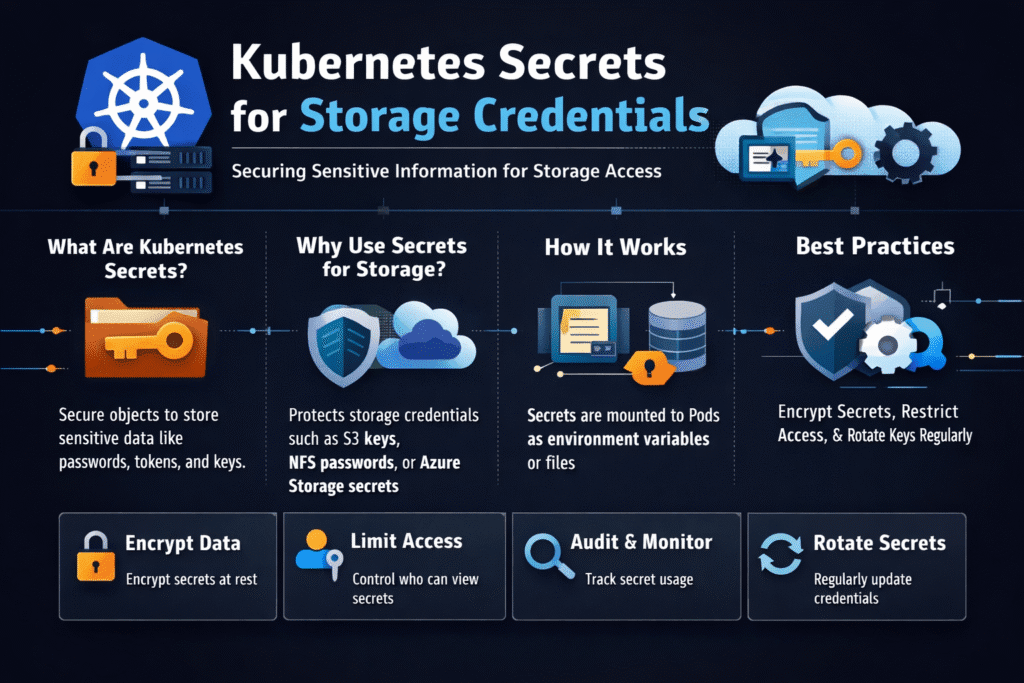
Kubernetes Secrets store sensitive values, such as usernames, passwords, and tokens, so teams do not hardcode credentials in Pod specs or images. For storage, these Secrets often hold the login data a CSI driver needs to provision, attach, mount, snapshot, or expand volumes.
Storage credentials sit on a hot path for reliability and compliance. If a Secret leaks, an attacker can reach your Kubernetes Storage backend. If a Secret breaks during rotation, StatefulSets can fail to start, and recovery gets messy. Strong handling of Secrets reduces both security risk and downtime risk.
Teams that run Software-defined Block Storage across many tenants feel this first. They need tight access control, clean rotation, and clear ownership, without slowing down delivery.
Why credential hygiene matters more for storage than app config
Storage Secrets differ from typical app secrets because they control infrastructure actions, not just runtime behavior. A storage credential may allow volume creation, deletion, clone, snapshot, and mapping changes. That scope can exceed what an app service account should ever hold.
Treat storage credentials as “platform keys.” Limit who can read them, limit where they can be used, and limit what they can do on the backend.
🚀 Set Up Kubernetes Secrets for Storage Credentials With the Simplyblock CSI Driver
Use Simplyblock to store CSI credentials in a dedicated Secret and keep access consistent across clusters.
👉 Install Simplyblock CSI and Configure the Secret →
How Kubernetes Secrets for Storage Credentials flow through CSI operations
CSI supports passing Secrets for different stages, such as provisioning and node publish, based on your driver and StorageClass parameters. The pattern looks simple, but the failure modes stack up fast: RBAC gaps block access, namespace boundaries confuse owners, and rotation timing breaks mounts.
Aim for a setup where the platform team owns storage Secrets, and app teams only reference StorageClasses. When app teams need custom settings, give them a controlled path, such as a reviewed Helm value, not raw Secret edits.
Kubernetes Secrets for Storage Credentials in Kubernetes Storage Governance
Governance starts with two rules: scope and separation. Scope means you keep each Secret as narrow as possible, both in permissions and reach. Separation means you avoid sharing the same credentials across environments, tenants, or clusters.
Use namespaces to set clean boundaries. Use RBAC to lock down get/list/watch on Secrets. Use the admission policy to block Pods that try to mount unexpected Secret names. If you run many clusters, use the same policy set everywhere, so audits do not turn into a one-off project.
For executives, this lowers the blast radius. For operators, it cuts pager noise tied to “mystery auth failures.”
Kubernetes Secrets for Storage Credentials and NVMe/TCP data paths
NVMe/TCP speeds up storage traffic over standard Ethernet, but it does not change one key fact: the control plane still needs credentials to perform storage actions. In many incidents, the data path looks fine while the control path fails because a Secret went stale or RBAC blocked access.
Also, watch CPU headroom on busy nodes. If your stack spends too much CPU per I/O, cluster churn rises, and mount timing can drift. SPDK-style user-space I/O paths can improve CPU efficiency for Software-defined Block Storage, which helps keep latency steady under load, even when clusters scale fast.
What to measure when storage auth breaks at scale
Track signals that point to action, not just symptoms. Measure the CSI operation error rate by method (CreateVolume, ControllerPublish, NodePublish). Measure mount and attach time during rollouts. Measure Secret rotation events against error spikes. Measure backend auth failures separately from Kubernetes RBAC denials.
When you correlate these, you stop guessing. You can tell if the cluster blocked access, if the backend rejected credentials, or if node pressure slowed down the flow.
Practical hardening steps that keep rotations safe
- Keep one Secret per environment and per tenant, and avoid shared “global” storage credentials
- Restrict Secret read access to the CSI components that need it, and deny broad namespace reads
- Rotate credentials on a schedule, and test rotations during a controlled rollout window
- Prefer short-lived tokens when your storage backend supports them, and log token use
- Alert on CSI auth failures and RBAC denials separately, so teams can route issues faster
Comparing credential options for Kubernetes storage backends
Most teams choose between static credentials in Secrets, external secret managers, and short-lived tokens. The table below frames the operational trade-offs.
| Credential approach | Ops overhead | Rotation risk | Best fit | Main gap |
|---|---|---|---|---|
| Static user/pass in Secret | Low | Medium | large-scale, multi-tenant platforms | Higher blast radius if leaked |
| External secret manager + CSI mount | Medium | Low | Regulated orgs, strict audits | More moving parts to run |
| Short-lived tokens issued on demand | Medium | Low | High scale, multi-tenant platforms | Needs backend support and logging |
Predictable storage access with Simplyblock™
Simplyblock™ supports Kubernetes Storage through a CSI integration and NVMe/TCP transport, so teams can standardize how workloads request volumes while the platform enforces policy. With multi-tenancy and QoS, simplyblock can help teams keep tenant boundaries clear and performance stable, even when many apps share the same storage pools.
This matters for credential handling because strong tenant separation reduces the need for shared credentials. It also helps operations teams align Secrets, StorageClasses, and backend policies to a consistent model, rather than fixing auth drift cluster by cluster.
What changes next in storage credential handling
Expect more teams to pair CSI with external secret managers and policy controls. Expect more focus on short-lived tokens and automated rotation tests.
Also expect tighter links between observability and security signals, so storage auth failures trigger targeted alerts instead of broad “pods failing” noise.
Related Terms
Teams often review these glossary pages alongside Kubernetes Secrets for Storage Credentials when they standardize Kubernetes Storage, NVMe/TCP, and Software-defined Block Storage.
Kubernetes Volume Health Monitoring
CSI NodePublishVolume Lifecycle
Kubernetes Volume Attachment
Storage Metrics in Kubernetes
Questions and Answers
Kubernetes Secrets for storage credentials securely store access keys, tokens, or passwords needed to provision or mount volumes via CSI drivers. This is critical when deploying persistent Kubernetes Stateful workloads that rely on secure authentication to external storage backends.
CSI drivers reference Secrets defined in the StorageClass or VolumeSnapshotClass to authenticate API calls to the storage backend. Simplyblock’s Kubernetes CSI implementation supports secret injection for secure provisioning and snapshot operations.
Yes. Kubernetes supports encryption at rest for Secrets using KMS providers. When used alongside storage solutions like Simplyblock that provide encryption at rest, it ensures end-to-end data protection across the control plane and storage layers.
Storage Secrets are usually created in the same namespace as the pod or StorageClass. They can include keys like accessKey, secretKey, or endpoint. These credentials enable dynamic provisioning for block storage replacement solutions.
Yes, if RBAC and namespace boundaries are properly enforced. For added isolation, Secrets should be tightly scoped and used with trusted CSI drivers, especially in environments with multi-tenant Kubernetes storage.