CSI Driver vs Sidecar
Terms related to simplyblock
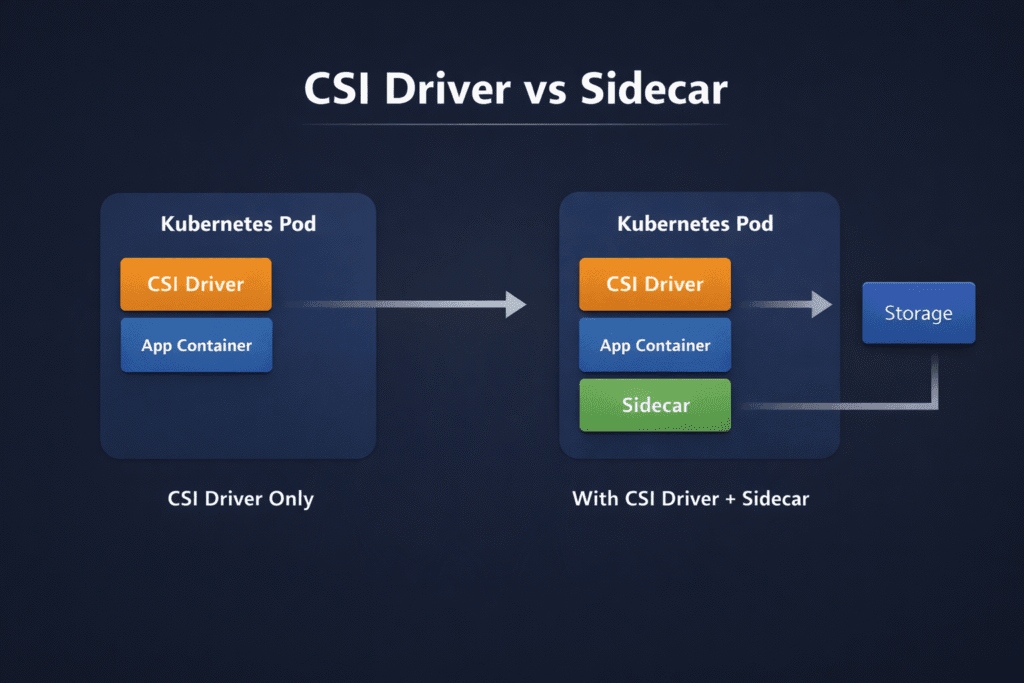
CSI Driver vs Sidecar comes down to where the logic lives. The CSI driver implements the Container Storage Interface RPCs and talks to the storage backend. The sidecars run alongside the driver and handle Kubernetes control-plane workflows like provisioning, attach/detach, resize, snapshots, and health checks.
Teams feel the difference in day-2 work. A clean separation makes upgrades safer, reduces code in the driver, and helps operators debug issues faster. Poor separation creates drift across clusters because each installation behaves a bit differently.
This topic matters most in Kubernetes Storage platforms that run many stateful services and aim for repeatable performance with Software-defined Block Storage on NVMe/TCP.
CSI Driver vs Sidecar – What Each Component Owns
A CSI deployment typically includes a “driver container” plus standard sidecar containers maintained by the Kubernetes CSI community. Those sidecars watch the Kubernetes API, trigger actions against the CSI endpoint, and then update Kubernetes objects with results.
Use this quick mapping when you review a vendor’s manifest:
- external-provisioner creates and deletes volumes in response to PVC activity by calling
CreateVolumeandDeleteVolume. - external-attacher manages controller-side attach and detach via
ControllerPublishandControllerUnpublish. - external-resizer coordinates volume expansion flows when the backend supports it.
- external-snapshotter handles snapshot CRDs and triggers snapshot calls on the CSI endpoint.
- node-driver-registrar registers the driver with the kubelet so nodes can mount volumes reliably.
- livenessprobe exposes
/healthzand callsProbe()to report driver health.
This split creates a clear contract. The driver focuses on storage behavior. The sidecars focus on Kubernetes workflows.
🚀 Debug CSI Driver vs Sidecar Behavior in NVMe/TCP Kubernetes Storage
Use Simplyblock’s CSI architecture guide to standardize sidecars, speed up triage, and keep Software-defined Block Storage workflows predictable.
👉 Read Simplyblock Kubernetes CSI Architecture and Troubleshooting →
CSI Driver vs Sidecar in Kubernetes Storage Operations
Operations teams usually care about three outcomes: consistent provisioning, predictable attach/mount time, and clean failure handling. Sidecars help because they standardize how controllers watch for events and retry work when the cluster churns.
This architecture also improves upgrade hygiene. You can upgrade a sidecar to get a bug fix in provisioning logic without touching the driver code, as long as versions remain compatible. On the other hand, you still need discipline. A mismatched sidecar set can break workflows even when the driver works.
In practice, the sharp edges show up during scale events. Large clusters generate more API events, more reschedules, and more parallel requests for volumes. Sidecars that lag or crash can throttle the whole storage pipeline, so teams should treat them as first-class production components, not “supporting cast.”
CSI Driver vs Sidecar for NVMe/TCP Performance and Isolation
Performance does not stop at “driver works.” The full path includes the node, the network, and the target, especially with NVMe/TCP. If the platform burns CPU in the storage path, it can raise tail latency under load, even when the backend has plenty of IOPS headroom.
That’s why many teams pair NVMe/TCP with an efficient dataplane and strong policy controls. Simplyblock’s Kubernetes Storage offering highlights CSI-based integration with NVMe/TCP volumes, which fits disaggregated designs and scales across clusters.
Isolation matters as much as speed. Sidecars do not enforce fairness by themselves. Your Software-defined Block Storage layer needs multi-tenancy and QoS to stop noisy neighbors from consuming shared queue depth and bandwidth. Simplyblock positions QoS as a core control for multi-tenant Kubernetes environments.
Common Failure Modes and How to Debug Faster
Many CSI incidents look like “storage is down,” but the root cause often sits in the control plane. Start with symptoms and map them to the likely component.
Provisioning stalls often point to the external-provisioner path, StorageClass parameters, or API permission issues. Attach issues often track back to the external-attacher or node registration. Snapshot problems often come from snapshot CRD handling and version mismatches.
When you troubleshoot, check logs per container, not only the driver container. Also, validate that the sidecars match the driver’s supported versions, and confirm that leader election works as expected in HA controller deployments.
Design Comparison for CSI Packaging Choices
The table below compares common deployment styles based on operator effort, upgrade risk, and how well the stack supports consistent outcomes at scale.
| Pattern | What teams deploy | Upgrade risk | Ops effort | Best fit |
|---|---|---|---|---|
| Driver-only (minimal sidecars) | CSI driver plus only required helpers | Medium | Low | Simple clusters with limited features |
| Standard sidecar set | Driver + provision/attach/resize/snapshot health tools | Low to medium | Medium | Most enterprise Kubernetes Storage |
| Sidecar-heavy, feature-rich | Standard set plus extra controllers and policy hooks | Medium | Medium to high | Multi-tenant platforms with strict SLOs |
| Managed CSI stack with SDS controls | Sidecars + driver + platform QoS and isolation | Low | Low to medium | Shared Software-defined Block Storage fleets |
Running CSI at Scale with Simplyblock™
Simplyblock™ focuses on Kubernetes Storage that stays predictable under mixed workloads. The platform integrates through CSI, supports NVMe/TCP volumes, and adds multi-tenancy and QoS controls so platform teams can set guardrails instead of relying on best-effort sharing.
That combination helps when you run storage as a service for many internal teams. You can standardize StorageClasses, reduce one-off tuning, and keep a fast path for stateful apps without turning the storage team into a ticket queue.
Where CSI Component Design Is Moving
CSI component design keeps trending toward clearer contracts and safer upgrades. Kubernetes clusters also push more storage policy into code and automation, so teams can roll out changes consistently across environments.
Volume attribute profiles and richer controller logic will keep raising the bar for driver/sidecar compatibility testing.
Related Terms
Platform teams often review these glossary pages alongside CSI Driver vs Sidecar when they set up Kubernetes Storage and Software-defined Block Storage with repeatable workflows and stable performance.
Container Storage Interface (CSI)
Block Storage CSI
CSI Topology Awareness
Dynamic Provisioning in Kubernetes
Questions and Answers
The CSI driver handles volume lifecycle operations like provisioning and attaching. CSI sidecars are helper containers that handle tasks such as attaching metadata, resizing volumes, or snapshotting. Together, they enable dynamic Kubernetes storage operations through the CSI spec.
CSI sidecars like external-provisioner and external-attacher manage communication between Kubernetes and the CSI driver. Without sidecars, Kubernetes can’t dynamically request or mount persistent volumes. This architecture is essential for cloud-native workloads that need scalable storage on demand.
Simplyblock provides a CSI-compliant solution that works seamlessly with standard sidecars for provisioning, resizing, and snapshotting. Its integration with Kubernetes ensures smooth management of encrypted and high-performance volumes. See the full feature overview for supported capabilities.
Technically, CSI drivers require sidecars to interact with the Kubernetes control plane. Sidecars act as intermediaries, making it possible for Kubernetes to execute storage operations through the driver. This design separates concerns and enables modular enhancements—vital for robust containerized storage systems.
If provisioning or mounting fails, logs from both the CSI driver and sidecars should be inspected. Issues like missing volume attachments or incorrect capacity often stem from misconfigured StorageClass settings or broken sidecar communication. Refer to Simplyblock’s documentation portal for troubleshooting steps.