NVMe/RDMA
Terms related to simplyblock
As the complexity of applications and workloads increases, ensuring optimal storage performance is more critical than ever. NVMe/RDMA (Non-Volatile Memory Express/Remote Direct Memory Access) offers a powerful solution by significantly reducing latency and increasing data transfer speeds. This makes it ideal for demanding cloud environments, on-premises setups, and containerized applications that require high throughput and ultra-low latency.
How NVMe/RDMA Works
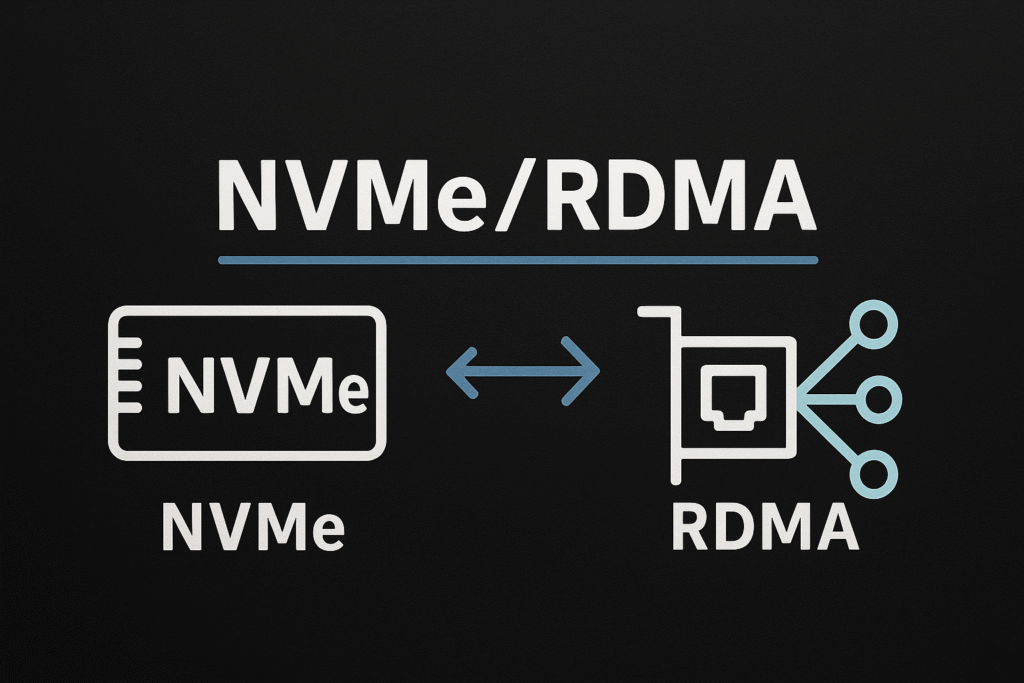
NVMe is a high-performance protocol designed to connect SSDs to the CPU via PCIe, providing fast data access. RDMA, on the other hand, allows direct memory access between systems, bypassing the operating system and minimizing CPU involvement.
When combined, NVMe/RDMA enables ultra-fast data transfer, especially for data-heavy applications that need fast access to storage. This combination maximizes the potential of SSDs while reducing overhead, resulting in high-performance data transfer across systems with minimal delay.
🚀 Simplify NVMe/RDMA Storage with simplyblock
Maximize the potential of NVMe/RDMA setups for high-performance storage in your environment.
👉 Optimize NVMe/RDMA Storage with simplyblock →
The Role of NVMe/RDMA in Modern Workloads
As workloads evolve, particularly in cloud environments and containers, the need for fast, efficient storage solutions grows. NVMe/RDMA is ideal for applications that require high-speed access to large amounts of data with minimal latency, including databases, AI/ML workloads, and containers.
For example, databases benefit from NVMe/RDMA because it allows for faster read/write speeds and reduced query response times. Similarly, AI and machine learning applications require rapid access to massive datasets, and NVMe/RDMA accelerates these processes, improving model training and data processing. Containerized applications in Kubernetes also demand high-performance storage, and NVMe/RDMA ensures optimal performance by providing low-latency, high-throughput storage for containers under load.
Key Benefits of NVMe/RDMA
NVMe/RDMA offers numerous advantages, particularly for environments where high-speed data access and minimal latency are essential. With NVMe/RDMA, organizations benefit from:
- Reduced Latency: By bypassing the operating system, RDMA reduces latency, and NVMe SSDs provide fast data access times. This combination ensures near-instantaneous data transfer.
- High Throughput: NVMe’s PCIe interface enables high data transfer rates, which RDMA further accelerates by reducing the time spent moving data between systems.
- Lower CPU Utilization: With RDMA, data transfer is handled directly between memory spaces, freeing the CPU for other tasks, making it ideal for resource-intensive applications.
Together, these benefits improve system efficiency and performance, making NVMe/RDMA particularly effective for applications that need rapid access to data across multiple systems.
NVMe/RDMA Use Cases for High-Performance Workloads
One of the most impactful use cases for NVMe/RDMA is its application in high-performance databases. Modern relational and NoSQL databases like PostgreSQL, MySQL, and MongoDB require very high throughput and low-latency access to disk storage in order to handle the intense read/write operations they perform. NVMe/RDMA enables these databases to:
- Minimize Latency: By leveraging RDMA for direct memory access, database operations that typically experience delays due to disk I/O are dramatically accelerated, providing near-instant access to data.
- Enhance Throughput: NVMe provides high data throughput, which is critical for large-scale databases with high transaction volumes. RDMA further increases throughput by minimizing CPU involvement.
- Improve Reliability: The low-latency and high-throughput capabilities of NVMe/RDMA make these storage solutions ideal for critical applications where downtime and lag cannot be tolerated.
For example, in a Kubernetes-based microservices architecture, each microservice can access persistent volumes backed by NVMe/RDMA storage, ensuring quick data access while maintaining application performance at scale.
NVMe/RDMA vs Other Modern Storage Solutions
In the evolving storage landscape, NVMe/RDMA stands out due to its high performance and low latency. Here’s how NVMe/RDMA compares with other modern storage technologies:
| Feature | NVMe-over-TCP | RDMA over InfiniBand | NVMe/RDMA |
| Latency | Low latency, but not as low as RDMA | Ultra-low latency, optimized for InfiniBand | Ultra-low latency with both NVMe and RDMA |
| Throughput | High throughput, but limited by TCP | Very high throughput, especially with InfiniBand | Highest throughput with NVMe + RDMA |
| CPU Utilization | Moderate, requires CPU for data transfer | Low CPU usage, bypasses OS completely | Very low CPU usage, minimal OS overhead |
| Scalability | Scalable, especially in cloud setups | Highly scalable in dedicated environments | Highly scalable, ideal for cloud and enterprise |
| Network Compatibility | Compatible with existing TCP networks | Requires InfiniBand network infrastructure | Compatible with both InfiniBand and Ethernet networks |
NVMe/RDMA Enhancing Storage Performance in Kubernetes
In Kubernetes environments, where applications are distributed across multiple nodes, NVMe/RDMA can significantly improve storage performance. Containerized workloads benefit from the ultra-low latency and high throughput of NVMe/RDMA to handle data transfer between pods, improve persistent volume access, and scale storage resources efficiently.
With NVMe/RDMA, Kubernetes clusters can access persistent storage volumes with minimal latency, making stateful applications run faster. Additionally, RDMA enhances pod-to-pod communication, reducing bottlenecks and speeding up data exchanges between microservices. This results in improved performance, especially in distributed systems.
How Simplyblock Enhances NVMe/RDMA Storage
Optimizing NVMe/RDMA setups becomes much simpler with simplyblock. By integrating with your NVMe/RDMA infrastructure, the solution provides several key benefits:
- Enhanced Storage Performance: Take advantage of NVMe/RDMA for ultra-fast, low-latency data transfer, boosting storage system performance for high-demand workloads.
- Simplified Integration: Simplyblock streamlines the integration of NVMe/RDMA with your existing infrastructure, enabling quick and straightforward deployment of high-performance storage solutions.
- Automated Provisioning: Eliminate manual configuration by automating storage provisioning, which ensures scalability and efficiency as your storage needs grow.
- Efficient Resource Management: The solution supports dynamic scaling for NVMe/RDMA storage, managing increasing data volumes effectively while maintaining optimal performance.
- Built-in Monitoring and Optimization: Monitoring tools are integrated to continuously track NVMe/RDMA performance, allowing for quick adjustments to ensure reliability and stability in your storage environment.
With these features, managing NVMe/RDMA storage becomes significantly easier, empowering your team to focus on higher-level tasks without compromising system performance.
Implementing NVMe/RDMA in Your Environment
To successfully implement NVMe/RDMA, there are a few key requirements and considerations:
You’ll need to ensure that your hardware supports NVMe SSDs and RDMA-compatible network interfaces, such as InfiniBand or RDMA over Ethernet. This is crucial for achieving the best performance with NVMe/RDMA. In addition, installing the right software and drivers for both NVMe and RDMA interfaces is essential for ensuring proper communication between your storage devices and network.
Once the hardware and software are in place, tuning the configuration for maximum performance is important. You’ll need to adjust network settings, RDMA parameters, and NVMe device settings to ensure that you’re optimizing both throughput and latency.
Related Terms
Teams often review these glossary pages alongside NVMe/RDMA when they evaluate kernel-bypass data paths, NIC offload options, and end-to-end latency budgets.
Zero-copy I/O
SmartNIC vs DPU vs IPU
PCIe-based DPU
Infrastructure Processing Unit (IPU)
Questions and Answers
NVMe/RDMA combines NVMe storage with RDMA’s direct memory access, reducing latency and improving throughput. This results in faster data transfers, making it ideal for high-performance environments like databases and real-time analytics.
NVMe/RDMA reduces CPU overhead by bypassing the processor, offering lower latency and higher throughput. This leads to improved system efficiency and performance, particularly in applications requiring rapid data access, such as AI and cloud services.
NVMe/RDMA is best suited for applications that demand high-speed data access, like big data analytics, databases, and AI/ML workloads. Its low latency and high throughput are essential for real-time processing and high-performance computing.
To implement NVMe/RDMA, you’ll need RDMA-capable network adapters (like RoCE or InfiniBand) and NVMe storage devices. These components allow for high-speed, low-latency data transfers between compute and storage systems.
Challenges include the need for RDMA-compatible hardware and specialized network configurations. Additionally, ensuring software compatibility and managing RDMA-based networks can be more complex than traditional storage solutions.