Retain vs Recycle vs Delete Policy
Terms related to simplyblock
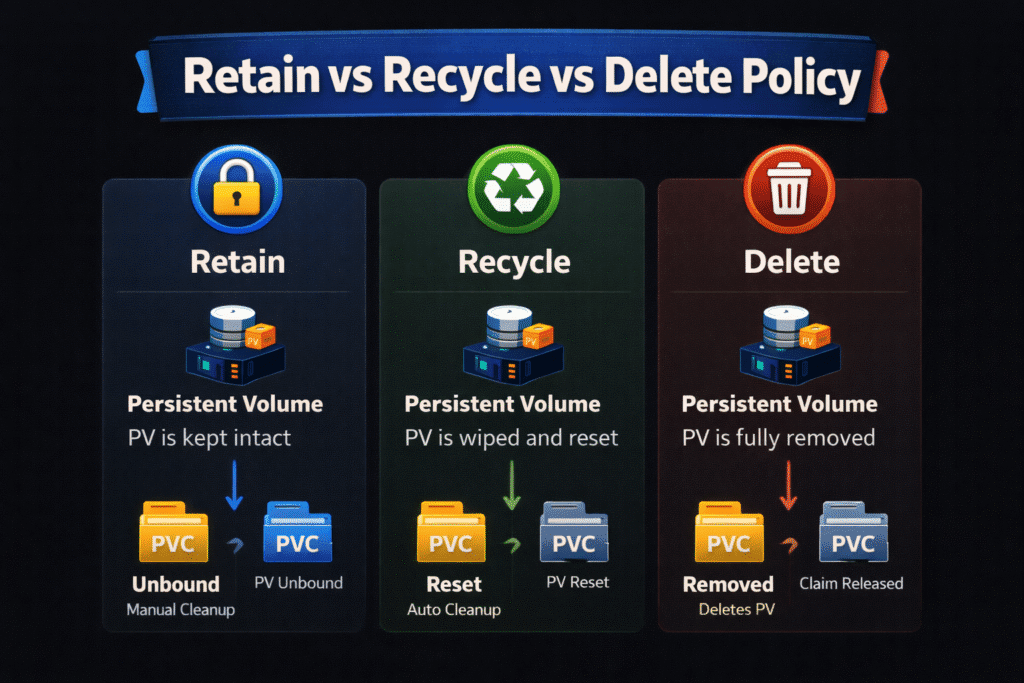
Retain vs Recycle vs Delete Policy describes the PersistentVolume reclaim policy that controls what Kubernetes does after a PersistentVolumeClaim releases a PersistentVolume. Kubernetes supports three values: Retain, Delete, and Recycle, although Recycle is deprecated and rarely belongs in production plans.
Reclaim policy decisions sit at the intersection of risk, cost, and operational control. They also shape how teams standardize Kubernetes Storage tiers on NVMe/TCP and other backends that behave like Software-defined Block Storage.
Retain vs Recycle vs Delete Policy and Lifecycle Governance
Retain keeps the underlying storage asset intact after a claim goes away. Kubernetes marks the PersistentVolume as released, and an admin must remove claim references, clean data, and decide on reuse.
Delete removes the PersistentVolume object and triggers deletion of the backing storage asset when the plugin or CSI driver supports it. Most dynamically provisioned volumes inherit the StorageClass reclaim policy, which commonly defaults to Delete.
Recycle attempts a basic scrub and then returns the PV to the pool, but Kubernetes flags it as deprecated and points teams toward dynamic provisioning instead.
🚀 Standardize PV Reclaim Policy Workflows in Kubernetes
Use Simplyblock to manage Retain cleanup safely, avoid orphaned capacity, and keep NVMe/TCP tiers stable.
👉 Use Simplyblock for Retained PV Removal →
Retain vs Recycle vs Delete Policy in Kubernetes Storage Operations
In day-to-day Kubernetes Storage operations, the reclaim policy affects three practical workflows. Data recovery and auditability improve with Retain because the storage asset stays put. Delete fits ephemeral environments and strict cost controls.
Safety controls around deletion matter most when Delete is in play for CSI volumes. Kubernetes uses protection mechanisms to reduce accidental data loss. Runbook complexity also changes with the policy. Retain shifts work to the platform team. Delete shifts work to the storage platform and the CSI driver. Recycle adds uncertainty and weak guarantees for sanitization.
Operational guardrails that prevent reclaim-policy incidents
- Standardize reclaim policy per tier, not per app, and treat exceptions as change-controlled.
- Pair Retain with a clear wipe process aligned to your security standard and evidence trail.
- Require explicit tags or labels for “break-glass” volumes that must never auto-delete.
- Track PV phase transitions (Bound to Released to Available) in your monitoring stack.
- Test deletion and restore paths in a staging cluster with the same CSI driver version.
Retain vs Recycle vs Delete Policy for NVMe/TCP and Software-defined Block Storage
On NVMe/TCP, reclaim policy influences more than cleanup. It changes how fast teams can recycle capacity without destabilizing performance tiers.
Delete works well for high-churn workloads where automation matters more than reuse, but it can amplify backend work during mass teardown events.
Retain fits regulated data, long-lived databases, and cases where the business wants explicit sign-off before data destruction. When you run Software-defined Block Storage on baremetal, Retain also helps when you migrate workloads between hyper-converged and disaggregated layouts and want tight control of data placement.
Recycle looks attractive for quick reuse, yet the built-in behavior only performs a basic scrub, and Kubernetes marks it deprecated. For environments that need assured sanitization, teams should implement wipe as a controlled workflow that follows their security standard.
Measuring Reclaim-Policy Impact on Release and Reuse
Measure reclaim-policy impact with metrics that map to real risk and real cost.
Track time-to-release (PVC delete to PV Released), time-to-reclaim (Released to Available or backend deletion), and capacity recovery time (when the pool capacity actually returns). For performance-sensitive tiers, also track tail latency during mass deletes and reschedules, because backend cleanup and control-plane load can hit at the same time.
Tuning Approaches That Improve Predictability
Prefer predictable, repeatable outcomes over clever reclaim tricks. Set reclaim policy at the StorageClass tier for volumes that use dynamic provisioning, and keep app manifests simple.
Use Retain only when your team can enforce a wipe-and-reuse runbook. Avoid Recycle for a long-term strategy because Kubernetes deprecates it. When you need fast teardown, use Delete with guardrails such as quota, deletion protection, and clear ownership of the CSI driver lifecycle.
Reclaim Policy Comparison Matrix
The table below highlights how each option behaves after a PVC deletion and what that means for risk, effort, and speed.
| Policy | What Kubernetes does after PVC deletion | Data outcome | Admin effort | Typical fit |
|---|---|---|---|---|
| Retain | Keeps PV object and storage asset; PV moves to Released | Data remains until you wipe it | High | Regulated data, controlled reuse, recovery-first tiers |
| Delete | Deletes PV and requests backend deletion (when supported) | Data removed with backend delete | Low | High-churn clusters, cost-first tiers, automated teardown |
| Recycle (deprecated) | Scrubs and returns PV to Available (plugin dependent) | Partial/basic scrub | Medium | Legacy only, not a strategic choice |
Predictable Reclaim Outcomes with Simplyblock™
Simplyblock helps teams standardize reclaim behavior across tiers while keeping Kubernetes Storage performance stable on NVMe/TCP.
Simplyblock’s SPDK-based, user-space, zero-copy architecture reduces CPU overhead in the I/O path, which matters when clusters face bursty attach, detach, snapshot, and cleanup cycles. That same design supports multi-tenant controls and QoS, so one namespace cannot starve another during lifecycle events.
For platforms that treat block storage as a SAN alternative, simplyblock supports hyper-converged, disaggregated, and mixed deployments, so you can keep policy consistent while you change topology. When a reclaim policy keeps volumes around after claim deletion, simplyblock supports explicit cleanup workflows at the storage layer, which helps teams avoid orphaned capacity and unclear ownership.
Future Directions for Retain vs Recycle vs Delete Policy
Kubernetes continues to improve safe deletion semantics for CSI with clearer lifecycle guarantees. At the same time, security expectations around data destruction keep rising, which pushes teams toward controlled wipe workflows for Retain and away from legacy-style scrubbing approaches like Recycle.
For executive teams, the practical direction stays consistent: enforce reclaim policy at the tier level, tie it to measurable recovery and deletion outcomes, and validate behavior in staging before broad rollout.
Related Terms
Teams often review these glossary pages alongside the Retain vs Recycle vs Delete Policy when they set Kubernetes Storage guardrails for data retention, cleanup, and recovery.
Questions and Answers
These policies define what happens to a PersistentVolume (PV) after its claim is released. Retain preserves the data and volume for manual reuse. Recycle wipes the data via a basic rm -rf, now deprecated. Delete removes both the volume and underlying storage using CSI or cloud APIs, method in dynamic provisioning.
Use Retain when data preservation is critical—e.g., in database recovery scenarios. The volume won’t be deleted or reused until manually handled, giving admins control to inspect or back up data before deletion or reattachment.
Recycle uses a built-in scrub (rm -rf /thevolume/*) that lacks flexibility, customization, and secure deletion. It’s deprecated and unsupported by CSI drivers. In modern Kubernetes-native storage, users should prefer Delete snapshots or secure erasure routines.
When a PVC is deleted, CSI invokes the DeleteVolume call to remove the underlying storage. This is ideal for ephemeral, stateless apps or CI/CD pipelines. With CSI-integrated platforms like Simplyblock, it aligns well with automated storage provisioning and cleanup.
Choosing the right policy helps control storage sprawl and retention. Delete reduces unused volume buildup, while Retain ensuring important datasets aren’t lost. In cost-sensitive environments, pairing reclaim policies with storage tiering strategies helps optimize budget and compliance.